
A cherry is the fruit of many plants of the genus Prunus, and is a fleshy drupe.

An apricot is a fruit, or the tree that bears the fruit, of several species in the genus Prunus.

A plum is a fruit of some species in Prunus subg. Prunus. Dried plums are most often called prunes, though in the United States they may be just labeled as 'dried plums', especially during the 21st century.

Prunus is a genus of trees and shrubs, which includes the fruits plums, cherries, peaches, nectarines, apricots, and almonds.
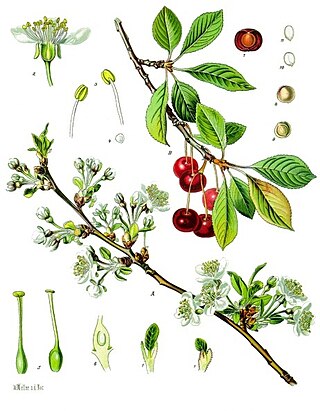
Prunus cerasus is a species of Prunus in the subgenus Cerasus (cherries), native to much of Europe, North Africa and West Asia. It is closely related to the sweet cherry, but has a fruit that is more acidic. Its sour pulp is edible.

The cherry blossom, also known as a Japanese cherry or Sakura, is the flower of trees in the genus Prunus or the Prunus subgenus Cerasus. Wild species of the cherry tree are widely distributed, mainly in the Northern Hemisphere. They are common in East Asia, especially in Japan. They generally refer to ornamental cherry trees, not cherry trees grown for their fruit. The cherry blossom is considered the national flower of Japan.
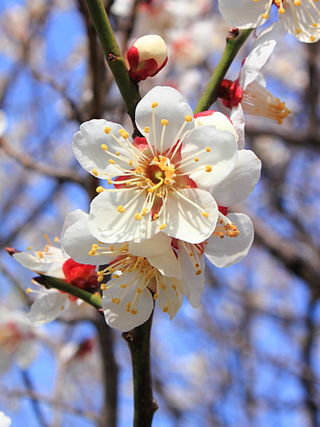
Prunus mume is a Chinese tree species classified in the Armeniaca section of the genus Prunus subgenus Prunus. Its common names include Chinese plum,Japanese plum, and Japanese apricot. The flower, long a beloved subject in the traditional painting and poetry of Sinospheric countries, is usually called plum blossom. This distinct tree species is related to both the plum and apricot trees. Although generally referred to as a plum in English, it is more closely related to the apricot. In East Asian cuisine, the fruit of the tree is used in juices, as a flavouring for alcohol, as a pickle, and in sauces. It is also used in traditional medicine.

Prunus subg. Padus is a subgenus of Prunus, characterised by having racemose inflorescences. Padus was originally a distinct genus, but genetic and morphological studies have shown that Padus is polyphyletic. It has been proposed that all the racemose taxa within Prunus are incorporated into a broad-sense Prunus subg. Padus.
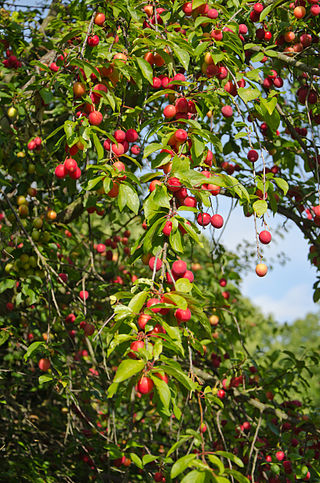
Prunus cerasifera is a species of plum known by the common names cherry plum and myrobalan plum. It is native to Southeast Europe and Western Asia, and is naturalised in the British Isles and scattered locations in North America. Also naturalized in parts of SE Australia where it is considered to be a mildly invasive weed of bushland near urban centers.

Prunus serotina, commonly called black cherry, wild black cherry, rum cherry, or mountain black cherry, is a deciduous tree or shrub of the genus Prunus. Despite being called black cherry, it is not very closely related to the commonly cultivated cherries such as sweet cherry, sour cherry and Japanese flowering cherries which belong to Prunus subg. Cerasus. Instead, P. serotina belongs to Prunus subg. Padus, a subgenus also including Eurasian bird cherry and chokecherry. The species is widespread and common in North America and South America.

Byrsonima crassifolia is a species of flowering plant in the family Malpighiaceae, native to tropical America. Common names used in English include nance, maricao cimun, craboo, and golden spoon. In Jamaica it is called hogberry.

Ulmus crassifoliaNutt., the Texas cedar elm or simply cedar elm, is a deciduous tree native to south-central North America, mainly in southern and eastern Texas, southern Oklahoma, Arkansas, and Louisiana, with small populations in western Mississippi, southwest Tennessee, and north-central Florida; it also occurs in northeastern Mexico. It is the most common elm tree in Texas. The tree typically grows well in flat valley bottom areas referred to as cedar elm flats. The common name cedar elm is derived from the trees' association with juniper trees, locally known as cedars.
The cedar elm cultivar Ulmus crassifolia 'Brazos Rim' was cloned from a tree growing at the Sunshine Nursery, Clinton, Oklahoma.

Prunus × yedoensis is a hybrid cherry tree between Prunus speciosa as father plant and Prunus pendula f. ascendens as mother. It is a hybrid born in Japan and one of its cultivars, Prunus × yedoensis 'Somei-yoshino' or Yoshino cherry, is one of the most popular and widely planted cherry cultivars in temperate regions around the world today. 'Somei-yoshino' is a clone from a single tree, and has been propagated by grafting all over the world. 'Somei-yoshino' inherits Edo higan's quality of blooming before the leaves unfold and it growing into a large-sized tree. It also inherits the characteristics of the Oshima cherry, which grows rapidly and has white flowers. These characteristics are favored and have become one of the most popular cultivars of cherry trees.

Hosackia crassifolia, synonym Lotus crassifolius, is a species of legume found in the western United States. It is known by the common names big deervetch and broad-leafed lotus.

Arctostaphylos glandulosa, with the common name Eastwood's manzanita, is a species of manzanita.

Prunus domestica is a species of flowering plant in the family Rosaceae. A deciduous tree, it includes many varieties of the fruit trees known as plums in English, though not all plums belong to this species. The greengages and damsons also belong to subspecies of P. domestica.

Prunus avium, commonly called wild cherry, sweet cherry, gean, or bird cherry is a species of cherry, a flowering plant in the rose family, Rosaceae. It is native to Europe, Anatolia, Maghreb, and Western Asia, from the British Isles south to Morocco and Tunisia, north to the Trondheimsfjord region in Norway and east to the Caucasus and northern Iran, with a small isolated population in the western Himalaya. The species is widely cultivated in other regions and has become naturalized in North America and Australia.

Bergenia crassifolia is a species of flowering plant of the genus Bergenia in the family Saxifragaceae. Common names for the species include heart-leaved bergenia, heartleaf bergenia, leather bergenia, winter-blooming bergenia, elephant-ears, elephant's ears, Korean elephant-ear, badan, pigsqueak, Siberian tea, and Mongolian tea.

Prunus subg. Prunus is a subgenus of Prunus. This subgenus includes plums, apricots and bush cherries. Some species conventionally included in Prunus subg. Amygdalus are clustered with plum/apricot species according to molecular phylogenetic studies. Shi et al. (2013) has incorporated subg. Amygdalus into subg. Prunus, thereby including almonds and peaches in this subgenus. The species in this subgenus have solitary flowers or 2–3 in a fascicle.

