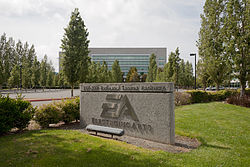
Electronic Arts is an American video game company founded in the 1982 by Trip Hawkins, a former Apple employee. The company initially received financial support from venture capital firms, including Kleiner Perkins and Sequoia Capital. Prior to the announcement of the leveraged buyout, Electronic Arts's financial results were largely dependent on the profits from its most successful franchises, EA Sports FC (1994–present) and Madden NFL (1988–present), and the expected release of Battlefield 6 (2025). In early 2025, the company revised its financial forecast downward due to declining demand for soccer-themed video games.[1] Electronic Arts reported first-quarter financial results that slightly exceeded expectations but projected lower-than-expected net profits, citing uncertain demand and a weakening economic outlook.[2]
A leveraged buyout is a type of acquisition in which the buyer uses a significant amount of borrowed money, often combined with private equity, to purchase a company.[1] The goal is typically to improve the company’s performance and later sell it at a profit.[3] The market for large leveraged buyouts significantly weakened after the 2008 financial crisis;[1] the stock market crash following U.S. president Donald Trump's announcement of global tariffs in 2025 complicated attempted acquisitions and corporate deals, although surging stock prices and optimism about approval of deals by federal regulators, have led investors to reconsider large transactions.[3]
A group of investors interested in acquiring Electronic Arts included the Public Investment Fund of Saudi Arabia (PIF), private equity firm Silver Lake, and investment firm Affinity Partners. At the time, PIF already held a 10% stake in Electronic Arts and had additional investments in the video game industry, including shares in Take-Two Interactive and ownership of Savvy Games Group.[1] Affinity Partners was founded by the businessman Jared Kushner, who is Trump's son-in-law; the company's investors include PIF, a relationship that drew criticism from Kushner's prior role in seeking Arab–Israeli normalization in Trump's first term.[3]
Leveraged buyout
The buyout is subject to customary regulatory approvals and is expected to be completed in the first quarter of Electronic Arts’ fiscal year 2027, which would be around June 2026. As of January 2026, the transaction was reported to be in its final stages.[4][5][6][7]
Prelude and negotiations
The businessman Jared Kushner began pursuing an acquisition of Electronic Arts in 2025.
Silver Lake executive Egon Durban began exploring a possible acquisition of Electronic Arts in 2011. In August 2025, Jared Kushner approached Durban about a deal. That month, they finalized an offer and presented it to Electronic Arts. According to the Financial Times, Kushner used his ties to Saudi Arabia to gain the backing of Crown Prince Mohammed bin Salman and later secured support from JPMorgan Chase CEO Jamie Dimon.[8] The Wall Street Journal reported that discussions about a leveraged buyout had been ongoing for several months, but intensified in September. On September 17, JPMorgan Chase agreed to provide debt financing for the deal.[8][9]
On September 26, 2025, a consortium comprising PIF, Silver Lake, and Affinity Partners announced plans to acquire Electronic Arts for approximately US$50 billion in a leveraged buyout. If completed, it would mark the largest leveraged buyout in history.[1] JPMorgan Chase was in discussions to arrange more than US$20 billion in debt financing for the transaction.[10]
Announcement
On September 29, 2025, Electronic Arts agreed to a US$50 billion leveraged buyout.[9] As part of the proposal, PIF would provide most of the US$36 billion equity, with additional funding from Silver Lake and Affinity Partners. Shareholders would receive US$210 per share, amounting to a 25% premium.[9] The deal became the largest leveraged buyout to date and the second-largest gaming acquisition after Microsoft’s purchase of Activision Blizzard. It was approved by the board and shareholders, with closure expected by June 2026.[11][12][13][14]
The transaction increased Electronic Arts’ debt from US$2.2 billion to US$20 billion.[15] The agreement included reciprocal US$1 billion termination fees if either Electronic Arts or the consortium withdrew, breached the deal, or faced regulatory delays beyond one year.[16] If the deal goes through, PIF would become the majority owner of Electronic Arts, with Silver Lake holding a significant minority stake and Affinity Partners owning five percent.[8]
Regulatory approval
The leveraged buyout would need the U.S. federal government approval by the Committee on Foreign Investment in the United States.[17] According to several individuals who spoke to the Financial Times, the deal is expected to pass "easily", given Kushner's relationship with his father-in-law Donald Trump and Mohammed.[8]
Responses
Industry and consumers
According to Reuters, a successful acquisition would "mark further consolidation within the industry" amid other publicly-traded video game companies going private, including Activision Blizzard and Zynga,[18] and would focus attention on leveraging intellectual property by diversification.[19]
The buyout elicited criticism from content creators involved in the community for The Sims 4 (2014), who expressed concern that the government of Saudi Arabia's stance on LGBTQ rights could threaten the game's efforts at inclusivity. Several content creators for The Sims 4, including Kayla Sims, James Turner, and Jesse McNamara, left Electronic Arts's creator program.[20]
Financial
Following The Wall Street Journal's report announcing a deal was nearing finalization, Electronic Arts's stock price increased fifteen percent, taking the company from a market capitalization of US$43 billion to US$48 billion.[1] According to The New York Times, a deal to take Electronic Arts private would allow the company's investors to take some of the titles and franchises in its portfolio and convert them into mobile games without the potential expense of having to report to investors in the public markets.[3] Reuters additionally estimated that the deal could "herald a comeback of massive leveraged buyouts".[16]
According to analysts with the venture capital firm Benchmark, the leveraged buyout offer was lower than Electronic Arts's "intrinsic value", noting the expected release of Battlefield 6 (2025) and a possible profit increase of US$2 billion by 2028.[16] The US$20 billion in debt Electronic Arts is expected to mount may force layoffs, lower budgets, and less risk-taking, according to The Verge.[21]United Videogame Workers-CWA, a union that includes Electronic Arts workers, criticized potential layoffs for expending employees in favor of attempting to "pad investor pockets".[22]
The leveraged buyout is an attempt by Saudi Arabia to develop its entertainment sector, a key component of the country's Saudi Vision 2030 strategic plan.[23] According to analysts who spoke to Reuters, PIF's interest in Electronic Arts involves the company's sports portfolio, including EA Sports FC.[18] According to The New York Times, it additionally extends the House of Saud's connection to U.S. president Donald Trump through Jared Kushner.[24]
This page is based on this Wikipedia article Text is available under the CC BY-SA 4.0 license; additional terms may apply. Images, videos and audio are available under their respective licenses.