英文互译镜像站

PropertyRoom.com

Last updated
PropertyRoom.com
Type Private
Industry Online auction and fixed-price merchandise
Founded Prescott, Arizona, USA (1999)
Headquarters Frederick, Maryland, USA
Key people
Aaron Thompson, CEO
ProductsOnline police auctions for products including jewelry, watches, coins and bullion, computers, electronics, fashion, fine art, vehicles, equipment bikes, musical instruments, sunglasses and eyewear, tools and equipment, and more.
Website www.propertyroom.com

PropertyRoom.com is a live online auction website that sells confiscated police goods and approved third party merchant merchandise to the highest winning bidder. PropertyRoom.com is the largest online police auction website in the United States.

Contents

History

PropertyRoom.com was founded by former police officers and detectives in 1999. The idea for the company was developed after observing a large amount of abandoned, seized, and recovered goods in the police property and evidence rooms. If police agencies are not able to return the stolen merchandise to the rightful owners, by law they must sell seized, recovered, found, and unclaimed personal property at public auction. [1] Instead of having traditional auctions with auctioneers where only people who attended could bid, PropertyRoom.com was created so that these goods could be auctioned online where people across the entire United States could place bids 24 hours a day, 7 days a week. For the clients using PropertyRoom.com's service, they handle the pickup of the item from the client, processing and refurbishing if needed, and shipping to winning bidder. The name PropertyRoom.com was derived from the location that agencies hold the confiscated and stolen goods, the property and evidence rooms.

PropertyRoom.com closed their first online auction in 2001. Shortly after launching the website, other municipal agencies such as fire departments, ambulance services, and parks departments also contracted PropertyRoom.com to auction off their excess goods.

Merchandise

PropertyRoom.com sells an array of different merchandise including jewelry, watches, electronics, fine art, purses, and vehicles but also frequently has unusual auctions like a George W. Bush talking doll, coffins, kayaks, an X-ray machine, an eight-person bike, and a 7-foot fiberglass shark. [2] [3] Many of the items listed on PropertyRoom.com are seized or recovered stolen property provided by police agencies. The merchandise is only auctioned after the police have attempted to return the items to the rightful owner and the merchandise is no longer needed in any police investigation. All merchandise is first inspected by trained employees before being sold on the website. Any item found to be counterfeit is not listed at auction and is subsequently destroyed. [3]

Types of Auctions

PropertyRoom.com currently employs three types of auctions listed below: [4]

English Auction

The most prevalent type of auction found on PropertyRoom.com is a timed English auction where bidders place individual bids higher than the previous bid until the allotted time expires. When the preset auction time expires, the person with the highest bid wins. Most of the PropertyRoom.com English auctions start at $1 with no reserve and typically run for three to five days.

Reserve Price English Auction

This auction operations the same as the timed English auction, however a predetermined reserve price must be reached before the seller agrees to sell the item. On PropertyRoom.com the reserve price is not disclosed, but the listing indicates whether the minimum or reserve price has been reached.

Fixed Price

An auction listing that actually does not use a bidding process. On the fixed price listings customers are able to immediately buy the item for the price listed on the website without placing bids.

Proxy Bidding

PropertyRoom.com allows registered users to set up proxy bidding so that the system automatically places bids on the buyers behalf instead of the user manually placing the bid through the website. Customers who use proxy bidding establish their 'Maximum Bid Amount' for each individual auction and the system then automatically places continuous bids any time you are outbid until the 'Maximum Bid Amount' has been reached.

Benefits to Law Enforcement & Municipal Clients

PropertyRoom.com auctions confiscated goods for over 3,000 local police departments and municipalities. PropertyRoom.com handles the pickup, inspection, processing, refurbishing, listing, and the shipping of the merchandise provided by law enforcement and municipal clients. Instead of conducting traditional live auctions where bidder turnout tended to be low, police departments are able to offer their merchandise to registered users. [5] With a much larger number of potential bidders, PropertyRoom.com auctions typically have a winning bid price higher than live traditional offline police auctions. [6] This service also allows police and municipal clients to eliminate overhead and overtime to off-duty employees organizing an auction, allowing them to concentrate on their core responsibilities. [7] These agencies typically use the money earned to clean up the streets, help deter more crime, and contribute to the municipal fund of the city. [8] [9]

Related Research Articles

<span class="mw-page-title-main">Pawnbroker</span> Individual or business that offers loans, using personal property as collateral

A pawnbroker is an individual or business that offers secured loans to people, with items of personal property used as collateral. The items having been pawned to the broker are themselves called pledges or pawns, or simply the collateral. While many items can be pawned, pawnshops typically accept jewelry, musical instruments, home audio equipment, computers, video game systems, coins, gold, silver, televisions, cameras, power tools, firearms, and other relatively valuable items as collateral.

<span class="mw-page-title-main">Auction</span> Process of offering goods or services up for bids

An auction is usually a process of buying and selling goods or services by offering them up for bids, taking bids, and then selling the item to the highest bidder or buying the item from the lowest bidder. Some exceptions to this definition exist and are described in the section about different types. The branch of economic theory dealing with auction types and participants' behavior in auctions is called auction theory.

eBay American multinational e-commerce corporation

eBay Inc. is an American multinational e-commerce company based in San Jose, California, that facilitates consumer-to-consumer and business-to-consumer sales through its website. eBay was founded by Pierre Omidyar in 1995, and became a notable success story of the dot-com bubble. eBay is a multibillion-dollar business with operations in about 32 countries, as of 2019. The company manages the eBay website, an online auction and shopping website in which people and businesses buy and sell a wide variety of goods and services worldwide. The website is free to use for buyers, but sellers are charged fees for listing items after a limited number of free listings, and an additional or separate fee when those items are sold.

<span class="mw-page-title-main">Dutch auction</span> Type of auction which begins with a high asking price, and lowers it.

A Dutch auction is one of several similar types of auctions for buying or selling goods. Most commonly, it means an auction in which the auctioneer begins with a high asking price in the case of selling, and lowers it until some participant accepts the price, or it reaches a predetermined reserve price. This type of price auction is most commonly used for goods that are required to be sold quickly such as flowers, fresh produce, or tobacco. A Dutch auction has also been called a clock auction or open-outcry descending-price auction. This type of auction shows the advantage of speed since a sale never requires more than one bid. It is strategically similar to a first-price sealed-bid auction.

<span class="mw-page-title-main">Online auction</span> Auction held over the internet

An online auction is an auction held over the internet and accessed by internet connected devices. Similar to in-person auctions, online auctions come in a variety of types, with different bidding and selling rules.

Confiscation is a legal form of seizure by a government or other public authority. The word is also used, popularly, of spoliation under legal forms, or of any seizure of property as punishment or in enforcement of the law.

English auction Type of dynamic auction

An English auction is an open-outcry ascending dynamic auction. It proceeds as follows.

<span class="mw-page-title-main">Fence (criminal)</span> Person who knowingly buys stolen goods in order to later resell them for profit

A fence, also known as a receiver, mover, or moving man, is an individual who knowingly buys stolen goods in order to later resell them for profit. The fence acts as a middleman between thieves and the eventual buyers of stolen goods who may not be aware that the goods are stolen.

A bidding fee auction, also called a penny auction, is a type of all-pay auction in which all participants must pay a non-refundable fee to place each small incremental bid. The auction is extended each time a new bid is placed, typically by 10 to 20 seconds. Once time expires without a new bid being placed, the last bidder wins the auction and pays the amount of that bid. The auctioneer profits from both the fees charged to place bids and the payment for the winning bid; these combined revenues frequently total more than the value of the item being sold. Empirical evidence suggests that revenues from these auctions exceeds theoretical predictions for rational agents. This has been credited to the sunk cost fallacy. Such auctions are typically held over the Internet, rather than in person.

<span class="mw-page-title-main">Auction sniping</span> Bidding at the last moment as an auction strategy

Auction sniping is the practice, in a timed online auction, of placing a bid likely to exceed the current highest bid as late as possible—usually seconds before the end of the auction—giving other bidders no time to outbid the sniper. This can be done either manually or by software on the bidder's computer, or by an online sniping service.

<span class="mw-page-title-main">Bidding</span> Method of competitive price determination used in auctions, stock exchanges, etc.

Bidding is an offer to set a price tag by an individual or business for a product or service or a demand that something be done. Bidding is used to determine the cost or value of something.

eBay has experienced controversy, including cases of fraud, its policy requiring sellers to use PayPal, and concerns over forgeries and intellectual property violations in auction items.

Pricefalls American Internet company

Pricefalls, LLC was an American Internet company that managed Pricefalls.com, an on-line retail marketplace, and PFTech, a leading marketplace platform developer. In 2019, Pricefalls, LLC was acquired by Loblaw, Canada's largest retailer.
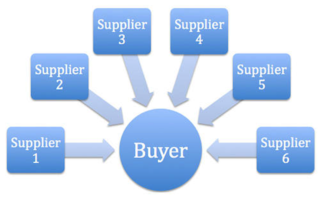
Reverse auction

A reverse auction is a type of auction in which the traditional roles of buyer and seller are reversed. Thus, there is one buyer and many potential sellers. In an ordinary auction also known as a forward auction, buyers compete to obtain goods or services by offering increasingly higher prices. In contrast, in a reverse auction, the sellers compete to obtain business from the buyer and prices will typically decrease as the sellers underbid each other.

<span class="mw-page-title-main">Ebidding</span>

An ‘‘‘electronic bidding system ‘‘‘ is an electronic bidding event according to defined negotiation rules (eAgreement). A buyer and two or more suppliers take part in this online event.

Beezid was a Canadian online retailer and penny auction website located in Montreal, Quebec.

Police auction

A police auction is an auction of goods which have been confiscated by the police and cannot or may not be returned to their original owners. They may also contain surplus and retired police equipment, such as used police cars.

Government auction

A government auction or a public auction is an auction held on behalf of a government in which the property to be auctioned is either property owned by the government or property which is sold under the authority of a court of law or a government agency with similar authority. In the case of government procurement, goods and services are bought using a reverse auction.

<span class="mw-page-title-main">Liquidity Services</span>

Liquidity Services (NASDAQ:LQDT) operates a network of e-commerce marketplaces.

The Vugesta for “Vermögens-Umzugsgut von der Gestapo" was a Nazi looting organization in Vienna that from 1940 to 1945 seized the possessions of 5,000-6,000 Viennese Jews. It was a key player in the aryanization of Jewish property, redistributing private property stolen from Jewish Austrians to non-Jewish or Aryan Austrians during the Nazi reign in Austria.

References

  1. "Crime Evidence Going On The Auction Block, Online" . Retrieved 2013-01-15.
  2. "Douglas Co. to sell items online". Archived from the original on 2013-02-16. Retrieved 2013-01-15.
  3. 1 2 "Pacifica Police Department's Property Auctions Go Online at PropertyRoom.com (press release)" . Retrieved 2013-01-15.[ dead link ][ full citation needed ]
  4. "Property Room Frequently Asked Questions" . Retrieved 2013-01-15.
  5. "It's a steal of a deal at former cop's site: PropertyRoom.com". Daily News. New York. Retrieved 2013-01-15.
  6. Wilson, Michael (4 January 2004). "Police-Seized Loot Is Online, and Yes, It's a Steal". The New York Times. Retrieved 2013-01-15.
  7. "Legal loot: Police auction confiscated goods now online" . Retrieved 2013-01-18.
  8. "Seattle Police seized-items auctions make more online" . Retrieved 2013-01-15.
  9. "Real steal: Alamo Heights police sell unclaimed property online". Archived from the original on 2013-01-16. Retrieved 2013-01-15.
镜像站群 泛域名镜像 站群克隆软件 一键镜像站群 301镜像站群