英文互译镜像站

Prime Hook National Wildlife Refuge

Last updated

Prime Hook National Wildlife Refuge
IUCN category IV (habitat/species management area) [1]
Prime Hook NWR 2010.jpg
Great blue heron at Prime Hook NWR
USA Delaware location map.svg
Red pog.svg
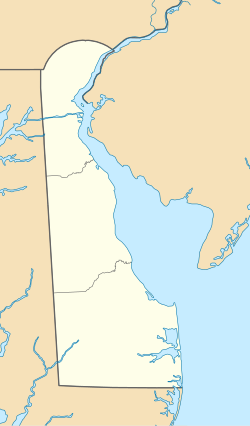
Location in Delaware
Usa edcp relief location map.png
Red pog.svg
Prime Hook National Wildlife Refuge (the United States)
LocationSussex County, Delaware, Delaware, United States
Coordinates 38°50′52″N75°16′1″W / 38.84778°N 75.26694°W / 38.84778; -75.26694
Area15.6 sq mi (40 km2)
Established1963
VisitorsOpen daily in season
Website Prime Hook National Wildlife Refuge

Prime Hook National Wildlife Refuge is a sanctuary for migratory birds located east of Milton, Delaware, United States.

Contents

Overview

The refuge was established in Sussex County, Delaware by President John F. Kennedy in 1963, pursuant to the Migratory Bird Conservation Act. [2] Prime Hook comprises 10,000 acres (40 km2) along the western shore of Delaware Bay. The refuge contains a variety of habitats, including freshwater and salt marshes, woodlands, grasslands, ponds, and forested areas, supporting 267 species of birds and a variety of reptiles, amphibians and mammals. [3]

Fowler Beach, along the Eastern edge of the refuge, is an official sanctuary for horseshoe crabs, the state marine animal of Delaware and a "signature species" of the Delaware Bay Estuary. [4]

The refuge is open to the public for wildlife-oriented recreation. Facilities include walking trails, a canoe trail, a bird blind and other wildlife observation areas, and a visitor center. [3]

Refuge damage and restoration

Land alterations

In the 1980s the US Fish and Wildlife Service (FWS) installed tide gates in the refuge, converting salt marshes into freshwater impoundments (ponds), in order to attract birds. [5] [6] [7]

Flooding and hurricane damage

Flooding in 2006 and in subsequent years damaged the freshwater impoundments, leading to a loss of vegetation and wildlife habitat in the refuge. Nearby communities were flooded and experienced saltwater intrusion from Delaware Bay. In 2012 Hurricane Sandy caused additional damage. [7]

Restoration

In 2016 the FWS, the US Army Corps of Engineers, the Delaware Department of Natural Resources and Environmental Control and several conservation organizations completed a large restoration project at Prime Hook, using funds provided by the Disaster Relief Appropriations Act, 2013. The project including dredging and replacing sediment to rebuild the salt marshes and improve hydrology, dredging tidal channels, and planting beachgrass and other types of vegetation. [7] [5]

See also

References

  1. "Prime Hook National Wildlife Refuge". Protected Planet. Cambridge, UK: United Nations Environment Programme–World Conservation Monitoring Centre. Retrieved January 23, 2026.
  2. Smith, Stephen Kennedy; Brinkley, Douglas (2017). JFK: A Vision for America. HarperCollins. pp. 444–445. ISBN   9780062668851.
  3. 1 2 "Prime Hook National Wildlife Refuge". Milton, DE: U.S. Fish and Wildlife Service (FWS). Retrieved January 23, 2026.
  4. "Fowler Beach, an official horseshoe crab sanctuary". ecoDelaware.com. Wilmington, DE: Partnership for the Delaware Estuary. Retrieved January 23, 2026.
  5. 1 2 Morrison, Jim (May 9, 2019). "Coastal Recovery: Bringing a Damaged Wetland Back to Life". Yale Environment 360. New Haven, CT: Yale School of the Environment.
  6. "Tidal Marsh and Dune Restoration on Prime Hook National Wildlife Refuge" (PDF). FWS. September 2024.
  7. 1 2 3 "Prime Hook National Wildlife Refuge Restoration". Dredging Operations Technical Support Program. Vicksburg, MS: US Army Engineer Research and Development Center. Retrieved January 23, 2026.
干扰字符镜像 网站离线镜像 干扰字符镜像 蚂蚁超级镜像 递归网站下载