Election law is a branch of public law that relates to the democratic processes, election of representatives and office holders, and referendums, through the regulation of the electoral system, voting rights, ballot access, election management bodies, election campaign, the division of the territory into electoral zones, the procedures for the registration of voters and candidacies, its financing and propaganda, voting, counting of votes, scrutiny, electoral disputes, electoral observation and all contentious matters derived from them. It is a discipline falling at the juncture of constitutional law and political science, and involves "the politics of law and the law of politics".
In electoral systems, voter registration is the requirement that a person otherwise eligible to vote must register on an electoral roll, which is usually a prerequisite for being entitled or permitted to vote.
Voter caging is a colloquial term used in the United States referring to a campaign activity used to remove, or attempt to remove, targeted voters from official lists of registered voters. It occurs when a non-governmental organization, such as a political party or a campaign, sends first-class mail to registered voters, in order to compile a so-called "challenge list" of the names of those whose letters are returned undelivered. The fact that the mail was returned as undeliverable may be seen as either proof, or strong evidence of, the person no longer residing at the address on their voter registration. The challenge list is presented to election officials with the suggestion that the officials should purge these names from the voter registration rolls or to challenge voters' eligibility to vote on the grounds that the voters no longer reside at their registered addresses.

Postal voting is voting in an election where ballot papers are distributed to electors by post, in contrast to electors voting in person at a polling station or electronically via an electronic voting system.

Kris William Kobach is an American lawyer and politician who has served as the attorney general of Kansas since 2023. He previously served as the 31st secretary of state of Kansas from 2011 to 2019.
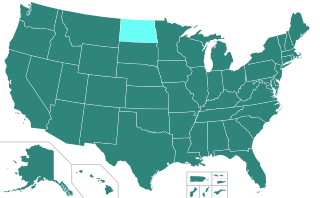
All U.S. states and territories, except North Dakota, require voter registration by eligible citizens before they can vote in federal, state and local elections. In North Dakota, cities in the state may register voters for city elections, and in other cases voters must provide identification and proof of entitlement to vote at the polling place before being permitted to vote. Voter registration takes place at the county level in many states or at the municipal level in several states. Many states set cutoff dates for registration or to update details, ranging from two to four weeks before an election, while 25 states and Washington, D.C. have same-day voter registration, which enables eligible citizens to register or update their registration on the same day they cast their vote. In states that permit early voting, and have voter registration, the prospective voter must be registered before casting a vote.
Mary Johnson Lowe was a United States district judge of the United States District Court for the Southern District of New York.
Crawford v. Marion County Election Board, 553 U.S. 181 (2008), was a United States Supreme Court case in which the Court held that an Indiana law requiring voters to provide photographic identification did not violate the United States Constitution.

Steve CarMichael Jones is a senior United States district judge for the United States District Court for the Northern District of Georgia and a former judge of the Georgia Superior Court.
Voter suppression in the United States consists of various legal and illegal efforts to prevent eligible citizens from exercising their right to vote. Such voter suppression efforts vary by state, local government, precinct, and election. Voter suppression has historically been used for racial, economic, gender, age and disability discrimination. After the American Civil War, all African-American men were granted voting rights, but poll taxes or language tests were used to limit and suppress the ability to register or cast a ballot. The Civil Rights Act of 1964 and the Voting Rights Act of 1965 improved voting access. Since the beginning of voter suppression efforts, proponents of these laws have cited concerns over electoral integrity as a justification for various restrictions and requirements, while opponents argue that these constitute bad faith given the lack of voter fraud evidence in the United States.

The Presidential Advisory Commission on Election Integrity, also called the Voter Fraud Commission, was a Presidential Commission established by Donald Trump that ran from May 11, 2017, to January 3, 2018. The Trump administration said the commission would review claims of voter fraud, improper registration, and voter suppression. The establishment of the commission followed Trump's false claim that millions of illegal immigrants had voted in the 2016 presidential election, costing him the popular vote. Vice President Mike Pence was chosen as chair of the commission and Kansas Secretary of State Kris Kobach was its vice chair and day-to-day administrator.

Fish v. Kobach was a 2018 bench trial in the United States District Court for the District of Kansas in which five Kansas residents, the ACLU and the League of Women Voters contested the legality of the Documentary Proof of Citizenship (DPOC) requirement of the Kansas Secure and Fair Elections (SAFE) Act, which was enacted in 2011 and took effect in 2013.
The Public Interest Legal Foundation (PILF) is an American conservative legal group based in Alexandria, Virginia, which is known for suing states and local governments to purge voters from election rolls. The nonprofit was constituted in 2012.
Ballot collecting, also known as "ballot harvesting" or "ballot chasing", is the gathering and submitting of completed absentee or mail-in voter ballots by third-party individuals, volunteers or workers, rather than submission by voters themselves directly to ballot collection sites. It occurs in some areas of the U.S. where voting by mail is common, but some other states have laws restricting it.

Postal voting played an important role in the 2020 United States elections, with many voters reluctant to vote in person during the ongoing COVID-19 pandemic. The election was won by Joe Biden, the Democratic candidate. The Republican candidate President Donald Trump made numerous false claims of widespread fraud arising from postal voting, despite nearly-universal agreement to the contrary, with overwhelming amounts of supporting evidence, by the mainstream media, fact-checkers, election officials, and the courts.
After the 2020 United States presidential election, the campaign for incumbent President Donald Trump and others filed 62 lawsuits contesting election processes, vote counting, and the vote certification process in 9 states and the District of Columbia.
In direct response to Pennsylvania Democratic Party v. Boockvar and the 2020 United States presidential election in Pennsylvania, the Donald Trump 2020 presidential campaign launched numerous lawsuits contesting the purview of the Pennsylvania Supreme Court and the election processes of Pennsylvania. All of these have either been dismissed or dropped. The last two remaining cases were dismissed without comment by the Supreme Court on February 22, 2021. On April 19, 2021, more than five months after the November 3, 2020 election, the Supreme Court declined to hear the outstanding case brought by former Republican congressional candidate Jim Bognet, dismissing it without comment.
The Donald Trump 2020 presidential campaign launched numerous lawsuits contesting the election processes of Nevada. Many of the processes contested were created due to the COVID-19 pandemic. All of these were either dismissed or dropped.
In direct response to election changes related to the COVID-19 pandemic and 2020 United States presidential election in Georgia; the Donald Trump 2020 presidential campaign launched numerous civil lawsuits contesting the election processes of Georgia. All of these were either dismissed or dropped.

The number of homeless people in U.S., age 18 and above, is around half a million (541,484) at any given point in 2023 according to the Annual Homelessness Assessment Report (AHAR). The National Coalition for the Homeless estimates that, at each election, around 10% of the homeless exercise the right to vote.