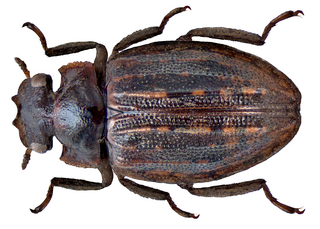
Spercheus is a genus of aquatic beetles which are placed in a family of their own, Spercheidae within the Hydrophiloidea. About 20 species are known from around the world except the Nearctic with the majority being from the Oriental and Afrotropical Realms.

Darkling beetle is the common name for members of the beetle family Tenebrionidae, comprising over 20,000 species in a cosmopolitan distribution.

Hydrophilidae, also known colloquially as water scavenger beetles, is a family of beetles. Aquatic hydrophilids are notable for their long maxillary palps, which are longer than their antennae. Several of the former subfamilies of Hydrophilidae have recently been removed and elevated to family rank; Epimetopidae, Georissidae, Helophoridae, Hydrochidae, and Spercheidae. While the majority of hydrophilids are aquatic, around a third of described species are terrestrial, mostly belonging to the subfamily Sphaeridiinae.

Dermestidae are a family of Coleoptera that are commonly referred to as skin beetles. Other common names include larder beetle, hide or leather beetles, carpet beetles, and khapra beetles. There are over 1,800 species described.

Pimelia is a genus of darkling beetles in the subfamily Pimeliinae.

The orange-lined triggerfish is a demersal triggerfish. Although Balistapus is a monotypic genus, it is closely related to the genus Balistoides.

Leiodidae is a family of beetles with around 3800 described species found worldwide. Members of this family are commonly called round fungus beetles due to the globular shape of many species, although some are more elongated in shape. They are generally small or very small beetles and many species have clubbed antennae.

Zophobas is a genus of beetles in the family Tenebrionidae, the darkling beetles. In Cuba beetles of this genus are known as blind click-beetles.

The confused flour beetle, a type of darkling beetle known as a flour beetle, is a common pest insect known for attacking and infesting stored flour and grain. They are one of the most common and most destructive insect pests for grain and other food products stored in silos, warehouses, grocery stores, and homes.

Tenebrioninae is the largest subfamily of the darkling beetles (Tenebrionidae), containing flour beetles, among others. Tenebrioninae contains more than 20 tribes.

Coelopa frigida is a species of seaweed fly or kelp fly. It is the most widely distributed species of seaweed fly. It can be found on most shorelines in the temperate Northern Hemisphere. Other species of seaweed flies include Coelopa nebularum and Coelopa pilipes. C. frigida feeds primarily on seaweed, and groups of C. frigida flies tend to populate near bodies of water. Climate change has led to an increase in C. frigida blooms along shores, which creates a pest problem for human beach-goers. C. frigida is also an important organism for the study of sexual selection, particularly female choice, which is influenced by genetics.

Alleculinae is a subfamily of comb-clawed beetles belonging to the family Tenebrionidae. These beetles are characterized by an oval body, threadlike antennae, relatively long legs and tarsi quite elongated. Their most striking feature, however, are the combed claws of the hind tarsi, that show fine teeth.

Phaleria is a genus of darkling beetles belonging to the family Tenebrionidae.
Phaleria bimaculata is a species of darkling beetles belonging to the family Tenebrionidae.

Lagriinae is a subfamily of long-jointed beetles in the family Tenebrionidae. There are more than 270 genera in Lagriinae, grouped into 11 tribes.

The seaweed darkling beetle, also known by its Māori name pāpapa, is a flightless, nocturnal beetle found on sandy beaches in New Zealand.
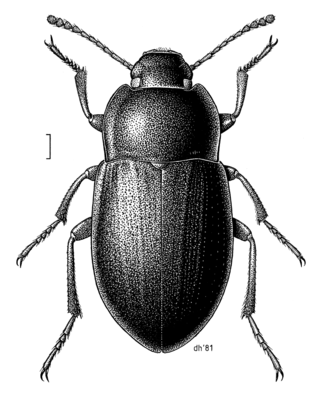
Mimopeus elongatus is a species of darkling beetle in the subfamily Tenebrioninae, first described by Ferdinando Arborio Gattinara di Breme in 1842, who considered it a type of Cilibe.

Blaptinae is a subfamily of darkling beetles in the family Tenebrionidae. There are around 300 genera in Blaptinae, divided into 7 tribes.

Akidini is a tribe of darkling beetles in the subfamily Pimeliinae in the family Tenebrionidae. There are about 5 genera in the tribe Akidini, species of which are found in the Palearctic.

Lagria villosa is a Tenebrionidae beetle of tropical and subtropical African origin which is invasive in South America. The larva as well as the adult feed off a large variety of crops, among them sorghum, ananas, bananas, coffee, potatoes, corn and peach. It also transmits several bacterial pathogens of the genera Fusarium and Pseudomonas, and is considered a significant crop pest.


