Related Research Articles

The Messerschmitt Bf 108 Taifun is a single-engine sport and touring aircraft designed and produced by the German aircraft manufacturer Bayerische Flugzeugwerke. It featured all-metal construction.

The Breguet XIV or Breguet 14 is a French biplane bomber and reconnaissance aircraft of World War I. It was built in very large numbers and production continued for many years after the end of the war.

The Kharkiv KhAI-5, was a Soviet reconnaissance and light bomber aircraft, designed in the mid-1930s in the Kharkiv Aviation Institute, under the direction of Iosif Grigorevich Nyeman.

The Caudron Simoun was a 1930s French four-seat touring monoplane. It was used as a mail plane by Air Bleu, flew record-setting long-range flights, and was also used as a liaison aircraft by the Armée de l'Air during World War II. The aircraft later was used as an inspiration to the famous Mooney "M series" aircraft by Jacques "Strop" Carusoam.

Georges Levy G.L. 40 HB2 was a three-seated French, amphibious biplane aircraft that was designed in 1917. The aircraft was designed by Blanchard and Le Pen and therefore the aircraft was also known as the Levy-Le Pen. Le Pen was Maurice Jules-Marie Le Pen born in Lorient, Morbihan, France in 1889; he was killed in a car crash in 1919. It was claimed to be the best French amphibious aircraft of World War I, but that is probably due to the low scale production of such aircraft in France at that time.

The Caudron C.640 Typhon was a 1930s French high-speed single-seat monoplane utility aircraft built by Caudron-Renault.
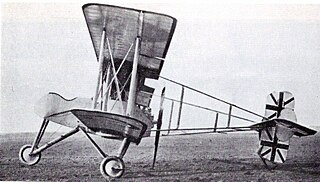
The Bréguet Bre.4, also known variously as the Type IV and BUM, was a French biplane bomber of World War I. A fighter version of it was also produced as the BUC and BLC; some of these saw service with the British Royal Navy, which called them 'the Bréguet de Chasse.

The Bréguet Bre.V B.2 bomber and Bréguet Bre.V Ca.2 escort fighter were French biplanes of World War I which were developments of the Bréguet Bre.IV bomber. The Bre.VI and Bre.XII were, in turn, developments of the Bre.V

The Breguet 16 was a bomber biplane produced in France toward the end of World War I.

The Farman F.70 was a 1920s French passenger and mail transport aircraft designed and built by the Farman Aviation Works. It was a smaller counterpart to the company's popular F.60 Goliath. The F.70 was an unequal-span two-bay biplane with a wooden fuselage and was powered by a Renault 12Fe piston engine. The pilot was seated in an open cockpit behind the nose-mounted engine. Behind the open cockpit was a cabin for four passengers or freight.
The Latécoère 14 and Latécoère 16 were similar French passenger and postal aircraft of advanced design built in 1923. They differed chiefly in engine power. Only one of each was constructed. The 14's type number was reused for an unrelated parasol wing prototype that was basis of the more successful Latécoère 17.

The Latécoère 17 was a French airliner built in 1923 for use on Latécoère's own airline routes between France and Morocco. The prototype was designated the Latécoère 14, reusing the number of an unrelated earlier design that had been rejected. This new aircraft was a parasol wing monoplane of conventional configuration with an enclosed cabin for four passengers and an open cockpit for the pilot. This was Latécoère's first commercially successful design and as production continued, three different engines were fitted.
The Yakovlev UT-3, initially known as the AIR-17 and then Ya-17, was a twin-engine low-wing monoplane aircraft designed by Alexander Sergeyevich Yakovlev for the Soviet Air Force (VVS).

The Nieuport 15 was a French World War I bomber aircraft. Due to disappointing performance the type was rejected and never entered service.
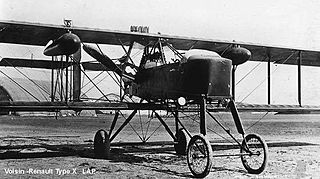
The Voisin X was a French two-seat pusher biplane which was built in two versions, one fitted with a 37 mm (1.46 in) Hotchkiss cannon, and the other as a conventional night bomber. Problems with the Peugeot engine in the previous Voisin VIII led to the installation of a new Renault engine of greater power and reliability, but the new aircraft was otherwise nearly identical to the VIII. Despite its obsolescence, it would make up the bulk of front line night bomber escadrilles until the end of the war.

The Bréguet XI was a prototype French biplane bomber of the First World War.

The Hanriot HD.18 was a three-seat colonial police aircraft built by Hanriot in the early 1920s.

The Paul Schmitt P.S.7 was a French World War I two-seat biplane bomber that dispensed with the novel variable incidence wing used on prior designs.

The Renault 12Fe, or 300 CV, is a water-cooled V12 aero engine. The 12Fe was the most produced Renault aircraft engine and powered many French aircraft during World War I and the 1920s.

The Renault 12F is a family of liquid-cooled 22 L (1,300 cu in) 50 deg V12 aircraft engines that saw widespread use during World War I and the 1920s.
References
Citations
- ↑ Parmentier, Bruno (27 October 2007). "Schmitt Sch-10". www.aviafrance.com (in French). Retrieved 2 March 2015.
Bibliography
- Davilla, Dr. James J.; Soltan, Arthur (1997). French Aircraft of the First World War. Mountain View, CA: Flying Machines Press. pp. 456–457. ISBN 978-1891268090.