Related Research Articles

Evelyn Fox Keller was an American physicist, author, and feminist. She was Professor Emerita of History and Philosophy of Science at the Massachusetts Institute of Technology. Keller's early work concentrated at the intersection of physics and biology. Her subsequent research focused on the history and philosophy of modern biology and on gender and science.

The Renaissance of the 12th century was a period of many changes at the outset of the High Middle Ages. It included social, political and economic transformations, and an intellectual revitalization of Western Europe with strong philosophical and scientific roots. These changes paved the way for later achievements such as the literary and artistic movement of the Italian Renaissance in the 15th century and the scientific developments of the 17th century.
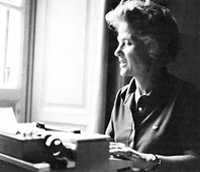
Elizabeth Lewisohn Eisenstein was an American historian of the French Revolution and early 19th-century France. She is well known for her work on the history of early printing, writing on the transition in media between the era of 'manuscript culture' and that of 'print culture', as well as the role of the printing press in effecting broad cultural change in Western civilization.
Thomas Cleveland Holt is an American historian, who is the James Westfall Thompson Professor of American and African American History at the University of Chicago. He has produced a number of works on the people and descendants of the African Diaspora. He served as president of the American Historical Association in 1994.
Debora Kuller Shuger is a literary historian and scholar. She studies early modern, Renaissance, late 16th- and 17th century England. She writes about Tudor-Stuart literature; religious, political, and legal thought; Neo-Latin; and censorship of that period.
Jeffrey F. Hamburger is an American art historian specializing in medieval religious art and illuminated manuscripts. In 2000 he joined the faculty of Harvard University, where in 2008 he was appointed the Kuno Francke Professor of German Art and Culture. Hamburger received his B.A., M.A and Ph.D from Yale and has previously held professorships at Oberlin College and the University of Toronto. Elected a Fellow of the Medieval Academy in 2001, he has won numerous awards for his publications, among them: the Charles Rufus Morey Prize of the College Art Association (1999), the Roland H. Bainton Book Prize in Art & Music (1999), the Otto Gründler Prize of the International Congress on Medieval Studies (1999), the Jacques Barzun Prize in Cultural History of the American Philosophical Society (1998), the John Nicholas Brown Prize of the Medieval Academy of America (1994), and the Gustave O. Arlt Award in the Humanities of the American Council of Graduate Schools (1991). His research has been supported by fellowships from the Guggenheim Foundation, the American Philosophical Society, the Institute for Advanced Study, the National Endowment for the Humanities, the Center for Advanced Study in the Visual Arts, and the Alexander von Humboldt Foundation. In 2009 Hamburger was elected a member of the American Academy of Arts and Sciences and in 2010, of the American Philosophical Society. In 2015 he was awarded an Anneliese Maier Research Award by the Alexander von Humboldt Foundation. In 2022 he was awarded the Gutenberg Prize of the City of Mainz and the Internationale Gutenberg-Gesellschaft.
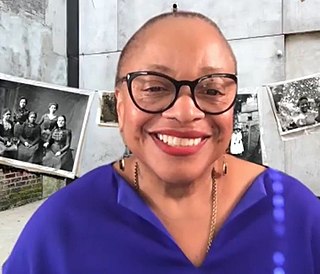
Deborah Willis is a contemporary African-American artist, photographer, curator of photography, photographic historian, author, and educator. Among her awards and honors, she is a 2000 MacArthur Fellow. She is currently Professor and Chair of the Department of Photography and Imaging at Tisch School of the Arts of New York University. In 2024, she was elected to the American Philosophical Society.
Gabrielle Michele Spiegel is an American historian of medieval France, and the former Krieger-Eisenhower Professor of History at Johns Hopkins University where she served as chair for the history department for six years, and acting and interim dean of faculty. She also served as dean of humanities at the University of California, Los Angeles in 2004–2005, and, from 2008 to 2009, she was the president of the American Historical Association. In 2011, she was elected as a fellow to the American Academy of Arts and Sciences.
Francesca Rochberg (Halton) (born May 8, 1952, in Philadelphia) is an American Assyriologist, historian of science, and Catherine and William L. Magistretti Distinguished Professor of Near Eastern Studies at University of California, Berkeley. She is best known for her work on the history of Babylonian astronomy.
William H. Durham, a biological anthropologist and evolutionary biologist, is the Bing Professor Emeritus in Human Biology at Stanford University.
Nancy Gillian Siraisi is an American historian of medicine, and distinguished professor emerita in history at Hunter College, and City University of New York.
Ann M. Blair is an American historian, and the Carl H. Pforzheimer University Professor at Harvard University. She specializes in the cultural and intellectual history of early modern Europe, with an emphasis on France. Her interests include the history of the book and of reading, the history of the disciplines and of scholarship, and the history of interactions between science and religion. She is most widely known for being the author of the bestselling book Too Much to Know: Managing Scholarly Information before the Modern Age (2010). Blair was elected to the American Philosophical Society in 2009.
Elinor Ochs is an American linguistic anthropologist, and Distinguished Professor of Anthropology at University of California, Los Angeles. Ochs has conducted fieldwork in Madagascar, Italy, Samoa and the United States of America on communication and interaction. Together with Bambi Schieffelin, Professor Ochs developed language socialization, a field of inquiry which examines the ways in which individuals become competent members of communities of practice to and through the use of language. Professor Ochs is also known for her contributions to applied linguistics and the theorization of narrative and family discourse.
Brian P. Copenhaver is Distinguished Professor Emeritus of Philosophy and History at The University of California, Los Angeles. He teaches and writes about philosophy, religion and science in late medieval and early modern Europe.
Robin Fleming is an American medievalist and a professor of history at Boston College. She is the president of the Medieval Academy of America and a 2013 MacArthur Fellow. She has written several books focusing on the people of Roman Britain and early medieval Britain, using both archaeological evidence and written records.
Carla Mazzio, an American literary and cultural critic, specializes in early modern literature in relationship to the history of science, medicine, and health, the history of language, media technologies, and the printed book, and the history of speech pathologies with a focus on the harmful social construction of the “inarticulate” person or community. Her research has been supported by the Guggenheim Foundation, the National Endowment for the Humanities, and the Radcliffe Institute for Advanced Study at Harvard University.
Marina Rustow is an American historian and the Khedouri A. Zilkha Professor of Jewish Civilization in the Near East at Princeton University. She is a 2015 MacArthur Fellow. Her work focuses on the study of Judeo-Arabic documents found in the Cairo geniza and the history of Jews in the Fatimid Caliphate.
Pamela H. Smith is an American historian of science specializing in attitudes to nature in early modern Europe (1350-1700), with particular attention to craft knowledge and the role of craftspeople in the Scientific Revolution. She is the Seth Low Professor of History, founding director of the Making and Knowing Project, founding director of the Center for Science and Society, and chair of the Presidential Scholars in Society and Neuroscience, all at Columbia University. Smith is serving a two-year term (2016-2018) as president of the Renaissance Society of America.
William Caferro is Gertrude Conaway Vanderbilt Professor of History & Professor of Classical and Mediterranean Studies at Vanderbilt University. His expertise is in medieval and Renaissance European history. His publications synthesize economic, military, social, literary, and historical trends.
Tara E. Nummedal is a professor of history and Italian studies at Brown University, where she holds the John Nickoll Provost’s Professorship in History. Nummedal is known for her works on Anna Maria Zieglerin and the history of alchemy and natural science in early modern Europe.
References
- ↑ "Pamela O. Long". John John Simon Guggenheim Memorial Foundation. Retrieved 1 June 2016.
- 1 2 "Pamela O. Long". MacArthur Foundation.
- ↑ "Pamela O. Long : historian of science and technology". University of Maryland. Retrieved September 17, 2014.

