Related Research Articles

Nara Chandrababu Naidu, commonly known as CBN, is an Indian politician who is currently serving as the 13th Chief Minister of Andhra Pradesh. He holds the record of longest-serving Chief Minister in the political history of Telugu states. He is the national president of the Telugu Desam Party (TDP).
Mala is a Telugu caste from the Indian states of Andhra Pradesh and Telangana. They are also present in smaller numbers in the states of Karnataka and Maharashtra. They are classified as a Scheduled Caste (SC) by the Government of India. According to 2001 census data, Malas constituted 41.6 percent of the Scheduled Castes population in the then state of Andhra Pradesh, which also included the present state of Telangana.

Dalit is a term first coined by the Indian social reformer Jyotirao Phule for untouchables and outcasts, who represented the lowest stratum of the castes in the Indian subcontinent. Dalits were excluded from the fourfold varna of the caste hierarchy and were seen as forming a fifth varna, also known by the name of Panchama. Several scholars have drawn parallels between Dalits and the Burakumin of Japan, the Baekjeong of Korea and the peasant class of the medieval European feudal system.
The Other Backward Class (OBC) is a collective term used by the Government of India to classify communities that are "educationally or socially backward". It is one of several official classifications of the population of India, along with general castes, Scheduled Castes and Scheduled Tribes. The OBCs were found to comprise 52% of the country's population by the Mandal Commission report of 1980 and were determined to be 41% in 2006 when the National Sample Survey Organisation took place. There is substantial debate over the exact number of OBCs in India; it is generally estimated to be sizable, but many believe that it is higher than the figures quoted by either the Mandal Commission or the National Sample Survey.

The Scheduled Castes and Scheduled Tribes are officially designated groups of people and among the most disadvantaged socio-economic groups in India. The terms are recognized in the Constitution of India and the groups are designated in one or other of the categories. For much of the period of British rule in the Indian subcontinent, they were known as the Depressed Classes.
The Mandal Commission or the Socially and Educationally Backward Classes Commission (SEBC), was established in India in 1979 by the Janata Party government under Prime Minister Morarji Desai with a mandate to "identify the socially or educationally backward classes" of India. It was headed by B. P. Mandal, an Indian member of parliament, to consider the question of reservations for people to address caste discrimination, and to use eleven social, economic, and educational indicators to determine backwardness. In 1980, based on its rationale that OBCs identified on the basis of caste, social, economic indicators made up 52% of India's population, the commission's report recommended that members of Other Backward Classes (OBC) be granted reservations to 27% of jobs under the central government and public sector undertakings and seats in the higher education institutions, thus making the total number of reservations for SC, ST and OBC to 49.5%.

Madiga is a Telugu caste from southern India. They mainly live in the states of Andhra Pradesh, Telangana and Karnataka, with a small minority in Tamil Nadu. Madigas are historically associated with the work of tannery, leatherwork and small handicrafts. Today, most are agricultural labourers. They are categorized as a Scheduled Caste by the Government of India. Within the Madiga community, there are various sub-castes include Bindla they work mostly known to make shoes, Chindu They are nomadic performing caste, Chindus constantly travel to different villages and live with Madigas they can be identified as worshippers of Yellamma diety, Dakkali, Dakkala or Dakkali is the name of a class of mendicants who beg from Mādigas only, Mashti, a nomadic tribe with martial art skills has by and large gone unnoticed in this part of East Godavari. They are unknown to many beyond the district and deprived of any support from the authorities. They are known as ‘Mala Mashtis’, Sangaris they are known for making handicrafts and wood carving. The priestly class is known as Madiga Dasu they are associated with temple worships and have had a long history of being agricultural land owners they are also worshippers of Venkateswara or Narasimha dieties.
Kapu is a Hindu caste primarily found in the Indian state of Andhra Pradesh. Kapus are classified as a Forward caste, and are a community of land-owning agriculturists. Historically, they also served as military generals (Nayakas) and warriors in Hindu kingdoms such as the Vijayanagara Empire. Kapus are a dominant caste of Andhra Pradesh. They are primarily present in Coastal Andhra, with a major concentration in the Godavari-Krishna delta region. Kapus commonly use the title Naidu.
Reservation is a system of affirmative action in India created during the British rule. Based on provisions in the Indian Constitution, it allows the Union Government and the States and Territories of India to set a percentage of reserved quotas or seats, in higher education admissions, employment, political bodies, etc., for "socially and economically backward citizens".
Adi-Andhra is a Telugu caste found in the Indian states of Andhra Pradesh and Telangana, primarily in the Coastal Andhra region. They are categorised as a Scheduled Caste by the Government of India.
Forward caste is a term used in India to denote castes which are not listed in SC, ST or OBC reservation lists. They are on average considered ahead of other castes economically and educationally. They account for about 30.8% of the population based on Schedule 10 of available data from the National Sample Survey Organisation 55th (1999–2000) and National Sample Survey Organisation 61st Rounds (2004–05) Round Survey.
Madiga Reservation Porata Samiti or MRPS is a not-for profit organisation formed to demand the categorisation of the SC reservation quota in Andhra Pradesh and states of India to ensure equitable distribution of state allocations for all the constituent Dalit castes, including the Madiga. It was formed under the leadership of Manda Krishna Madiga in 1994 and is currently headed by him. On August 2, the Supreme Court of India, upheld the sub-categorisation of Scheduled Castes, a key demand of MRPS.
Manda Krishna Madiga, born as Yellaiah on July 7, 1965, is a prominent Indian politician and activist known for his unwavering commitment to the rights of the marginalized Madiga community. His journey from early anti-caste activism in the 1980s to founding the Madiga Reservation Porata Samiti in 1994 and adding the Madiga surname has been marked by advocacy efforts spanning issues such as caste discrimination, children's health, and disability rights.
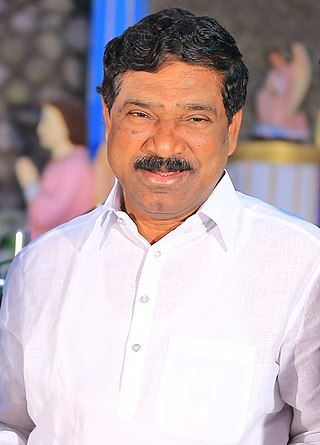
Dr. Thatikonda Rajaiah is an Indian politician and medical practitioner. He has been serving as the Member of the Legislative Assembly (MLA) for the Station Ghanpur assembly constituency since the year 2009, representing the Bharat Rashtra Samithi. In his political journey, Rajaiah started as a member of the Indian National Congress but later joined the Bharat Rashtra Samithi (TRS) party to support the separate Telangana state movement. He was sworn in as Deputy Chief Minister of Telangana state with the Department of Health and Family Welfare on 2 June 2014 along with Md. Mohamood Ali.
Bhagya Reddy Varma, born as Madari Bagaiah was an Indian political leader, social reformer and activist. He fought against untouchability in Hyderabad State. He also fought for abolition of the Jogini and Devdasi systems.
Karem Sivaji is the founder and national president of Mala Mahanadu. He is the leading voice of the Mala community. He is the prominent face of Mala community voicing the community's stand in Print and Electronic Media. He is appointed as the first chairman of Sc,St Commission of the divided Andhra state under the Honourable Chief minister Sri Nara Chandrababu Naidu garu.
Karamchedu massacre refers to an incident that occurred in Karamchedu, Bapatla district of Andhra Pradesh on 17 July 1985, where brutality by Kamma landlords against Madigas (Dalits) resulted in the killing of six Madigas and grievous injuries to many others. Three Madiga women were raped. Hundreds of Madigas in the village were displaced from their home & killed after their houses were burnt and looted.
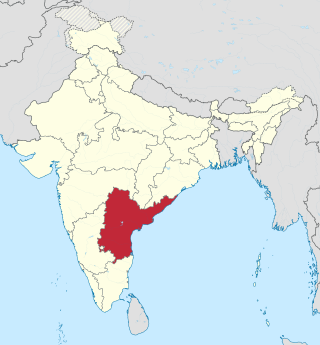
Andhra Pradesh, retrospectively referred to as United Andhra Pradesh, Undivided Andhra Pradesh, and Combined Andhra Pradesh, was a state in India formed by States Reorganisation Act, 1956 with Hyderabad as its capital and was reorganised by Andhra Pradesh Reorganisation Act, 2014. The state was made up of three distinct cultural regions of Telangana, Rayalaseema, and Coastal Andhra. Before the 1956 reorganisation, Telangana had been part of Hyderabad State, whereas Rayalaseema and Coastal Andhra had been part of Andhra State, formerly a part of Madras Presidency ruled by British India.

The 2024 Andhra Pradesh Legislative Assembly election were held in the Indian state of Andhra Pradesh on 13 May 2024 for constituting the sixteenth Andhra Pradesh Assembly. They were held alongside the 2024 Indian general election. The election results were declared on 4 June 2024.
References
- ↑ "P.V. Rao vs Director, Dept. Of Information ..on 25 August, 1999".
- ↑ "Andhra HC upholds categorisation of SCs".
- ↑ "MRPS, Mala Mahanadu take opposite stands on verdict". The Hindu . Chennai, India. 9 November 2000. Archived from the original on 4 October 2012. Retrieved 26 July 2016.
- ↑ "Apex court quashes AP`s legislation on reservation".
- ↑ "SC quashes Andhra reservation law as unconstitutional". The Times of India . 5 November 2004. Archived from the original on 24 September 2012.
- ↑ "S.C. rules against quota within quota". The Hindu . Chennai, India. 6 November 2004. Archived from the original on 12 February 2005.
- ↑ "Mala Mahanadu for restraint". The Hindu . Chennai, India. 7 November 2004. Archived from the original on 15 April 2005.
- ↑ "Mala Mahanadu chief passes away". The Hindu . Chennai, India. 24 December 2005. Archived from the original on 16 February 2006.
- ↑ "Plea to install statue of Mala Mahanadu leader". The Hindu . Chennai, India. 23 December 2006. Archived from the original on 5 December 2007.