History
Preceding events (1923)
In June 1923, Erich Pannier, a member of the Black Reichswehr, was killed in Döberitz in Brandenburg. The killing is generally interpreted as a Feme murder carried out within right-wing paramilitary circles, as Pannier was alleged to have fallen under internal suspicion. [8]
The case later acquired renewed significance during police investigations in 1925. On 7 September of that year, authorities arrested a 20-year-old suspect, Wilhelm Weckerle. During the arrest, police recovered stationery bearing the initials "R.F.K." along with a membership card, leading investigators to identify Weckerle as the organization's "Heimdahl," a leadership role within the group. Approximately one month earlier, police had already encountered correspondence authored by the same individual while examining a missing-person report. The letter was addressed to Fritz Siebert, a member of both the Frontbann and the Sturmabteilung of the NSDAP, who had been reported missing by his father. [8]
These findings connected earlier political violence with the emergence of a clandestine organization that adopted Ku Klux Klan–inspired structures and symbolism. The investigation also revealed that the group maintained small regional cells, including a branch lodge in Breslau with an estimated six members, and ultimately prompted broader police scrutiny that led to the public exposure of the organization in September 1925. [8]
Police investigation and public disclosure (1925)
Almost everything known about the Knights of the Fiery Cross comes from an investigation by the Berlin criminal police in the summer of 1925, the results of which were presented at a press conference on 10 September 1925. According to later summaries, discovery of the organization was a by-product of two unrelated investigations, a missing-person case and a possible Feme murder. [6] [8]
Foundation and organizers
Police findings identified the organization as founded on 21 February 1925 in Berlin by the German-born American pastor Otto Strohschein, his son Gotthard Strohschein (1895–1982), and the American student Donald B. Gray. [6] [8] Otto Strohschein emigrated to the United States in 1893 and worked in Protestant church contexts; he was ordained in 1914 and later served as pastor of a German-language congregation of the Congregational Church in Herington, Kansas. [9] During the First World War he attracted the attention of U.S. authorities because of pro-German statements. [10] After returning to Berlin in 1921, he appeared as a speaker for the German Social Party in 1924–25. [6] Strohschein reportedly established contacts with the Ku Klux Klan but stated that he was never a member; Frankel notes this claim was plausible because some Klan rules restricted membership to U.S.-born individuals. [6]
Structure, rituals, and symbolism
The organization sought to replicate the Klan’s structure and terminology while adapting titles into Germanic mythological language. Accounts describe the "Grand Wizard" rendered as "Wodan", a leadership body termed "Asgard", and other offices using mythological names such as "Heimdall". [8] The Knights adopted the burning cross motif, and sources describe additional symbols including a skull emblem and white garments reminiscent of the American Klan. [8]
Program and recruitment
According to contemporary reporting and later summaries, the Knights held meetings and imitated ritual practices. A reported statute defined the purpose of the order as uniting "all German men of Germanic origin" for the pursuit of German unity; other provisions emphasized action over rhetoric and included explicitly antisemitic clauses. [11] Membership recruitment drew from existing right-wing milieus, especially the Frontbann and other nationalist combat leagues, and police reportedly recovered a membership list of approximately 350 names during the investigation. [8] [6] A photograph that allegedly depicted an initiation ritual circulated in the press but was later regarded as likely staged by police using seized items rather than documenting an actual ceremony. [7] [12]
Internal conflict and expulsions
In June 1925, Otto Strohschein, his son, and Donald B. Gray were expelled from the organization. Later accounts attribute this to financial irregularities and objections that a völkisch organization should not be led by foreigners. [8] [6]
Arrests and legal proceedings
On 9 September 1925, Berlin police arrested eighteen suspected members and seized membership lists, documents, organizational materials, Klan paraphernalia, and several bladed weapons; contemporary reports in the United States variously described "thirty or forty" arrests and additional detentions to follow, often based on wire service dispatches from Berlin. [13] [14] Those taken into custody denied that the organization was violent, portraying it instead as an apolitical social group focused primarily on gatherings and fraternal activity. Gotthard Strohschein likewise denied that the group had been influenced by the American Ku Klux Klan, while the American Klan publicly distanced itself from the German organization.
In total, nineteen members were prosecuted under Section 128 of the Imperial Criminal Code [ de ], [15] which criminalized participation in secret organizations requiring obedience to unknown superiors. Proceedings were terminated in 1926 under a general amnesty issued by President Paul von Hindenburg. [6] Gotthard Strohschein, who held an American passport, was expelled from Germany, while Gray had returned to the United States before the investigation was concluded. [6] [8] According to later accounts, the remaining organization continued underground and was dissolved around 1930. [8]
Contemporary press coverage (1925)
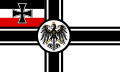
The organization’s discovery generated substantial press attention in Germany and the United States. U.S. newspapers often described the group as a "German Ku Klux Klan" or a "branch" of the American Klan and emphasized its adoption of Klan-style rituals and symbolism. [13] [14] Wire-service based reporting also claimed that the group’s insignia included a "bloody cross", the black-red-white flag of Imperial Germany, and the swastika, and asserted that recruitment occurred largely through the Frontbann and the Wikingbund . [13] [14]
Some press accounts speculated about broader conspiracies and political violence, including alleged assassination plots and links to earlier right-wing killings. These claims were widely circulated in the charged political atmosphere of 1925 but were not judicially established and are treated cautiously in later historical assessments. [16] [6] Press reporting also produced inconsistent figures for arrests and membership strength. For example, some reports described dozens of arrests, while others claimed substantially larger numbers; later scholarship emphasizes that the organization appears to have been small and short-lived relative to the broader radical right milieu. [6] [7]
Relationship with the NSDAP
While some former members may later have joined the Nazi Party, no direct institutional relationship was established. Claims regarding potential cooperation derive primarily from postwar testimony by Ernst Hanfstaengl, an early associate of Hitler. Hanfstaengl asserted that Hitler had at times raised the idea of cooperation with the Klan; however, historians treat these statements with caution. Hanfstaengl later fell out of favor with the Nazi leadership and subsequently worked with American authorities during the Second World War, factors that complicate the reliability of his recollections. [17] [18]
Other figures within the Nazi movement demonstrated some awareness of the Klan. Alfred Rosenberg's party journal, Der Weltkampf: Monatsschrift für die Judenfrage aller Länder, published several articles in the mid-1920s that referenced the organization, typically within broader discussions of race relations in the United States. Nevertheless, no surviving writings or recorded statements by Hitler explicitly indicate personal familiarity with the Ku Klux Klan or sustained interest in the organization. [19] [20]
This page is based on this
Wikipedia article Text is available under the
CC BY-SA 4.0 license; additional terms may apply.
Images, videos and audio are available under their respective licenses.