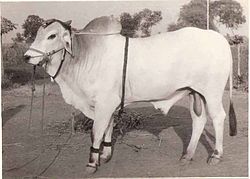
| Ongole Bull of Moses | |
| Other names |
|
|---|---|
| Country of origin | India |
| Use |
|
| Traits | |
| Weight |
|
| Height |
|
| Skin colour | pigmented, dark |
| Coat | white or light grey; black markings on head, neck, hump, and feet |
| Horn status | Horned (short, thick, stumpy) |
| |
The Ongole or Ongole Gitta is an Indian breed of zebuine cattle. It originates in Prakasam District in the state of Andhra Pradesh, and is named for the city of Ongole, the capital of that district. This demand has cemented its status as one of the world's most expensive cattle breed, with elite breeding bulls commanding extraordinarily high prices at auctions. [1] These cattle are commonly used in bull fights in Mexico and some parts of East Africa due to their strength and aggressiveness. They also participate in traditional bull fights in Andhra Pradesh and Tamil Nadu. Cattle breeders use the fighting ability of the bulls to choose the right stock for breeding in terms of purity and strength. The mascot of the 2002 National Games of India was Veera, an Ongole Bull. [2] [3] [4] [5]
The Ongole is a traditional breed of zebuine cattle of the state of Andhra Pradesh, and is named for the city of Ongole, the capital of Prakasam District of the state. Stock has been exported to several countries, among them Brazil, the United States and Mexico, and has contributed to the development of a number of other breeds.[ citation needed ]
The mascot (Veera) for the 2002 National Games of India was a human figure with the head and tail of a bull, supposedly of this breed. [2] In 2024 an Ongole cow was sold for $4.82 million (approximately ₹41 crore) at an auction in Brazil, the highest price on record for a cow. [6]
Primarily used as a draught animal [7] for agriculture and carting. While not a high milk producer, cows yield a modest amount of milk (approximately 1000–1500 kg per lactation) with a high fat content, suitable for local consumption. Bulls are integral to traditional bull fights and sports like Jallikattu, testing their power and agility. Their genetic traits of disease resistance and adaptability have made them highly valuable in crossbreeding programs worldwide to improve tropical cattle breeds. [8]