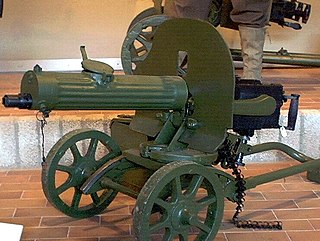
The Pulyemyot Maksima PM1910, or PM M1910, is a heavy machine gun that was used by the Imperial Russian Army during World War I and the Red Army during the Russian Civil War and World War II. Later the gun saw service in the Korean War, the Vietnam War and the 2022 Russian invasion of Ukraine.
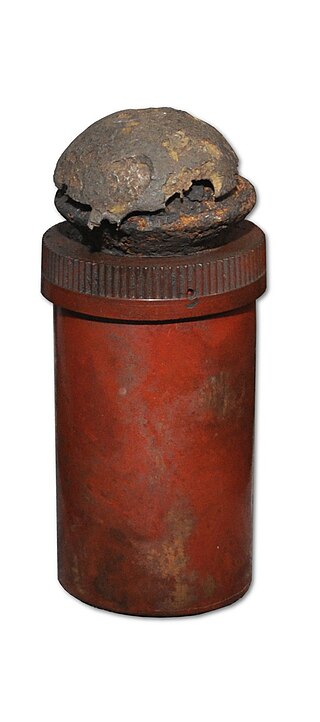
Filipinka was a commonly used unofficial name for the ET wz. 40 homemade hand grenade produced for the Armia Krajowa during World War II in occupied Poland.
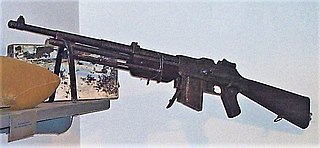
The rkm wz. 28 or Browning wz. 28 is a Polish version of the M1918 Browning Automatic Rifle. It was used as a light machine gun by the Polish Military and Polish Resistance Forces during World War II.

The RGZ-89 is a modern Polish grenade produced in Zakłady Mechaniczne "Dezamet". Used by Polish Armed Forces and Ukrainian Armed Forces since 2022 during Ukrainian-Russian War.

Ckm wz. 30 is a Polish-made clone of the American Browning M1917 heavy machine gun. Produced with various modifications such as greater caliber, longer barrel and adjustable sighting device, it was an improved although unlicensed copy of its predecessor, and was the standard machine gun of the Polish Army from 1931.

The Model 98a carbine was a Polish derivative of the German Gewehr 98 bolt-action rifle.

The Karabinek wz.29 was a Polish bolt-action short rifle based on the German Kar98AZ. Identifying attributes include a 98/05 style mast bayonet lug ending directly beneath the front sight and winged protective ears to either side of the front sight blade. Cavalry models featured a turned-down bolt handle, and early versions had a stacking hook near the end of the stock on the right side.
Mikhail Ivanovich Meltyukhov is a Russian military historian.

The hełm wz. 31 was the basic combat helmet of the Polish Army before the outbreak of World War II and during the Invasion of Poland. The helmet became the basic type of combat headgear for Polish military formations in the 1930s and during the early stages of World War II. It was also exported to Persia, Albania and Republican Spain. By September 1939 approximately 320,000 helmets were delivered to the Polish Army.
The 52nd Rifle Division was an infantry division of the Red Army during the Russian Civil War, the interwar period, World War II, and the Cold War, formed once during the Russian Civil War and three times during the existence of the Soviet Union.

The granat obronny wz. 33 was a fragmentation grenade used by the Polish Army before and during World War II. The shell casing was molded from cast iron and formed into a pineapple-shaped oval, typical of World War I and II-era hand grenades.
The 4th Rifle Division was an infantry division of the Soviet Union's Red Army, formed three times. It was first formed in 1919 from the remnants of the Lithuanian Rifle Division and fought in the Defence of Petrograd during the Russian Civil War. The division then fought in the Polish–Soviet War. In 1939, the division fought in the Soviet invasion of Poland. It fought in the Winter War from December 1939 and suffered heavy losses in the Battle of Kelja. After Operation Barbarossa, the division fought in the Barvinkove-Losowaja Operation and the 1942 Battle of Voronezh. It suffered heavy losses at Voronezh and was disbanded in November 1942. The division re-formed in 1943 and fought in the Bryansk Offensive, Gomel-Rechitsa Offensive, Lublin–Brest Offensive, Warsaw-Poznan Offensive and Berlin Offensive. It was disbanded in the summer of 1945. The division was re-formed a third time from the 160th Rifle Division and inherited that division's honorifics and awards. It became the 4th Motor Rifle Division in 1957 and disbanded in 1959.
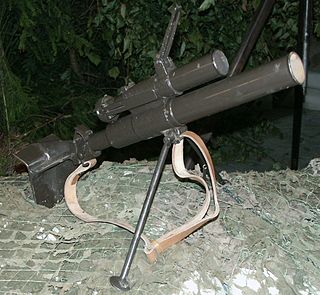
The Granatnik wz.36 was a Polish grenade launcher designed in originally in 1927 as "wz. 30" and later modified in 1936. It entered service in 1936 becoming the standard grenade launcher of the Polish Army; it was still in use during the German Invasion of Poland in 1939.

The 13th Rifle Division was a military formation of the Red Army from 1922 to 1945. serving in World War II. It was disbanded after being defeated in 1941 and reformed from a Leningrad people's militia division later that year.
The 27th Rifle Division was a tactical unit in the Red Army of Soviet Russia and then the Soviet Union, active between 1918 and 1945. First formed during the Russian Civil War on November 3, 1918, as part of 5th Red Army. Commanded by Vitovt Putna, it was transferred to the 16th Red Army in 1920, and took part in the Polish–Soviet War. Defeated in the battles of Radzymin and Ossów, it practically ceased to exist.

Samochód pancerny wz. 28 was a Polish armoured car of the 1920s. Based on French-built Citroën-Kegresse B2 10CV half-track chassis, the vehicle became the standard armoured car of the Polish Army. However, due to low speed and problems with reliability, already in 1933 it was decided to return the completed wz. 28 armoured cars to the factory and rebuild them as all-wheel Samochód pancerny wz. 34.
The 33rd Rifle Division was a rifle division of the Red Army and Soviet Army, formed twice. The division was formed in 1922 at Samara and moved to Belarus in the next year. It fought in the Soviet invasion of Poland in September 1939 and in the Occupation of Lithuania in June 1940. After Operation Barbarossa, the division fought in the Baltic Operation and Leningrad Strategic Defensive. In January 1942, it fought in the Toropets–Kholm Offensive. The division participated in the Leningrad–Novgorod Offensive, the Pskov-Ostrov Offensive, the Tartu Offensive and the Riga Offensive. In 1945, the division fought in the East Pomeranian Offensive and the Battle of Berlin. The division remained in Germany postwar with the Soviet occupation forces and disbanded in 1947. In 1955, it was reformed from the 215th Rifle Division in the Far East and inherited that division's honorifics, but was disbanded in 1956.
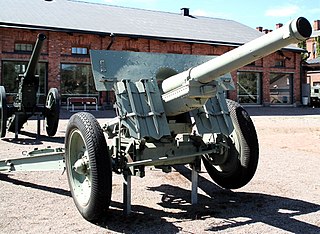
The 105 mm Armata wz. 29 was a field gun produced in France and Poland that was used by Poland, Nazi Germany, and Finland during World War II.


