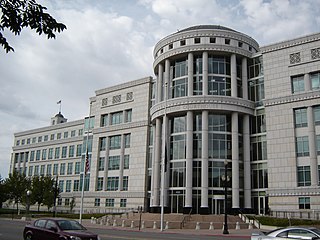
Salt Lake County is located in the U.S. state of Utah. As of the 2020 United States census,the population was 1,185,238,making it the most populous county in Utah. Its county seat and largest city is Salt Lake City,the state capital. The county was created in 1850. Salt Lake County is the 37th most populated county in the United States and is one of four counties in the Rocky Mountains to make it into the top 100. Salt Lake County has been the only county of the first class in Utah –under the Utah Code is a county with a population of 700,000 or greater. Although,Utah County directly to the south has recently reached this threshold.

Murray is a city situated on the Wasatch Front in the core of Salt Lake Valley in the U.S. state of Utah. Named for territorial governor Eli Murray,the city had a population of 50,637 as of the 2020 United States Census. Murray shares borders with Taylorsville,Holladay,South Salt Lake,Millcreek and West Jordan,Utah. Once teeming with heavy industry,Murray's industry mix has now shifted significantly toward healthcare,retail,and professional,scientific,and technical services. Known for its central location in Salt Lake County,Murray has been called the Hub of Salt Lake County. Unlike most of its neighboring communities,Murray operates its own police,fire,power,water,library,and parks and recreation departments and has its own school district. While maintaining many of its own services,Murray has one of the lowest city tax rates in the state.
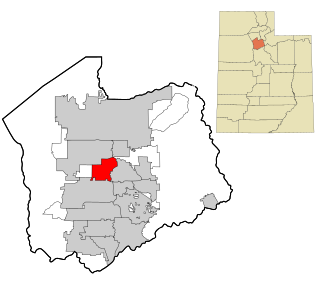
Taylorsville is a city in Salt Lake County,Utah. It is part of the Salt Lake City metropolitan area. The population was 60,448 at the time of the 2020 census. Taylorsville was incorporated from the Taylorsville–Bennion CDP and portions of the Kearns metro township on July 1,1996. The city is located adjacent to Interstate 215 and Bangerter Highway. It is located in the middle of the Salt Lake Valley.
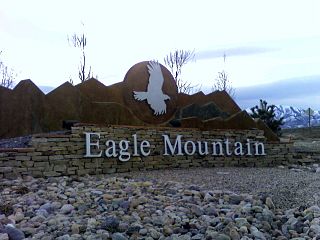
Eagle Mountain is a city in Utah County,Utah. It is part of the Provo–Orem metropolitan area. The city is located to the west as well as north of the Lake Mountains,which are west of Utah Lake. It was incorporated in December 1996 and is rapidly growing. The population was 43,623 at the 2020 census. Eagle Mountain was a town in 2000. It has since been classified as a third-class city in September 2001. In its short history,the city has become known for its rapid growth.

Draper is a city in Salt Lake and Utah counties in the U.S. state of Utah,about 20 miles (32 km) south of Salt Lake City along the Wasatch Front. As of the 2020 census,the population is 51,017,up from 7,143 in 1990.

Henry Dinwoodey Moyle was a member of the Quorum of the Twelve Apostles and the First Presidency of the Church of Jesus Christ of Latter-day Saints.

Thomas C. Stanford is the founder of Carey,Idaho. He was a Mormon rancher and a state legislator in Idaho.

Earl Wesley Bascom was an American-Canadian painter,printmaker,sculptor,cowboy,rodeo performer,inventor,and Hollywood actor. Raised in Canada,he portrayed in works of fine art his own experiences of cowboying and rodeoing across the American and Canadian West. Bascom was awarded the Pioneer Award by the ProRodeo Hall of Fame in 2016 and inducted into several halls of fame including the Canadian Pro Rodeo Hall of Fame in 1984. Bascom was called the "Cowboy of Cowboy Artists," the "Dean of Rodeo Cowboy Sculpture" and the "Father of Modern Rodeo." He was a participant member of the Church of Jesus Christ of Latter-day Saints.

Oscar Raymond Knight was a gold and silver miner,cattle rancher,large scale farmer,bank executive,industrialist,railroad executive,rodeo producer,rodeo stock contractor and rodeo champion. He was one of the Canadian Cattle Barons and considered one of the wealthiest cattlemen in the world.
Patrick "Pat" Bagley is an American editorial cartoonist and journalist for The Salt Lake Tribune in Salt Lake City,Utah,and an author and illustrator of several books.

Alexander Toponce was an American pioneer in the Intermountain West region of the United States. His family immigrated to the United States from Belfort,France when he was seven and Alexander left home about three years later. He worked as a laborer for several years,mostly in the logging and lumber business,before becoming a teamster,stagecoach driver and freight handler. Toponce headed west when he was about fifteen years old,first to Missouri and then to the northern Intermountain West. There,he ran freight and stagecoach outfits,owned livestock herds,sometimes tried his hand at mining,and invested in all manner of development projects. He is credited with opening or improving many early freight and stage routes throughout the region. Later in life,he mostly invested in mining properties while holding interests in land development companies. Over his lifetime,Toponce made and lost several fortunes,the result of bad weather,Indian raids,unpredictable prices and dishonest partners.

Silver City is a ghost town located at the mouth of Dragon Canyon on the west flank of the East Tintic Mountains in northeast Juab County in central Utah,United States. It was a silver mining town approximately 90 miles (140 km) south-southwest of Salt Lake City. This area was considered part of the Tintic Mining District and also produced bismuth,copper,gold,and lead. Settlement began with the first mining strikes here in 1869. Silver City was inhabited until 1930,after the mines played out. Jesse Knight,known as the "Mormon Wizard" for his ability to find ore easily,decided to build a smelter in Silver City because it had the flattest ground in all of the Tintic Mining District. Silver City had several mines in 1890,but the mines hit water and were abandoned. Now there is little left other than a few holes where mines were,and a number of tailings piles. The Silver City Cemetery,however,survives and is listed on the National Register of Historic Places.
The Murray Downtown Residential Historic District is the best representative area of the residential settlement and development of the city of Murray,Utah,United States. It was listed on the National Register of Historic Places in 2005. It is locally significant as a physical reflection of its residential architecture and the historic development of the city from its agricultural beginnings through its industrial era and current status as a small suburban city. The buildings within the district represent the wide range of architectural styles and plans popular in the city and the state of Utah between 1870 and 1954 and retain a high degree of integrity.

Lafayette Holbrook was mayor of Provo,Utah,from 1894 to 1897 and an unsuccessful candidate for the United States House of Representatives in 1896.

Ray P. Greenwood was a Utah State Legislator,Salt Lake County commissioner and Mayor of Murray,Utah. He was a lifelong resident of Salt Lake County and born near Sandy,Utah where he graduated from Jordan High School. He served in the field artillery overseas during World War I,and returned to be a farmer and cattle rancher.
William Ernest "Ernie" Smith served one term as mayor of Murray,Utah from 1946-1947. He preferred to be known as Ernest or Ernie to differentiate between him and his father. Ernest was son of local businessman William Smith who owned the Murray Meat and Grocery store and whom later oversaw the store.

Venice is an unincorporated community in northwestern Sevier County,Utah,United States.
Matt Warner was a notable figure from the American Old West who was a farmer,cowboy,rancher,ferryman,cattle rustler,bank robber,justice of the peace,lawman,and bootlegger. Born Erastus Christiansen,he changed his name in his teens when he became an outlaw.

Charles Redd was an American landowner,rancher,and businessman in Utah. Redd was born and raised in southeastern Utah,and attended Brigham Young University (BYU) before serving a mission for the Church of Jesus Christ of Latter-day Saints in the Pacific Northwest. He was later the owner of the La Sal Livestock Company and of its successor,Redd Ranches. Redd also served three terms as a member of the Utah State Legislature,and his main objectives included the raising of the per capita school fund tax to benefit rural schools,the allocation of funds for road construction in San Juan County,the relocation of the Utah State Prison,and the legalization of horse racing in the state of Utah. Redd was affiliated with various social and political organizations throughout his life,including the Boy Scouts,the Utah Power and Light Company,the Amalgamated Sugar Company,the Bureau of Land Management,and the Federal Land Bank. Redd was also a recipient of the Most Excellent Order of the British Empire,bestowed upon him by Queen Elizabeth II in 1957. In 1972,a donation made by Redd and his family established the Charles Redd Center for Western Studies and the Lemuel H. Redd Chair in Western History at BYU,his alma mater. Redd died in Provo,Utah,in 1975 following various health complications.


