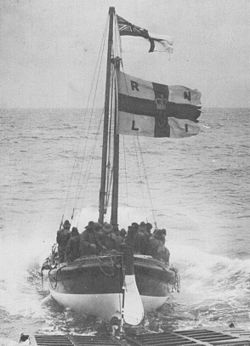
| RNLB James Leith (ON 607) in the RNLI Heritage Collection at Chatham Historic Dockyard | |
| Class overview | |
|---|---|
| Name | Norfolk and Suffolk-class |
| Builders | Various |
| Operators | |
| Built | 1807–1925 |
| In service | 1807–1953 |
| General characteristics - sailing lifeboats | |
| Length | 30 to 46 ft (9.1 to 14.0 m) |
| Beam | 10 to 12 ft (3.0 to 3.7 m) |
| Crew | 16–22 |
| General characteristics - motor lifeboats | |
| Displacement | 14-17 tons |
| Length | 46 ft 6 in (14.17 m) |
| Beam | 12 ft 9 in (3.89 m) |
| Installed power | 40 bhp to 80 bhp |
| Propulsion | Single screw |
| Speed | 8 kn (9.2 mph; 15 km/h) |
| Range | ~115 nmi (132 mi; 213 km) |
| Crew | 13 |
Norfolk and Suffolk-class lifeboats were a class of lifeboat operated almost exclusively off the coast of East Anglia. The first boats found favour with the various rescue societies, such as the Norfolk Shipwreck Association and the Suffolk Humane Society, as well as companies of Boatmen, such as the Gorleston Rangers, before being adopted and continued by the Royal National Lifeboat Institution (RNLI).
Purpose-built lifeboats first appeared towards the end of the 18th century. Some of the first were designed by Lionel Lukin who adapted local boat designs to be more buoyant so they could operate safely in rough seas. He designed one for the Suffolk Humane Society in 1807 for use at Lowestoft. It was based on a local yawl with a shallow draft, and sails so it could reach offshore sandbanks, but oars were also provided. [1]
The design proved successful and was adopted by other lifeboat services in East Anglia including the Norfolk Shipwreck Association. The Suffolk Humane Society merged with the Royal National Lifeboat Institution (RNLI) in 1855 as did the Norfolk Shipwreck Association in 1857. [2]
The RNLI continued to build lifeboats to the Norfolk and Suffolk design, and stationed them at other places on the east coast, between the River Thames and the Humber. [3]
The Norfolk and Suffolk-class lifeboat were usually of a larger size, typically being around 42 ft (13 m) in length. The boat were non-self-righting, but usually had a broad beam for stability, typically 11–12 ft (3.4–3.7 m). However, some smaller Norfolk and Suffolk-class lifeboats, around 30–34 ft (9.1–10.4 m) in length, were produced for closer inshore work, and are generally referred to as 'Surf-Boats'.
The last Norfolk and Suffolk-class lifeboat was built in 1925 and was in use until 1953. The design evolved throughout this time, the last boats being built with petrol engines.
The Lowestoft lifeboat of 1807 was 40 feet (12 m) long and 10 ft (3.0 m) wide. It had wood and cork 'wales' or pads 15 in (380 mm) deep that projected up to 9 in (230 mm) from the sides. Empty 22 in (560 mm) casks along the inside of the sides with two more each at the front and back of the boat to give it buoyancy. An iron keel was fitted and a large volume of water ballast kept it lower in the water so that it cut through the waves instead of riding up and down over them. The water ballast was let in and out by plugs in the bottom to reduce the boat's weight when being launched and recovered from the beach. It had three masts, lug sails and 12 oars. [1]
Most of these features continued to be used in Norfolk and Suffolk lifeboats built during the next 85 years. The empty casks were replaced by detachable wood and canvas air cases along the sides and fixed air boxes in the bow and stern like Palmer-class lifeboats. The water ballast, up to 7 tons of it, was just left in the bottom of the boat so lifeboat crews worked in wet conditions. If too much water was taken on board, the excess drained out through gaps along the side. They were rigged with 2 lug sails. [4] [5]
| ON [a] | Name | Built | In service [6] [7] | Station | Comments [8] [6] [7] |
|---|---|---|---|---|---|
| – | Frances Ann | 1807 | 1807–1850 | Lowestoft | [Note 1] Suffolk Humane Society. Condemned 1850. [1] [9] |
| – | Braybrooke | 1821 | 1821–1826 | Harwich | [Note 2] Essex Lifeboat Association. Sold 1926. |
| – | Unnamed | 1825 | 1825–1833 | Great Yarmouth | [Note 3] Norfolk Shipwreck Association. Unknown fate. |
| Pre-160 | Unnamed | 1833 | 1833–1861 | Great Yarmouth | [Note 4] Suffolk Humane Society, to RNLI in 1855. Unservicable by 1861. |
| Pre-195 | Marianne | 1840 | 1840–1868 | Pakefield | [Note 5] Disposed of at Lowestoft, 1872. |
| Pre-195 | Sisters | 1840 | 1868–1872 | Pakefield | [Note 6] Suffolk Humane Society, to RNLI in 1855. Renamed Sisters in 1868. [10] |
| – | Solebay | 1840 | 1841–1855 | Southwold | [Note 7] Condemned 1869. [11] |
| 1855–1869 | Kessingland | ||||
| Pre-218 | Unnamed | 1846 | 1846–1865 | Caister | [Note 8] Norfolk Shipwreck Association, to RNLI in 1857. Condemned and Sold, 1865. [12] |
| Pre-229 | Victoria | 1850 | 1850–1868 | Lowestoft | [Note 9] Suffolk Humane Society, to RNLI in 1855. Renamed Laetitia in 1868. |
| Pre-229 | Laetitia | 1850 | 1868–1876 | Lowestoft | Condemned and Broken up, 1876. |
| – | Rescuer | 1853 | 1853–1868 | Gorleston | [Note 10] Capsized with the ultimate loss of 13 crew, 13 January 1866. Capsized after a collision, with the loss of six crew, 3 December 1867. Transferred to Winterton in 1868. |
| 1868–1878 | Winterton | ||||
| – | Royal Albert | 1854 | 1854–1894 | Scratby | [Note 11] Transferred to Walton-on-the-Naze and renamed True to the Core in 1894. |
| – | True to the Core | 1854 | 1894–1897 | Walton-on-the-Naze | [Note 12] Fate unknown. |
| 28 | Harriett | 1855 | 1855–1869 | Southwold | [Note 13] Renamed London Coal Exchange in 1869. [13] [11] |
| 28 | London Coal Exchange | 1855 | 1869–1893 | Southwold | Sold 1893. |
| – | Ranger | 1856 | 1858–???? | Gorleston | [Note 14] Service dates and fate unknown. |
| 20 | Brave Robert Shedden | 1861 | 1861–1868 | Great Yarmouth | [Note 15] Renamed Mark Lane in 1868. |
| 20 | Mark Lane | 1861 | 1868–1883 | Great Yarmouth | [Note 16] Condemned and Sold, 1889. |
| 1883–1889 | Gorleston | ||||
| – | Friend of All Nations | 1863 | 1863–1925 | Gorleston | [Note 17] Sold 1925. |
| Pre-427 | Birmingham No. 2 | 1865 | 1865–1878 | Caister | [Note 18] Renamed Covent Garden in 1878. |
| Pre-427 | Covent Garden | 1865 | 1878–1883 | Caister | [Note 19] Condemned 1883. |
| – | Refuge | 1866 | 1866–1888 | Gorleston | [Note 20] Capsized with the loss of four crew, 10 November 1888. Condemned 1888. [14] |
| 16 | Husband | 1869 | 1869–1879 | Corton | [Note 21] Sold 1892. [15] |
| 1879–1890 | Winterton No.2 | ||||
| 25 | Bolton | 1870 | 1870–1893 | Kessingland | [Note 22] Sold 1893. |
| 14 | British Workman | 1870 | 1870–1893 | Palling No.2 | [Note 23] Sold 1893. |
| 23 | Sisters | 1872 | 1872–1876 | Pakefield | [Note 24] Renamed The Two Sisters, Mary and Hannah in 1876. |
| 23 | The Two Sisters, Mary and Hannah | 1872 | 1876–1886 | Pakefield | [Note 25] Sold 1910. |
| 1886–1890 | Lowestoft | ||||
| 1890–1910 | Pakefield | ||||
| 22 | Samuel Plimsoll | 1876 | 1876–1905 | Lowestoft | [Note 26] Sold 1905. |
| 17 | Covent Garden | 1882 | 1883–1899 | Caister | [Note 27] Sold and Broken up, 1900. |
| – | Caroline Hamilton | 1883 | 1883–1893 | Lowestoft | [Note 28] Sold 1893. |
| 27 | Charles Bury | 1884 | 1884–1897 | Kessingland No.3 | [Note 29] Sold 1897. |
| 233 | Mark Lane | 1889 | 1889–1892 | Gorleston | [Note 30] Transferred to the Relief fleet, 1892. [11] |
| 233 | Reserve No. 1 | 1889 | 1892–1899 | Relief Fleet | Renamed Margaret on transfer to Winterton No.2, 1899 |
| 233 | Margaret | 1889 | 1899–1907 | Winterton No.2 | [Note 31] Condemned and Sold, 1907 |
| 270 | Margaret | 1889 | 1890–1899 | Winterton No.2 | [Note 32] Transferred to the Relief fleet, 1899. [16] |
| 270 | Reserve No.1 | 1889 | 1899–1902 | Aldeburgh | Sold 1924. |
| 1902–1924 | Relief fleet | ||||
| – | Elizabeth Simpson | 1889 | 1889–1926 | Gorleston | [Note 33] She was launched on service 119 times, and rescued 441 lives. Motor conversion in 1926. Sold 1948. [17] |
| 288 | Stock Exchange | 1890 | 1890–1892 | Lowestoft No.2 | [Note 34] Renamed Mark Lane when transferred to Gorleston in 1892. [16] |
| 288 | Mark Lane | 1890 | 1892–1921 | Gorleston | [Note 35] Sold 1922. Renamed Gorleston, a converted houseboat, broken up at Felixstowe Ferry, 1978. |
| 304 | Aldeburgh | 1890 | 1890–1899 | Aldeburgh | [Note 36] Capsized with the loss of seven crew, & December 1899. Broken up in 1900. [18] [19] |
| 327 | Beauchamp | 1891 | 1892–1901 | Caister No.2 | [Note 37] Wrecked on service with the loss of nine crew, 13 November 1901.1901 Caister lifeboat disaster. Sold 1901. Renamed Triton, used as a Broadland trip boat. Broken up in 1966. |
| ON [a] | Name | Built | In service [7] | Station | Comments [8] [7] |
|---|---|---|---|---|---|
| Pre-162 | Unnamed | 1833 | 1833–1858 | Great Yarmouth No.2 | [Note 38] Sold 1858. |
| 19 | Unnamed | 1859 | 1859–1866 | Great Yarmouth No.2 | [Note 39] Renamed Duff in 1866. |
| 19 | Duff | 1859 | 1866–1875 | Great Yarmouth No.2 | [Note 40] Renamed Abraham Thomas in 1875. |
| 19 | Abraham Thomas | 1859 | 1875–1892 | Great Yarmouth No.2 | [Note 41] Capsized 18 January 1881 with the loss of six crew. Sold 1892. |
| 15 | Anne Maria | 1860 | 1861–1875 | Winterton | [Note 42] Renamed Edward Birkbeck in 1875. |
| 15 | Edward Birkbeck | 1860 | 1875–1896 | Winterton | [Note 43] Condemned and broken up, 1896 |
| 18 | Boys | 1867 | 1867–1875 | Caister No.2 | [Note 44] Renamed Godsend in 1875. |
| 18 | Godsend | 1867 | 1875–1892 | Caister No.2 | [Note 45] Sold 1892. Acquired by the Frinton Volunteer Lifeboat Society in 1901, and renamed Sailors Friend. |
| 18 | Sailors Friend | 1867 | 1901–1907 | Frinton-on-Sea | Sold 1907. |
| 26 | Grace & Lalley of Broad Oak | 1867 | 1867–1871 | Kessingland | [Note 46] Renamed St Michaels, Paddington in 1879. |
| 1871–1897 | Kessingland No.2 | ||||
| 26 | St Michaels, Paddington | 1867 | 1871–1897 | Kessingland No.2 | [Note 47] Sold 1897. |
| Pre-521 | George | 1869 | 1870–1881 | Lowestoft No.2 | [Note 48] Sold 1881. [15] |
| 21 | Leicester | 1870 | 1870–1883 | Gorleston | [Note 49] Sold 1894. |
| 1883–1894 | Gorleston No.2 | ||||
| 24 | Henry Burford, RN | 1870 | 1871–1895 | Pakefield | [Note 50] Broken up, 1895. |
| 29 | Dorinda and Barbara | 1871 | 1871–1882 | Theddlethorpe | [Note 51] Renamed Quiver No.2 in 1882. |
| 29 | Quiver No. 2 | 1871 | 1882–1897 | Southwold No.2 | [Note 52] Displayed at the Imperial Institute in London from 1897 until 1917. |
| 319 | Unnamed | 1890 | 1891–1895 | Unallocated (Spare) | [Note 53] . Used in the Montrose lifeboat trials in 1893. Sold to Crown Agents for Accra, Ghana in 1895. |
| 326 | Thora Zelma | 1891 | 1892–1904 | Gorleston No.3 | [Note 54] Transferred to the Relief fleet, 1904. |
| 326 | Reserve No. 8 | 1891 | 1904–1913 | Relief fleet | Condemned and Sold, October 1913. |
| 329 | John Burch | 1892 | 1892–1912 | Great Yarmouth | [Note 55] Sold 1919. Renamed Crescent, last reported as a yacht at St Olaves in the 1970s. |
The RNLI staged a trial of sailing lifeboats in 1892. Of the four different boats, the Norfolk and Suffolk class was deemed the least effective. The trial was held at Lowestoft and that station's two-year-old lifeboat was used. The water ballast proved to be a problem, the boat getting into difficulty in the surf close to the beach before the water ballast could be taken in. Even when properly ballasted, the boat could become unstable as water was able to shift side-to-side and back-and-front. Boats built after the trial had the water ballast constrained in tanks beneath a deck in the centre of the boat where it was not able to shift so much. Valves were fitted to allow water above the deck to drain out. An alteration was also made to the shape of the wales so that waves flowed over them better; in the past they sometimes waves coming from the side got caught under the wale and pushed the boat over the opposite side. [20] [1]
| ON [a] | Name | Built | In service [7] | Station | Comments [8] [7] |
|---|---|---|---|---|---|
| 351 | Hearts of Oak | 1893 | 1893–1917 | Palling | [Note 56] Sold 1919. Renamed Mayflower, later Valentina. Broken up at Willow Wren Wharf, Southall, 1990. |
| 352 | Bolton | 1893 | 1893–1902 | Kessingland | [Note 57] Sold 1926. Renamed Juno, later Ladies of Bolton. Converted houseboat, now holiday accommodation Ole Gal on a farm at Saint Helena, Horsford, Norwich, December 2025. |
| 1902 | Aldeburgh | ||||
| 1902–1918 | Kessingland | ||||
| 1918–1925 | Southwold | ||||
| 353 | Alfred Corry | 1893 | 1893–1918 | Southwold | [Note 58] Sold 1919. Renamed Alba, Albemarle and Thorfinn. Now on display as Alfred Corry at the Alfred Corry Museum, Southwold, the relocated former Cromer lifeboat house. [11] [21] |
| 356 | Stock Exchange | 1893 | 1893–1912 | Lowestoft No. 2 | [Note 59] Transferred to the Relief fleet, 1912 |
| 356 | Reserve No. 1A | 1893 | 1912–1918 | Lowestoft No. 2 | Sold 1919. |
| – | True to the Core | 1897 | 1897–1909 | Walton-on-the-Naze | [Note 60] Motor conversion 45-hp Brooke, 1909. Sold c.1913. |
| 406 | St Paul | 1897 | 1897–1918 | Kessingland No.2 | [Note 61] Sold 1931. Renamed Stormcock. On display since April 1996 as St Paul in the RNLI Heritage Collection at Chatham Historic Dockyard, December 2025. |
| 1918–1931 | Kessingland | ||||
| 430 | James Stevens No. 9 | 1899 | 1899–1923 | Southend-on-Sea | [Note 62] Sold 1923. Renamed Viking. Destroyed by a bomb at Dover in World War II. |
| 431 | Covent Garden | 1899 | 1899–1919 | Caister | [Note 63] Sold and broken up, 1920. |
| 432 | James Stevens No.14 | 1900 | 1900–1905 | Walton-on-the-Naze | [Note 64] Stood down in 1905 for an engine to be fitted. Returned to service in 1907, see below. [22] |
| 482 | City of Winchester | 1902 | 1902–1928 | Aldeburgh | [Note 65] Sold 1928. Renamed Ellen Gordon, Houseboat, broken up at Maldon, 1980. [23] [24] |
| 543 | Kentwell | 1905 | 1905–1921 | Lowestoft | [Note 66] Sold 1928. |
| 1922–1924 | Gorleston | ||||
| 1924–1928 | Relief fleet | ||||
| – | Sailor's Friend | 1907 | 1907–1917 | Frinton | [Note 67] Sank in 1917, subsequently sold. |
| 589 | Eleanor Brown | 1909 | 1909–1924 | Winterton | [Note 68] Transferred to Relief fleet, 1924. [25] |
| 589 | Reserve No. 1C | 1909 | 1924–1931 | Relief fleet | Sold 1928. Renamed Mary. Houseboat at Morston Quay, Blakeney, December 2025. |
| 607 | James Leith | 1910 | 1910–1919 | Pakefield | [Note 69] Sold 1936. Renamed Robin Hood II, On display since April 1996 as James Leith in the RNLI Heritage Collection at Chatham Historic Dockyard, December 2025. |
| 1919–1929 | Caister | ||||
| 1930–1935 | Aldeburgh | ||||
| 656 | Hearts of Oak | 1918 | 1918–1929 | Palling | [Note 70] Sold 1934. Renamed Wander Bird. Last reported as a yacht at Frontignan, France, 2002. |
| 1929–1934 | Relief fleet | ||||
| ON [a] | Name | Built | In service [7] | Station | Comments [8] [7] |
|---|---|---|---|---|---|
| 371 | Leicester | 1894 | 1894–1923 | Gorleston No.2 | [Note 71] Condemned and Sold, 1923. |
| 397 | Edward Birkbeck | 1896 | 1896–1925 | Winterton | [Note 72] Sold 1925. Renamed Mirosa. Now stored awaiting restoration as Edward Birkbeck at Winterton, Norfolk, December 2025. |
| 405 | Rescue | 1897 | 1897–1920 | Southwold No.2 | [Note 73] Sold 1920. Renamed Mermaid. Last reported as a houseboat at Horning Broad, August 1969. |
| 506 | Nancy Lucy | 1903 | 1903–1929 | Caister | [Note 74] Sold 1929. |
| 629 | Hugh Taylor | 1912 | 1912–1919 | Great Yarmouth | [Note 75] Sold 1937. Renamed Johannes J, last reported as a yacht in Dordrecht, NL, 1987. |
| 1919–1922 | Pakefield | ||||
| 1922–1929 | Reserve No. 1A | ||||
| 1929–1931 | Aldeburgh | ||||
| 1931–1936 | Kessingland | ||||
The RNLI deployed its first experimental motor lifeboat in 1904 and in 1905 converted three pulling and sailing lifeboats into motor lifeboats. One of these was Walton-on-the-Naze's Norfolk and Suffolk-class lifeboat James Stevens No.14. It was fitted with a Blake 40 hp petrol engine with 4 cylinders and running at 550 rpm. Tests on 7 June 1906 measured the converted lifeboat's speed to be 6.952 knots (12.875 km/h). It was then sent to Harwich for sea trials in October. These were completed in February 1907, after which the boat returned to Walton-on-the-Naze to take up duty. [26] [22]
The engines in motor lifeboats were regarded as a supplement to sails at first but the experimental conversions were deemed a success. Construction of new motor lifeboats was protracted as it was difficult to obtain the parts and skilled staff, especially during World War I. Three Norfolk and Suffolk class motor lifeboats were built for service at East Anglian stations in the 1920s. [27] The engines were a 4-cylinder 60 bhp unit in John and Mary Meiklam Of Gladswood of 1921, and 6-cylinder engines of 80 bhp in the two boats built in 1923 and 1925.
| ON [a] | Name | Built | In service [7] | Station | Comments [28] [7] |
|---|---|---|---|---|---|
| – | Elizabeth Simpson | 1889 | 1926–1939 | Gorleston | [Note 76] Sold 1948. |
| – | True to the Core | 1897 | 1909–1911 | Walton-on-the-Naze | [Note 77] Sold c.1913. |
| 432 | James Stevens No.14 | 1900 | 1907–1928 | Walton-on-the-Naze | [Note 78] Sold 1928. Renamed Mardee. Stored ashore at Titchmarsh Marine, Walton-on-the-Naze, August 2025. [22] |
| 663 | John and Mary Meiklam of Gladswood | 1921 | 1921 | Gorleston No. 1 | [Note 79] Transferred to Lowestoft in 1921, renamed Agnes Cross. (The original name was reused by ON 670 in 1924). |
| 663 | Agnes Cross | 1921 | 1921–1939 | Lowestoft | [Note 80] Sold October 1952. Renamed Wimp, last reported at Aden, 1955. |
| 1940–1941 | Dover | ||||
| 1941–1952 | Relief fleet | ||||
| 670 | H.F. Bailey | 1923 | 1923–1924 | Cromer | [Note 81] Renamed in 1924, the original name was then reused on Watson-class lifeboat ON 694. |
| 670 | John and Mary Meiklam of Gladswood | 1923 | 1924–1939 | Gorleston No. 1 | [Note 82] Sold October 1952. Renamed Pen Cw. On display since June 1994 as John and Mary Meiklam of Gladswood at Gorleston, December 2025. [29] |
| 1939–1952 | Relief fleet | ||||
| 691 | Mary Scott | 1925 | 1925–1940 | Southwold | [Note 83] Sold March 1953. Renamed Atanua. Yacht with added cabin at Whitton Hoo boatyard, Rochester, August 2024. [29] |
| 1940–1953 | Relief fleet | ||||