Related Research Articles
In logic, the semantic principleof bivalence states that every declarative sentence expressing a proposition has exactly one truth value, either true or false. A logic satisfying this principle is called a two-valued logic or bivalent logic.
In linguistics and philosophy, a vague predicate is one which gives rise to borderline cases. For example, the English adjective "tall" is vague since it is not clearly true or false for someone of middling height. By contrast, the word "prime" is not vague since every number is definitively either prime or not. Vagueness is commonly diagnosed by a predicate's ability to give rise to the Sorites paradox. Vagueness is separate from ambiguity, in which an expression has multiple denotations. For instance the word "bank" is ambiguous since it can refer either to a river bank or to a financial institution, but there are no borderline cases between both interpretations.

The sorites paradox, sometimes known as the paradox of the heap, is a paradox that results from vague predicates. A typical formulation involves a heap of sand, from which grains are removed individually. With the assumption that removing a single grain does not cause a heap to not be considered a heap anymore, the paradox is to consider what happens when the process is repeated enough times that only one grain remains and if it is still a heap. If not, then the question asks when it changed from a heap to a non-heap.
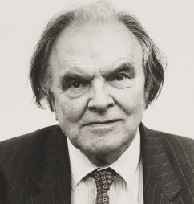
Peter Thomas Geach was a British philosopher who was Professor of Logic at the University of Leeds. His areas of interest were philosophical logic, ethics, history of philosophy, philosophy of religion and the theory of identity.

Ian MacDougall Hacking was a Canadian philosopher specializing in the philosophy of science. Throughout his career, he won numerous awards, such as the Killam Prize for the Humanities and the Balzan Prize, and was a member of many prestigious groups, including the Order of Canada, the Royal Society of Canada and the British Academy.
In classical logic, propositions are typically unambiguously considered as being true or false. For instance, the proposition one is both equal and not equal to itself is regarded as simply false, being contrary to the Law of Noncontradiction; while the proposition one is equal to one is regarded as simply true, by the Law of Identity. However, some mathematicians, computer scientists, and philosophers have been attracted to the idea that a proposition might be more or less true, rather than wholly true or wholly false. Consider My coffee is hot.
Dorothy Margaret Doig Edgington FBA is a philosopher active in metaphysics and philosophical logic. She is particularly known for her work on the logic of conditionals and vagueness.
Bastiaan Cornelis van Fraassen is a Dutch-American philosopher noted for his contributions to philosophy of science, epistemology and formal logic. He is a Distinguished Professor of Philosophy at San Francisco State University and the McCosh Professor of Philosophy Emeritus at Princeton University.
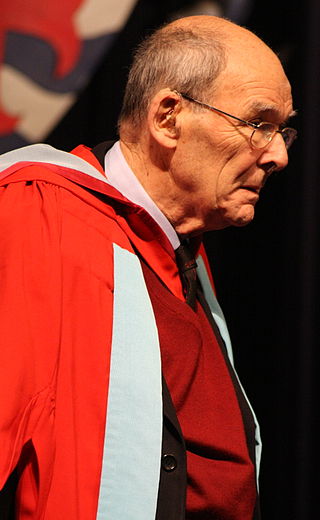
David Malet Armstrong, often D. M. Armstrong, was an Australian philosopher. He is well known for his work on metaphysics and the philosophy of mind, and for his defence of a factualist ontology, a functionalist theory of the mind, an externalist epistemology, and a necessitarian conception of the laws of nature.

Timothy Williamson is a British philosopher whose main research interests are in philosophical logic, philosophy of language, epistemology and metaphysics. He is the former Wykeham Professor of Logic at the University of Oxford, and a fellow of New College, Oxford.

Graham Priest is a philosopher and logician who is distinguished professor of philosophy at the CUNY Graduate Center, as well as a regular visitor at the University of Melbourne, where he was Boyce Gibson Professor of Philosophy and also at the University of St Andrews.

Stephen Yablo is a Canadian-born American philosopher. He is David W. Skinner Professor of Philosophy at the Massachusetts Institute of Technology (MIT) and taught previously at the University of Michigan, Ann Arbor. He specializes in the philosophy of logic, philosophy of mind, metaphysics, philosophy of language, and philosophy of mathematics.
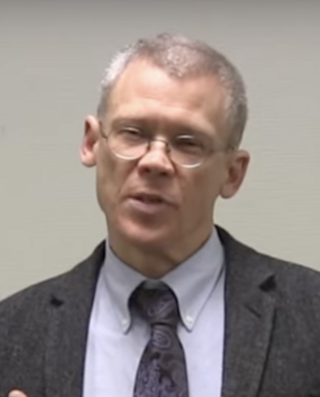
Robert Charles ("Rob") Koons is an American philosopher. He is a professor of philosophy at the University of Texas, noted for his contribution to metaphysics and philosophical logic. Koons has also advocated for academic freedom and courses on Western civilization.
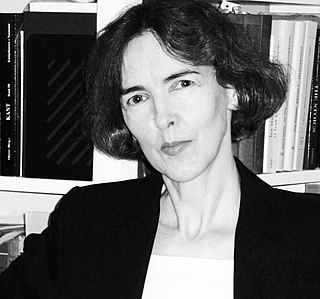
Susanne Bobzien is a German-born philosopher whose research interests focus on philosophy of logic and language, determinism and freedom, and ancient philosophy. She currently is senior research fellow at All Souls College, Oxford and professor of philosophy at the University of Oxford.
Peter Richard Haddow Forrest is an Australian philosopher.
In logic, a finite-valued logic is a propositional calculus in which truth values are discrete. Traditionally, in Aristotle's logic, the bivalent logic, also known as binary logic was the norm, as the law of the excluded middle precluded more than two possible values for any proposition. Modern three-valued logic allows for an additional possible truth value.
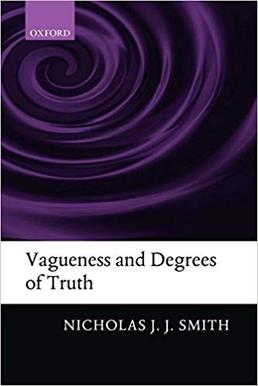
Vagueness and Degrees of Truth is a 2008 book by Nicholas J. Smith, in which the author examines vagueness based on the idea of "degrees of truth". It means that although some sentences are true and some are false, others possess intermediate truth values. In other words, some sentences are truer than the false sentences, but not as true as the true ones.
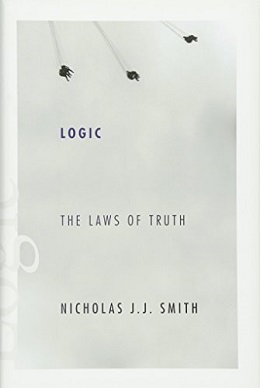
Logic: The Laws of Truth is a 2012 book by Nicholas J. Smith, in which the author provides an introduction to classical logic. It covers the formal tools and techniques of logic and their underlying rationales and broader philosophical significance. The book also presents various forms of proof: proof trees, major variants of natural deduction, axiomatic proofs, and sequent calculus. It also includes numerous logical exercises.

Nicholas Birns is a scholar of literature, including fantasy and Australian literature. As a Tolkien scholar he has written on a variety of topics including "The Scouring of the Shire" and Tolkien's biblical sources. His analysis of the writings of Anthony Powell and Roberto Bolaño has been admired by scholars.
Graham Nerlich was an Australian philosopher. He was an Emeritus Professor of Philosophy at the University of Adelaide, and his expertise was in the areas of philosophy; existence of God; meaning of life; mind and body; ethics; and philosophy of science.
References
- ↑ "Fellow Profile: Nicholas JJ Smith". Australian Academy of the Humanities. Retrieved 27 May 2024.
- ↑ Paoli, F. (27 March 2014). "Logic. The Laws of Truth". History and Philosophy of Logic . 35 (3): 306–308. doi:10.1080/01445340.2014.902243. ISSN 0144-5340. S2CID 119567628.
- ↑ Cook, Roy T. (25 November 2010). "Vagueness and Degrees of Truth - By Nicholas J. J. Smith". Theoria. 76 (4): 380–384. doi:10.1111/j.1755-2567.2010.01088.x. ISSN 0040-5825.
- ↑ Ripley, David (2010). "Review of Vagueness and Degrees of Truth". Analysis. 70 (1): 188–190. doi:10.1093/analys/anp152. JSTOR 23315099.
- ↑ "Logic taking the University by storm". Honi Soit. 9 September 2021. Retrieved 13 September 2022.


