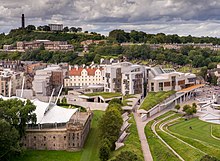
The Scottish National Party is a Scottish nationalist and social democratic political party. The party holds 63 of the 129 seats in the Scottish Parliament and 43 out of the 59 Scottish seats in the House of Commons in Westminster. It has 453 local councillors of 1,227.

Scottish independence is the idea of Scotland regaining its independence and once again becoming a sovereign state, independent from the United Kingdom. The term Scottish independence refers to the political movement that is campaigning to bring it about.
James Sillars is a Scottish politician and campaigner for Scottish independence. Sillars served as a Labour Party MP for South Ayrshire from 1970 to 1976. He founded and led the pro-Scottish Home Rule Scottish Labour Party in 1976, continuing as MP for South Ayrshire until he lost the seat in 1979.

The politics of Scotland operate within the constitution of the United Kingdom, of which Scotland is a country. Scotland is a democracy, being represented in both the Scottish Parliament and the Parliament of the United Kingdom since the Scotland Act 1998. Most executive power is exercised by the Scottish Government, led by the First Minister of Scotland, the head of government in a multi-party system. The judiciary of Scotland, dealing with Scots law, is independent of the legislature and the Scottish Government. Scots law is primarily determined by the Scottish Parliament. The Scottish Government shares some executive powers with the Scotland Office, a British government department led by the Secretary of State for Scotland.
The Scottish Constitutional Convention (SCC) was an association of Scottish political parties, churches and other civic groups, that developed a framework for Scottish devolution. It is credited as having paved the way for the establishment of the Scottish Parliament in 1999.

The first election to the devolved Scottish Parliament, to fill 129 seats, took place on 6 May 1999. Following the election, the Labour Party and the Liberal Democrats formed the Scottish Executive, with Labour Member of the Scottish Parliament (MSP) Donald Dewar becoming First Minister.

The Scottish devolution referendum of 1997 was a pre-legislative referendum held in Scotland on 11 September 1997 over whether there was support for the creation of a Scottish Parliament with devolved powers, and whether the Parliament should have tax-varying powers. The result was "Yes–Yes": a majority voted in favour of both proposals, and the Parliament was established following an election in 1999. Turnout for the referendum was 60.4%.

A post-legislative referendum was held in Scotland in 1979 to decide whether there was a sufficient support for a Scottish Assembly proposed in the Scotland Act 1978 among the Scottish electorate. This was an act to create a devolved deliberative assembly for Scotland. A majority (51.6%) of voters supported the proposal, but an amendment to the Act stipulated that it would be repealed if less than 40% of the total electorate voted in favour. As there was a turnout of 64% the "Yes" vote represented only 32.9% of the registered electorate, and the act was subsequently repealed.
In Scotland, the Scottish National Party (SNP) is a left social democratic political party which campaigns for Scottish independence. The SNP has controlled Scotland's devolved legislature since the 2007 election as a minority government, and were a majority government from the 2011 election and have been a minority government, since the 2016 election.
Unionism in Scotland is a political movement which favours the continuation of the political union between Scotland and the other countries of the United Kingdom, and hence is opposed to Scottish independence. Scotland is one of four countries of the United Kingdom which has its own devolved government and Scottish Parliament, as well as representation in the UK Parliament. There are many strands of political Unionism in Scotland, some of which have ties to Unionism and Loyalism in Northern Ireland. The two main political parties in the UK — the Conservatives and Labour — both support Scotland remaining part of the UK.

Scottish Labour, officially the Scottish Labour Party, is the part of the UK Labour Party active in Scotland. Ideologically social democratic and unionist, it holds 22 of 129 seats in the Scottish Parliament and 2 of 59 Scottish seats in the House of Commons. It is represented by 262 of the 1,227 local councillors across Scotland. The Scottish Labour party has no separate Chief Whip at Westminster.
The Scottish Liberal Democrats is a liberal, federalist political party in Scotland, a part of the United Kingdom Liberal Democrats. The party currently holds 4 of the 129 seats in the Scottish Parliament and 4 of the 59 Scottish seats in the House of Commons.

The 2011 Scottish Parliament election was held on Thursday, 5 May 2011 to elect 129 members to the Scottish Parliament.
Kenyon Edward Canon Wright was a priest of the Scottish Episcopal Church and a political campaigner. Wright chaired the Scottish Constitutional Convention (1989–1999), which laid the groundwork for the creation of the devolved Scottish Parliament in 1999.
The Commission on Scottish Devolution, also referred to as the Calman Commission or the Scottish Parliament Commission or Review, was established by an opposition Labour Party motion passed by the Scottish Parliament on 6 December 2007, with the support of the Conservatives and Liberal Democrats. The governing Scottish National Party opposed the creation of the commission.
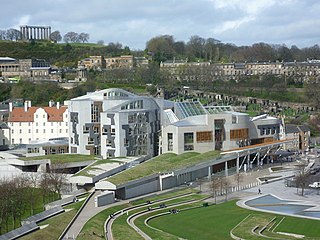
Devolution is the process in which the central British parliament grants administrative powers to the devolved Scottish Parliament. Prior to the advent of devolution, some had argued for a Scottish Parliament within the United Kingdom – while others have since advocated for complete independence. The people of Scotland first got the opportunity to vote in a referendum on proposals for devolution in 1979 and, although a majority of those voting voted 'Yes', the referendum legislation also required 40% of the electorate to vote 'Yes' for the plans to be enacted and this was not achieved. A second referendum opportunity in 1997, this time on a strong proposal, resulted in an overwhelming 'Yes' victory, leading to the Scotland Act 1998 being passed and the Scottish Parliament being established in 1999.
Alexander Elliot Anderson Salmond is a Scottish politician, economist and television host, who served as First Minister of Scotland from 2007 to 2014. A prominent figure in the Scottish nationalist movement, he has served as Leader of the Alba Party since 2021. Salmond was leader of the Scottish National Party (SNP), on two occasions, from 1990 to 2000 and from 2004 to 2014. He served as the party's depute leader from 1987 to 1990. Salmond hosted The Alex Salmond Show (2017–2022) on RT UK. He currently hosts Scotland Speaks with Alex Salmond (2023–present).

The 2014 Scottish Labour Party leadership election was an internal party election to choose a new leader and deputy leader of the Scottish Labour Party, following the resignations of Johann Lamont as leader and Anas Sarwar as deputy. Lamont announced her decision in an interview with the Daily Record on 24 October, saying that she was stepping down effective immediately because the UK Labour Party treated the Scottish party as a "branch office of London". Lamont, who had won the 2011 leadership contest, thus becoming the first Scottish leader to have authority over Labour's Scottish MPs in the House of Commons as well as in the Scottish Parliament, was the second leader of a Scottish political party to resign in the wake of the 2014 independence referendum. Before her resignation, Alex Salmond announced his intention to relinquish the role of Scottish National Party (SNP) leader and First Minister. Sarwar announced his own resignation on 30 October, saying he felt it was right for the party to elect a new leadership team.
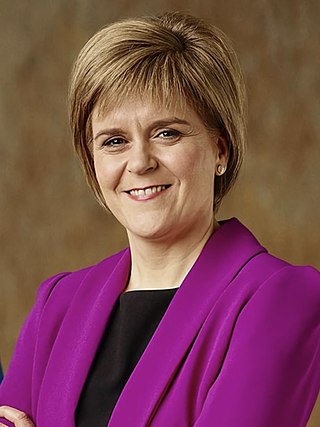
A general election was held in the United Kingdom on 7 May 2015 and all 59 seats in Scotland were contested under the first-past-the-post, single-member district electoral system. Unlike the 2010 general election, where no seats changed party, the Scottish National Party (SNP) won all but three seats in Scotland in an unprecedented landslide victory, gaining a total of 56 seats and taking the largest share of the Scottish vote in sixty years, at approximately 50 per cent. The Labour Party suffered its worst ever election defeat in Scotland, losing 40 of the 41 seats it was defending, including the seats of Scottish Labour leader Jim Murphy and the then Shadow Foreign Secretary Douglas Alexander. The Liberal Democrats lost ten of the eleven seats they were defending, with the then Chief Secretary to the Treasury Danny Alexander and former leader Charles Kennedy losing their seats. The election also saw the worst performance by the Scottish Conservative Party, which received its lowest share of the vote since its creation in 1965, although it retained the one seat that it previously held. In all, 50 of the 59 seats changed party, 49 of them being won by first-time MPs.

A general election was held in the United Kingdom on Thursday 8 June 2017; all 59 seats in Scotland were contested under the first-past-the-post electoral system.