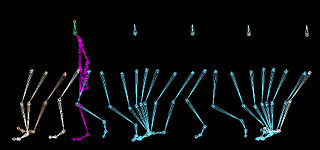
Walking is one of the main gaits of locomotion among legged animals. Walking is typically slower than running and other gaits. Walking is defined by an 'inverted pendulum' gait in which the body vaults over the stiff limb or limbs with each step. This applies regardless of the unusable number of limbs—even arthropods, with six, eight, or more limbs, walk.

Michael Francis Moore is an American documentary filmmaker and author. He is best known for his work on globalization and capitalism. Moore has been labeled a left-wing documentary filmmaker and left-wing political activist, however, he rejects the label "political activist".

New Pedestrianism (NP) is a more pedestrian and ecology-oriented variation of New Urbanism in urban planning theory, founded in 1999 by Michael E. Arth, an American artist, urban/home/landscape designer, futurist, and author. NP addresses the problems associated with New Urbanism and is an attempt to solve various social, health, energy, economic, aesthetic, and environmental problems, with special focus on reducing the role of the automobile. A neighborhood or new town utilizing NP is called a Pedestrian Village. Pedestrian Villages can range from being nearly car-free to having automobile access behind nearly every house and business, but pedestrian lanes are always in front.
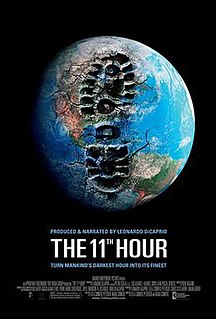
The 11th Hour is a 2007 documentary film on the state of the natural environment created, produced, co-written and narrated by Leonardo DiCaprio. It was directed by Leila Conners Petersen and Nadia Conners and financed by Adam Lewis and Pierre André Senizergues, and distributed by Warner Independent Pictures.
The Monastery: Mr. Vig and the Nun is a 2006 Danish documentary film directed by Pernille Rose Grønkjær.

Joe Strummer: The Future Is Unwritten is a 2007 documentary film directed by Julien Temple about Joe Strummer, the lead singer of the British punk rock band The Clash, that went on to win the British Independent Film Awards as Best British Documentary 2007. The film premiered 20 January 2007 at the 2007 Sundance Film Festival. It was also shown at the Dublin Film Festival on 24 February 2007.

A pedestrian village is a compact, pedestrian-oriented neighborhood or town, with a mixed-use village center, that follows the tenets of New Pedestrianism. Shared-use lanes for pedestrians and those using bicycles, Segways, wheelchairs, and other small rolling conveyances that do not use internal combustion engines. Generally, these lanes are in front of the houses and businesses, and streets for motor vehicles are always at the rear. Some pedestrian villages might be nearly car-free with cars either hidden below the buildings or on the periphery of the village. Venice, Italy is essentially a pedestrian village with canals.
Matt McCormick is a Portland, Oregon based video installation artist and filmmaker. His work extends documentary and experimental filmmaking, focusing on the sublime decay of contemporary culture and the landscape both urban and rural.

Scottsboro: An American Tragedy is a 2001 American documentary film directed by Daniel Anker and Barak Goodman. The film is based on one of the longest-running and most controversial courtroom pursuits of racism in American history, which led to nine black teenaged men being wrongly convicted of raping a white woman in Alabama. The film received an Oscar nomination for Best Documentary Feature. It was funded in part by the National Endowment for the Humanities.
Buddy Giovinazzo is an American independent filmmaker and author who is known for his gritty-low budget debut film, Combat Shock, and his collection of harrowing short stories of low urban life in his 1993 novel, Life is Hot in Cracktown.
A "choice-based, marketable, birth license plan" or "birth credits" for population control has been promoted by urban designer and environmental activist Michael E. Arth since the 1990s. Previous iterations of similar transferable birth licensing schemes can also be traced to economist Kenneth Boulding (1964) and leading ecological economist and steady-state theorist Herman Daly (1991)

In computational complexity theory, a problem is NP-complete when it can be solved by a restricted class of brute force search algorithms and it can be used to simulate any other problem with a similar algorithm. More precisely, each input to the problem should be associated with a set of solutions of polynomial length, whose validity can be tested quickly, such that the output for any input is "yes" if the solution set is non-empty and "no" if it is empty. The complexity class of problems of this form is called NP, an abbreviation for "nondeterministic polynomial time". A problem is said to be NP-hard if everything in NP can be transformed in polynomial time into it, and a problem is NP-complete if it is both in NP and NP-hard. The NP-complete problems represent the hardest problems in NP. If any NP-complete problem has a polynomial time algorithm, all problems in NP do. The set of NP-complete problems is often denoted by NP-C or NPC.
Rakontur is a Miami-based media studio founded by Alfred Spellman and Billy Corben in 2000. The word "Rakontur" comes from French, which means "a person who is skilled in relating stories".

Democracy and the Common Wealth: Breaking the Stranglehold of the Special Interests is a 2010 book by urban designer, policy analyst and artist Michael E. Arth. Arth attempts to expose what he calls the "dirty secrets" of America's electoral system, and provides a list of solutions that he believes will result in a "truly representative democracy." This democracy would be led by effective, trustworthy leaders, who would be elected by a majority, and who would not have to spend their time raising campaign funds, or catering to paid lobbyists.
Escape from Suburbia: Beyond the American Dream is a 2007 Canadian documentary film written and directed by Gregory Greene, as a sequel to Greene's film The End of Suburbia, and set to address what is termed "the upcoming energy crisis". Through interviews with individuals, Gregory Greene outlines potential solutions to the coming energy crisis.
The Hole is a small neighborhood in New York City on the border between Brooklyn and Queens. It is a low-lying area, with a ground level that is 30 feet (9.1 m) lower than the surrounding area. The area is run-down, and suffers from frequent flooding. It has been described as a "lost neighborhood", and as resembling a border town from the Wild West. It is generally bordered by Ruby Street, South Conduit Avenue, and Linden Boulevard. Nearby neighborhoods include East New York, Lindenwood, Howard Beach and Ozone Park.
Out of the Woods: Life and Death in Dirty Dave's Homeless Camp is a 2012 feature documentary film by Michael E. Arth. It follows the life and death struggles of homeless people living in a camp in the woods for four years. Arth single-handely directed, shot and edited Out of the Woods after meeting one of the subjects, Dean "Dino the Dinosaur" Bieber, in a former drug slum Arth had rebuilt and turned into "The Garden District" in DeLand some years before. The backstory of Out of the Woods is told in Arth's previous documentary, New Urban Cowboy: Toward a New Pedestrianism.