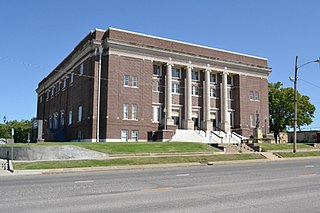
Montgomery County is a county located in Southeast Kansas. Its county seat is Independence, and its most populous city is Coffeyville. As of the 2020 census, the county population was 31,486. The county was named after Richard Montgomery, a major general during the American Revolutionary War.

Washington County is a county located in the northeastern part of the U.S. state of Oklahoma. As of the 2020 census, the population was 52,455. Its county seat is Bartlesville. Named for President George Washington, it is the smallest county in Oklahoma in total area, adjacent to the largest county in Oklahoma, Osage County. Washington County comprises the Bartlesville, OK micropolitan statistical area, which is also included in the Tulsa-Muskogee-Bartlesville, OK combined statistical area. It is located along the border with Kansas.

Osage County is the largest county by area in the U.S. state of Oklahoma. Created in 1907 when Oklahoma was admitted as a state, the county is named for and is home to the federally recognized Osage Nation. The county is coextensive with the Osage Nation Reservation, established by treaty in the 19th century when the Osage relocated there from Kansas. The county seat is in Pawhuska, one of the first three towns established in the county. The total population of the county as of 2020 was 45,818.
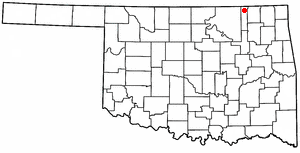
Copan is a town in Washington County, Oklahoma, United States. The population was 733 at the 2010 census, a decline of 7.9 percent from the figure of 796 recorded in 2000.

Bartlesville is a city mostly in Washington County and Osage County, Oklahoma. The population was 37,290 at the 2020 census. Bartlesville is 47 miles (76 km) north of Tulsa and 18 miles (29 km) south of the Kansas border. It is the county seat of Washington County. The Caney River runs through Bartlesville.

The Mid-continent oil field is a broad area containing hundreds of oil fields in the U.S. states of Arkansas, Kansas, Louisiana, New Mexico, Oklahoma and Texas. The area, which consists of various geological strata and diverse trap types, was discovered and exploited during the first half of the 20th century. Most of the crude oil found in the onshore Mid-continent oil field is considered to be of the mixed base or intermediate type.
The Drake Well Museum and Park is a museum in Cherrytree Township, Pennsylvania that chronicles the birth of the American oil industry in 1859 by Colonel Edwin Drake. The museum collects and preserves related artifacts. The reconstructed Drake Well demonstrates the first practical use of salt drilling techniques for the extraction of petroleum through an oil well.
Bowring is an unincorporated community and Census designated place in Osage County, Oklahoma, United States. The post office was established November 12, 1923. It is said to have been named from the combination of the names of two local ranchers, Mart Bowhan and Richard Woodring.

William Wayne Keeler was an American engineer, oilman, and tribal chief. He was the last appointed and first elected Principal Chief of the Cherokee Nation in the 20th century. Educated as a chemical engineer, he worked for Phillips Petroleum Company, where he became chief executive officer at the end of a long career with the company. Throughout his life he also worked in the federal government for the advancement of Indians. President Truman appointed him as Principal Chief of the Cherokee Nation of Oklahoma in 1949. He also served as chairman for the executive committee of the Texas Cherokees and Associate Bands from 1939 until 1972. In 1971, he became the Cherokees' first elected chief since 1903.

Frank Freeman Phillips was an American oilman who with his brother Lee Eldas Phillips co-founded the Phillips Petroleum Company in 1917. Phillips served as the company's president from 1917 to 1939 and as its chairman from 1939 to 1949.

The Caney River is a 180-mile-long (290 km) river in southern Kansas and northeastern Oklahoma. The river is a tributary of the Verdigris River, and is usually a flatwater stream.

The Osage Hills is a hilly area in Oklahoma, commonly known as The Osage. The name refers to the broad rolling hills and rolling tallgrass prairie and Cross Timbers encompassing Osage County and surrounding areas, including portions of Mayes, Tulsa, Washington and Kay Counties. The Osage is the southern extension of the Flint Hills of Kansas.

Well No. 4, Pico Canyon Oilfield, located about seven miles (11 km) west of Newhall, California, in the Santa Susana Mountains, was the first commercially successful oil well in the Western United States and is considered the birthplace of California's oil industry. Drilled in 1876, it turned nearby Newhall into a boomtown and also spawned a smaller boomtown called Mentryville adjacent to the drilling site. Well No. 4 continued in operation for 114 years until it was capped in 1990. The site was designated a National Historic Landmark in 1966, and the Mentryville ghost town is now open to the public as a historic park.
Thomas Baker Slick Sr. was born in Shippenville, Clarion County, Pennsylvania to Johnson M. and Mary A. Baker Slick. He became notable in 1912 for discovering Oklahoma's then-largest oil field, the Cushing Oil Field.

The First Oil Well in Western Canada, also known as Lineham Discovery Well No. 1, is a defunct oil well and national historic site of Canada. Which commemorates the September 21, 1902 oil strike in what is now Waterton Lakes National Park, Alberta. The oil well originally drilled in 1902, was the first productive oil well in the Western Canadian provinces.
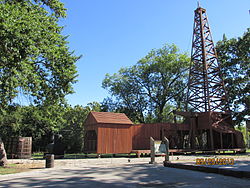
The First Oil Well in Oklahoma was drilled in 1885 in Atoka County, Choctaw Nation, Indian Territory, though it was not completed until 1888.
The Wheeler No. 1 Oil Well was the first well drilled in the Drumright-Cushing Oil Field of northeast Oklahoma, near Drumright. The success of the well, drilled in 1912 by Thomas Baker Slick, Sr., led to the development of the Cushing field and gave impetus to the early development of Oklahoma oilfields. The Drumright-Cushing field would go on to produce 310,000 barrels of oil a day at its peak in May 1917. The well made Slick's name as "King of the Wildcatters".
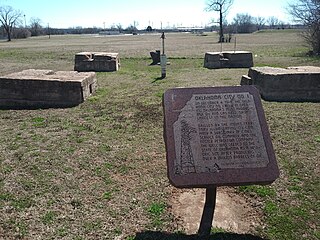
The Oklahoma City Discovery Well was the first successful oil well to be drilled in Oklahoma City, Oklahoma. The December 4, 1928 discovery opened the Oklahoma City Oil Field to extensive exploitation, creating an oil boom that sustained the area through the Great Depression. Because much of the oil was under the existing city, the Oklahoma City field pioneered the use of directional drilling to allow lateral displacement of well bores to reach deposits under developed areas.

Black Gold Casino is a Native American gaming syndicate operated and owned by the Chickasaw Nation in the state of Oklahoma. The casino is adjacent to U.S. Route 70 in Oklahoma bearing due north of Wilson, Oklahoma within Oklahoma administrative division of Carter County. The casino establishment offers provisions by the adjoining Chickasaw Travel Stop (CTS) providing travel necessities and a cultural native Chickasaw smokeshop.
The Kansas, Oklahoma Central and Southwestern Railway (“KOC&S”) was a railroad which in 1899 built tracks from a point near Caney, Kansas to what became Owasso, Oklahoma. After foreclosure in 1900, it was absorbed into the Atchison, Topeka and Santa Fe Railway (“AT&SF”).