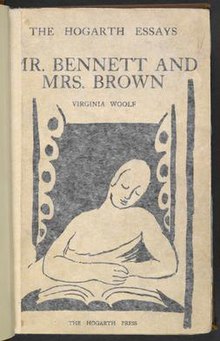
Adeline Virginia Woolf was an English writer. She is considered one of the most important modernist 20th-century authors. She pioneered the use of stream of consciousness as a narrative device.

The Bloomsbury Group was a group of associated British writers, intellectuals, philosophers and artists in the early 20th century. Among the people involved in the group were Virginia Woolf, John Maynard Keynes, E. M. Forster, Vanessa Bell, and Lytton Strachey. Their works and outlook deeply influenced literature, aesthetics, criticism, and economics, as well as modern attitudes towards feminism, pacifism, and sexuality.

Mrs Dalloway is a novel by Virginia Woolf published on 14 May 1925. It details a day in the life of Clarissa Dalloway, a fictional upper-class woman in post-First World War England.

Victoria Mary, Lady Nicolson, CH, usually known as Vita Sackville-West, was an English author and garden designer.

The Hogarth Press is a book publishing imprint of Penguin Random House that was founded as an independent company in 1917 by British authors Leonard Woolf and Virginia Woolf. It was named after their house in Richmond, in which they began hand-printing books as a hobby during the interwar period.

(Helen) Hope Mirrlees was a British poet, novelist and translator. She is best known for the 1926 Lud-in-the-Mist, an influential fantasy novel, and for Paris: A Poem (1920), an experimental poem published by Virginia and Leonard Woolf's Hogarth Press, which critic Julia Briggs deemed "modernism's lost masterpiece, a work of extraordinary energy and intensity, scope and ambition."
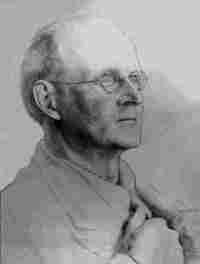
Charles Kay Ogden was a British linguist, philosopher, and writer. Described as a polymath but also an eccentric and outsider, he took part in many ventures related to literature, politics, the arts, and philosophy, having a broad effect particularly as an editor, translator, and activist on behalf of a reformed version of the English language. He is typically defined as a linguistic psychologist, and is now mostly remembered as the inventor and propagator of Basic English.

To the Lighthouse is a 1927 novel by Virginia Woolf. The novel centres on the Ramsay family and their visits to the Isle of Skye in Scotland between 1910 and 1920.

A Room of One's Own is an extended essay by Virginia Woolf, first published in September 1929. The work is based on two lectures Woolf delivered in October 1928 at Newnham College and Girton College, women's colleges at the University of Cambridge.

The Hours, a 1998 novel by the American writer Michael Cunningham, is a tribute to Virginia Woolf's 1923 work Mrs Dalloway. Cunningham emulates elements of Woolf's writing style while revisiting some of her themes in different settings. The Hours won the 1999 Pulitzer Prize for Fiction and the 1999 PEN/Faulkner Award for Fiction, and was later made into an Oscar-winning, 2002, eponymous film.
Modernist literature originated in the late 19th and early 20th centuries, and is characterised by a self-conscious separation from traditional ways of writing in both poetry and prose fiction writing. Modernism experimented with literary form and expression, as exemplified by Ezra Pound's maxim to "Make it new". This literary movement was driven by a conscious desire to overturn traditional modes of representation and express the new sensibilities of the time. The immense human costs of the First World War saw the prevailing assumptions about society reassessed, and much modernist writing engages with the technological advances and societal changes of modernity moving into the 20th century. In Modernist Literature, Mary Ann Gillies notes that these literary themes share the "centrality of a conscious break with the past", one that "emerges as a complex response across continents and disciplines to a changing world".
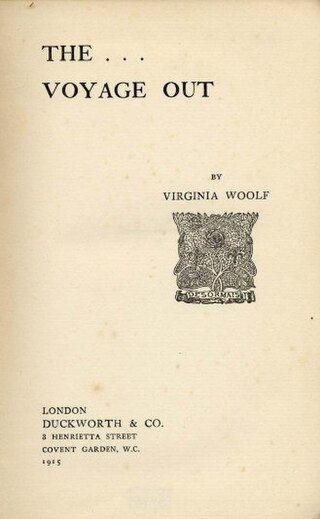
The Voyage Out is the first novel by Virginia Woolf, published in 1915 by Duckworth.

Night and Day is a novel by Virginia Woolf first published on 20 October 1919. Set in Edwardian London, Night and Day contrasts the daily lives and romantic attachments of two acquaintances, Katharine Hilbery and Mary Datchet. The novel examines the relationships between love, marriage, happiness, and success.
This is a bibliography of works by the English novelist and essayist Virginia Woolf (1882–1941).
The Mark on the Wall is the first published story by Virginia Woolf. It was published in 1917 as part of the first collection of short stories written by Virginia Woolf and her husband, Leonard Woolf, called Two Stories. It was later published in New York in 1921 as part of another collection entitled Monday or Tuesday.

Freshwater: A comedy is a play written and produced by Virginia Woolf in 1935, and the only play she wrote. Although only performed once in her lifetime, it has been translated into many languages and produced in many countries since. Alfred Lord Tennyson appears as a character in this play.
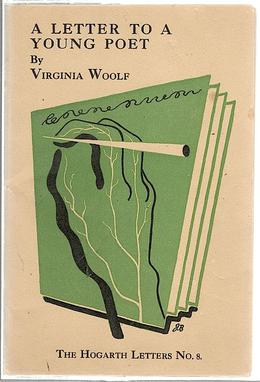
A Letter to a Young Poet was an epistolary novel by Virginia Woolf, written in 1932 to John Lehman, laying out her views on modern poetry.
Joan Adeney Easdale was an English poet from Sevenoaks, Kent. Her mother was the author Gladys Ellen Easdale, née Adeney (1875-1970). Her father, Robert Carse Easdale, left her mother during the First World War. Virginia Woolf discerned some "real merit" in her early work.

Paris: A Poem is a long poem by Hope Mirrlees, described as "modernism's lost masterpiece" by critic Julia Briggs. Mirrlees wrote the six-hundred-line poem in spring 1919. Although the title page of the first edition mistakenly has the year 1919, it was first published in 1920 by Leonard and Virginia Woolf at the Hogarth Press. Only 175 copies of the first edition were distributed. In 2011, the poem was reprinted in an edition of Mirrlees's Collected Poems, edited by Sandeep Parmar, which helped create more critical interest.