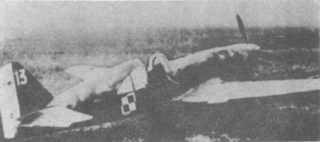
The C.710 were a series of light fighter aircraft developed by Caudron-Renault for the French Air Force just prior to the start of World War II. One version, the C.714, saw limited production, and were assigned to Polish pilots flying in France after the fall of Poland in 1939. A small number was also supplied to Finland.
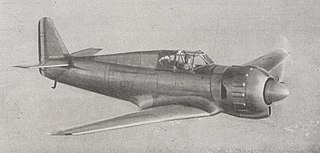
The Bloch MB.150 was a French fighter aircraft developed and produced by Société des Avions Marcel Bloch. It featured an all-metal construction, complete with a retractable undercarriage, low cantilever wing and a fully enclosed cockpit.

The Bloch MB.170 and its derivatives were French reconnaissance bombers designed and built shortly before the Second World War. They were the best aircraft of this type available to the Armée de l'Air at the outbreak of the war, with speed, altitude and manoeuvrability that allowed them to evade interception by the German fighters. Although the aircraft could have been in service by 1937, debate over what role to give the aircraft delayed deliveries until 1940.

The Farman F.220 and its derivatives were thick-sectioned, high-winged, four engined French monoplanes from Farman Aviation Works. Based on the push-pull configuration proven by the F.211, design started in August 1925 and the first flight of the prototype was on 26 May 1932. The largest bomber to serve in France between the two world wars was the final F.222 variant. One variation was intended to be an airliner.

Potez 25 was a French twin-seat, single-engine sesquiplane designed during the 1920s. A light multi-purpose fighter-bomber, it was designed as a line aircraft and used in a variety of roles, including fighter and escort missions, tactical bombing and reconnaissance missions. In the late 1920s and early 1930s, Potez 25 was the standard multi-purpose aircraft of over 20 air forces, including French and Polish. It was also popular among private operators, notably mail transport companies.

The ANF Les Mureaux 110 and its derivatives were a family of all-metal military reconnaissance aircraft developed and produced by the French aircraft manufacturer ANF Les Mureaux.
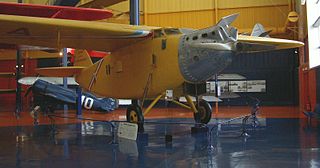
The Bernard 190 or Bernard-Hubert 190 was a French airliner of 1928. It was a high-wing cantilever monoplane of conventional configuration, based on the Bernard 18. Compared with its predecessor, it kept the same basic design but featured redesigned tail surfaces, an enlarged cabin, and offered its flight crew a completely enclosed cockpit. Also like its predecessor, the basic airliner model provided the basis for a long-range aircraft to be used in record attempts, the 191GR.

The CAMS 37 was a French 1920s biplane flying boat designed for military reconnaissance, but which found use in a wide variety of roles.

The CAMS 55 was a reconnaissance flying boat built in France in the late 1920s which equipped the French Navy throughout the 1930s.

The Potez 540 was a French multi-role aircraft of the 1930s. Designed and built by Potez, it served with the French Air Force as a reconnaissance bomber, also serving with the Spanish Republican Air Force during the Spanish Civil War. Although obsolete as a bomber, it remained in service in support roles and in France's overseas colonies at the start of World War II.

The Loire 46 was a French single-seater fighter aircraft of the 1930s. A high-winged monoplane designed and built by Loire Aviation, it was purchased by the French Air Force. It was also supplied to the Spanish Republican forces during the Spanish Civil War, but was almost out of service by the outbreak of World War II.

The Morane-Saulnier MS.230 aircraft was the main elementary trainer for the French Armée de l'Air throughout the 1930s. Almost all French pilots flying for the Armée de l'Air at the outbreak of World War II had had their earliest flight training in this machine. It was the equivalent of the Stearman trainer in the United States air services and the de Havilland Tiger Moth in the British Royal Air Force.

The Caudron C.690 was a single-seat training aircraft developed in France in the late 1930s to train fighter pilots to handle high-performance aircraft. It was a conventional low-wing cantilever monoplane that bore a strong resemblance to designer Marcel Riffard's racer designs of the same period. Caudron attempted to attract overseas sales for the aircraft, but this resulted in orders for only two machines - one from Japan, and the other from the USSR. In the meantime, the first of two prototypes was destroyed in a crash that killed René Paulhan, Caudron's chief test pilot.

The FBA 17 was a training flying boat produced in France in the 1920s.

The Morane-Saulnier AI is a French parasol-wing fighter aircraft that was produced by Morane-Saulnier during World War I.

The Morane-Saulnier AR was a trainer aircraft produced in France during and after the First World War.

The Morane-Saulnier MS.755 Fleuret was a prototype French two-seat jet trainer designed and built by Morane-Saulnier. It failed to gain any orders but was developed into the larger four-seat MS.760 Paris.
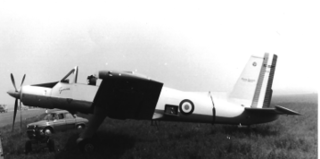
The Morane-Saulnier MS.1500 Épervier was a 1950s French two-seat ground attack and reconnaissance aircraft. Designed and built by Morane-Saulnier to meet a French Air Force requirement, it did not enter production.
Groupe de Chasse or groupe de chasse is the French language term for "fighter group" or "fighter wing". More literal translations include "pursuit group" and "hunting group".

The Lorraine Hanriot LH.130 is a French racing aircraft designed and built in the early 1930s, to compete in the Coupe Michelin air races.


