英文互译镜像站

Modern paganism in the United Kingdom

Last updated
Modern paganism in the United Kingdom
Stonehenge back wide.jpg
Stonehenge is an important part of certain modern neo-druidic practices. [1]
Total population
Flag of the United Kingdom (1-2).svg United Kingdom: 126,980 – 0.2%
(2021/22 Census)
[a] [2] [3] [4]
Regions with significant populations
Flag of England.svg England 99,500 – 0.2% (2021)
Flag of Scotland.svg Scotland 19,113 – 0.4% (2022) [b]
Flag of Wales (1959-present).svg Wales 7,033 – 0.2% (2021)
Northern Ireland 1,334 – 0.1% (2021)
Religions
Also includes Heathenry, Druidy, Pantheism, Witchcraft, Animism and Reconstructionist
Related ethnic groups
Modern paganism in Ireland

The Modern Pagan movement in the United Kingdom is primarily represented by Wicca and Neopagan witchcraft, Druidry, and Heathenry. 74,631 people in England, Scotland and Wales identified as either as Pagan or a member of a specific Modern Pagan group in the 2011 UK Census. [5] [6]

Contents

Demographics

A study conducted by Ronald Hutton compared a number of different sources (including membership lists of major organisations within the United Kingdom, major events attendance, subscriptions to magazines, etc.), and used standard models for calculating likely numbers of Pagans within the United Kingdom. This estimate accounted for multiple membership overlaps as well as the number of adherents represented by each attendee of a Pagan gathering. Hutton estimated that there are 250,000 Pagan adherents in the United Kingdom, roughly equivalent to the national Hindu community back in 2001 when it was much smaller than it is today (there are presently over a million Hindus in the United Kingdom). [7]

A smaller number is suggested by the results of the 2001 Census, in which a question about religious affiliation was asked for the first time. Respondents were able to write in an affiliation not covered by the check-list of common religions, and a total of 42,262 people from England, Scotland, and Wales declared themselves to be Pagans by this method (or 23% of the 179,000 adherents of "other religions" in the results). These figures were not released as a matter of course by the Office for National Statistics, but were released after an application filed by the Pagan Federation (Scottish branch). [8] With a population of around 59 million, this gives a rough proportion of 7 Pagans per 10,000 inhabitants of the United Kingdom.

The 2001 UK Census figures did not allow an accurate breakdown of traditions within the Pagan heading, as a campaign by the Pagan Federation before the census encouraged Wiccans, Heathens, Druids and others all to use the same write-in term 'Pagan' in order to maximise the numbers reported. The 2011 census however made it possible to describe oneself as Pagan-Wiccan, Pagan-Druid and so on. The figures for England, Wales and Scotland are as follows: [9] [10]

DescriptionEnglandWalesScotland
Pagan53,1723,4483,467
Wicca11,026740949
Druid3,946243245
Pantheism2,105111135
Heathen1,86791150
Witchcraft1,1938381
Shamanism6123892
Animism4875444
Reconstructionist 2232831
Total74,6314,8365,194

The overall numbers of people reporting Pagan or one of the other categories in the table above rose between 2001 and 2011. In 2001 about seven people per 10,000 UK respondents identified as pagan; in 2011 the number (based on the England and Wales population) was 14.3 people per 10,000 respondents.

Research conducted by Dr Leo Ruickbie suggested that the south-east of England had the highest concentration of Pagans in the country. [11]

2021 census

Pagan movementFlag of England.svg  England
(2021) [2]
Flag of Scotland.svg  Scotland
(2022) [3]
Flag of Wales (1959-present).svg  Wales
(2021) [2]
Northern Ireland
(2021) [4]
Flag of the United Kingdom (1-2).svg  United Kingdom
(2021/22) [c]
Pagan 68,62919,1135,10484093,686
Wicca 11,946To be published,
only 2011 figures
available [12]
86724313,056
Shamanism 7,624265157,904
Heathenry 4,478243704,791
Druidry 2,268222372,527
Pantheism 2,158141812,380
Witchcraft 9677701,044
Animism 7336948850
Reconstructionist 697450742
Total99,500TBC7,0331,334126,980

Religions

Modern Paganism in the UK is dominated by Wicca, the modern movement of Druidry, and forms of Heathenry.

Wicca

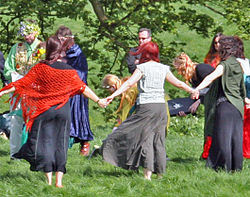
Wiccans gather for a handfasting ceremony at Avebury in England. Paganavebury.jpg
Wiccans gather for a handfasting ceremony at Avebury in England.

Wicca was developed in England in the first half of the 20th century. [13] It is generally a duotheistic religion which worships the Horned God and Moon Goddess. Although it had various terms in the past, from the 1960s onward the name of the religion was normalised to Wicca. [14]

Heathenry

Heathenry consists of a variety of modern movements attempting to revive Germanic paganism, such as that practiced in the British Isles by the Anglo-Saxon and Scandinavian peoples prior to Christianisation. Asatru UK was founded in 2013 and operates as a country-wide group for all inclusive Heathens. [15] [16]

Druidism

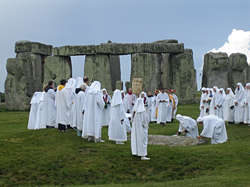
Druids' ritual at Stonehenge. Druids celebrating at Stonehenge (0).png
Druids' ritual at Stonehenge.

During the Iron Age, Celtic polytheism was the predominant religion in the area now known as England. Neo-Druidism grew out of the Celtic revival in 18th century Romanticism. Its first organised group was the Ancient Order of Druids, founded in London in 1781 along Masonic lines as a mutual benefit society and still extant today. It is not a neo-Pagan group. It was followed in 1792 by the Gorsedd of Bards of the Isle of Britain, also founded in London. This was the brainchild of Welsh stonemason, student of Welsh language, culture and heritage, and literary forger, Edward Williams, better known by his assumed name, Iolo Morganwg. It also survives to this day, its rituals forming an important part of the annual Welsh National Eisteddfod. Its members included Queen Elizabeth II and former archbishop of Canterbury, Rowan Williams. It is a cultural institution, not a neo-Pagan one. Inasmuch as it has a religious element, that element is Christian.[ dubious discuss ] The Ancient Druid Order, founded circa 1909, was the first that could be characterised as neo-Pagan, its founder being influenced by the occult movement of the late 19th century. The Order of Bards, Ovates and Druids, which split from the Ancient Druid Order in 1964, began to develop a more neo-Pagan style of Druidry, partly through the friendship between its founder, Ross Nichols, and the founder of modern Wicca, Gerald Gardner. More overtly Pagan Druid groups began to develop in the UK from the late 1970s onwards. These include the British Druid Order, The Druid Network and numerous other smaller groups. [17]

Reconstructionist Roman religion

The revival of the Reconstructionist Roman religion (Latin: Religio Romana), also known as Roman Neopaganism, in the United Kingdom focuses on the modern restoration of ancient Roman spiritual practices, virtues, and rituals. Unlike broader Wicca or eclectic Neopaganism, this movement is strictly reconstructionist, prioritising the study of historical Latin texts and archaeological evidence to recreate the Cultus Deorum (worship of the gods) as accurately as possible. [18] [19]

The history of organised Roman reconstructionism in Britain gained momentum in the late 20th century alongside the wider growth of contemporary Pagan movements and reconstructionist traditions in Europe and North America. [20] [21] International organisations such as Nova Roma have contributed to the development and visibility of Roman reconstructionist practice in Europe since this period. [22]

The movement in the UK is characterised by a dual focus on sacra privata—the domestic worship of the Lares (household spirits) and Manes (ancestors)—and the public observance of the ancient Roman calendar, such as Saturnalia, Lupercalia, and the Liberalia. [23] [24] [25]

Organisations

Modern Pagan organisations in Great Britain:

See also

Notes

  1. Includes all followers who are followers of the broad Modern Paganism movement, i.e. not just Modern paganism.)
  2. Only includes those identified as followers of Paganism, does not include other faiths in the broader Modern Paganism movement
  3. Excluding Scotland, with the exception of the Pagan religious group where 2022 census data is available.

Footnotes

  1. Khouri, Andrew (2010-06-21). "Thousands celebrate solstice". NBC News. Archived from the original on March 5, 2016. Retrieved 2010-10-03.
  2. 1 2 3 "TS031: Religion (detailed)". Office for National Statistics. Retrieved 5 April 2023.
  3. 1 2 "Scotland's Census 2022 - Ethnic group, national identity, language and religion - Chart data". Scotland's Census. National Records of Scotland. 21 May 2024. Retrieved 21 May 2024. Alternative URL 'Search data by location' > 'All of Scotland' > 'Ethnic group, national identity, language and religion' > 'Religion'
  4. 1 2 "MS-B21 Religion - full detail". Northern Ireland Statistics and Research Agency. Retrieved 30 November 2023.
  5. Office for National Statistics, 11 December 2012, 2011 Census, Key Statistics for Local Authorities in England and Wales . Accessed 12 December 2012.
  6. Office for National Statistics, 11 December 2012, 2011 Census, Scotland's Census 2011 - National Records of Scotland, Religion (detailed) All people , Accessed 20 March 2015.
  7. Hutton (2001)
  8. Pagan Federation, Scotland (25 March 2004). "The Pagan Federation in Scotland - Census Results". Archived from the original on 13 January 2010. Retrieved 4 April 2010.
  9. Office for National Statistics, 11 December 2012, 2011 Census, Key Statistics for Local Authorities in England and Wales . Accessed 12 December 2012.
  10. Office for National Statistics, 11 December 2012, 2011 Census, Scotland's Census 2011 - National Records of Scotland, Religion (detailed) All people , Accessed 20 March 2015.
  11. Ruickbie, Leo (2004). Witchcraft Out of the Shadows. Robert Hale. p. 170. ISBN   0-7090-7567-7.
  12. "2011 Detailed Table- Religion" (PDF). National Records of Scotland. Retrieved 10 February 2018.
  13. Hutton, Ronald (1999). The Triumph of the Moon: A History of Modern Pagan Witchcraft . Oxford, NY: Oxford University Press. p.  vii. ISBN   0-19-820744-1.
  14. Seims, Melissa (2008). "Wica or Wicca? - Politics and the Power of Words". The Cauldron (129).
  15. "Home | Welcome to the website of Asatru UK". Asatru UK. Retrieved 2021-05-16.
  16. "Asatru UK". Facebook. Retrieved 18 December 2021.
  17. Professor Ronald Hutton, The Druids, Hambeldon Continuum, 2007; Blood & Mistletoe: The History of The Druids in Britain, Yale University Press, 2009.
  18. Harvey, Graham (2011). Contemporary Paganism: Religions of the Earth from Druids and Witches to Heathens and Ecofeminists. NYU Press.
  19. Doyle White, Ethan (2016). Paganism in England: 1900–present. Sussex Academic Press.
  20. Hutton, Ronald (1999). The Triumph of the Moon: A History of Modern Pagan Witchcraft. Oxford University Press.
  21. Clifton, Chas S. (2006). Her Hidden Children: The Rise of Wicca and Paganism in America. AltaMira Press.
  22. York, Michael (2003). Pagan Theology: Paganism as a World Religion. NYU Press.
  23. Beard, Mary; North, John; Price, Simon (1998). Religions of Rome. Cambridge University Press.
  24. Scullard, H.H. (1981). Festivals and Ceremonies of the Roman Republic. Cornell University Press.
  25. Rüpke, Jörg (2007). Religion of the Romans. Polity Press.

References

干扰字符镜像 网页镜像工具 烟雨镜像程序 烟雨镜像程序 烟雨镜像程序