Related Research Articles

Richland is a town in Richland County, Wisconsin, United States. The population was 1,364 at the 2000 census.

Richland Center is a city in Richland County, Wisconsin, United States that also serves as the county seat. The population was 5,114 at the 2020 census.

Milford is a coastal city in New Haven County, Connecticut, United States, between New Haven and Bridgeport. The population was 50,558 at the 2020 United States Census. The city includes the village of Devon and the borough of Woodmont. Milford is part of the South Central Connecticut Planning Region and New York metropolitan area.

Milford is a town in Worcester County, Massachusetts, United States. The population was 30,379 according to the 2020 census. First settled in 1662 and incorporated in 1780, Milford became a booming industrial and quarrying community in the 19th century due to its unique location which includes the nearby source of the Charles River, the Mill River, the Blackstone River watershed, and large quantities of Milford pink granite.

New Milford is a town in Litchfield County, Connecticut, United States. The town, part of Greater Danbury, as well as the New York Metropolitan Area, has a population of 28,115 as of the 2020 census. New Milford lies 14 miles (23 km) north of Danbury on the banks of the Housatonic River, and shares its border with the northeastern shore of Candlewood Lake. It is the largest town in the state of Connecticut in terms of land area at nearly 63.7 mi2 (164.9822 km2). The town center is listed as a census-designated place (CDP).
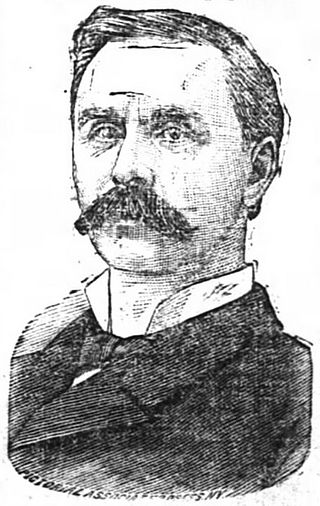
Daniel Hadley Sumner was a U.S. Representative from Wisconsin.

The 2010 Wisconsin gubernatorial election took place on November 2, 2010, to elect the governor and lieutenant governor of Wisconsin. The primary elections on September 14 determined which candidates advanced to the general election.
Edward A. Brooks was an American politician and farmer from the state of Wisconsin. He served ten years in the Wisconsin State Assembly, representing Juneau County and parts of northern Richland and Sauk counties.

The 2002 Wisconsin gubernatorial election was held on November 5, 2002. Incumbent Republican Governor of Wisconsin Scott McCallum, who had assumed office upon the resignation of Tommy Thompson, ran for his first full term in office. McCallum won his party's nomination by defeating two minor candidates, and Attorney General of Wisconsin Jim Doyle won the Democratic primary with a little more than a third of the vote in a highly competitive primary election. In the general election, the presence of Ed Thompson, former Governor Tommy Thompson's younger brother, the Mayor of Tomah, and the Libertarian Party nominee, held both McCallum and Doyle to under fifty percent of the vote, enabling Doyle to win with 45% of the vote, defeating McCallum.
The 14th Senate district of Wisconsin is one of 33 districts in the Wisconsin Senate. Located in central Wisconsin, the district comprises all of Richland and Sauk counties, along with most of Columbia County and parts of southern Adams County, southern Juneau County, and northern Dane County. It contains the cities of Baraboo, Columbus, Portage, Reedsburg, Richland Center, and Wisconsin Dells, and the villages of DeForest, Lake Delton, Poynette, Prairie du Sac, and Sauk City, and part of the city of Madison. The district also contains landmarks such as Devil's Lake State Park, Dane County Regional Airport, Mirror Lake State Park, Lake Wisconsin and the Kilbourn Dam.
Wisconsin's 17th Senate district is one of 33 districts in the Wisconsin Senate. Located in southwest Wisconsin, the district comprises all of Crawford, Grant, Green, Lafayette, and Iowa counties, as well as parts of southwest Dane County. It includes the cities of Boscobel, Brodhead, Cuba City, Darlington, Dodgeville, Lancaster, Mineral Point, Monroe, Oregon, Platteville, Prairie du Chien, and Shullsburg.
The 28th Senate district of Wisconsin is one of 33 districts in the Wisconsin Senate. Located in southeast Wisconsin, the district comprises southeast Waukesha County and northwest Racine County. It includes the cities of Muskego, New Berlin, and most of the city of Waukesha, along with the villages of Big Bend, Mukwonago, and Waterford.

William Stephens Irvine was a member of the Wisconsin State Assembly.
Norman Leslie James was an American farmer, merchant, and Republican politician. He was a member of the Wisconsin State Senate and State Assembly, representing Richland County. His brother David G. James also served in the Wisconsin Senate, representing the same district.
J. E. Coffland was a member of the Wisconsin State Assembly.
Robert Hughes DeLap was a member of the Wisconsin State Assembly.

The 1857 Wisconsin gubernatorial election was held on November 3, 1857. After incumbent Governor Coles Bashford declined to seek re-election, Republican Party candidate Alexander Randall narrowly defeated Democratic candidate James B. Cross by a margin of just 118 votes.
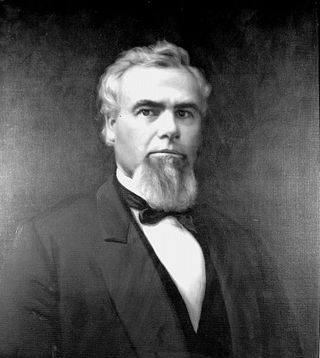
The 1873 Wisconsin gubernatorial election was held on November 4, 1873. Democratic Party candidate William Robert Taylor was elected with 55% of the vote, defeating incumbent Republican governor Cadwallader C. Washburn.

The 1942 Wisconsin gubernatorial election was held on November 3, 1942.

The Thirty-Sixth Wisconsin Legislature convened from January 10, 1883, to April 4, 1883, in regular session.
References
- ↑ "Kintz, Milford C. 1903". Wisconsin Historical Society. Retrieved November 8, 2011.
- ↑ "Milford C. Kintz". Political Graveyard. Retrieved November 8, 2011.
- ↑ 'Richland Observer,' September 3, 1998, Obituary of Milford Clark Kintz