
Vilnius is the capital of and largest city in Lithuania and the second-most-populous city in the Baltic states. The city's estimated July 2024 population was 605,270, and the Vilnius urban area has an estimated population of 708,627.
Sudovian was a West Baltic language of Northeastern Europe. Sudovian was closely related to Old Prussian. It was formerly spoken southwest of the Neman river in what is now Lithuania, east of Galindia and in the north of Yotvingia, and by exiles in East Prussia.
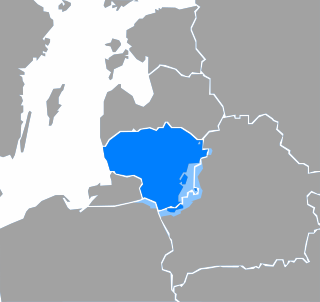
Lithuanian is an East Baltic language belonging to the Baltic branch of the Indo-European language family. It is the language of Lithuanians and the official language of Lithuania as well as one of the official languages of the European Union. There are approximately 2.8 million native Lithuanian speakers in Lithuania and about 1 million speakers elsewhere. Around half a million inhabitants of Lithuania of non-Lithuanian background speak Lithuanian daily as a second language.

Lithuania has participated in the Eurovision Song Contest 24 times since its debut in 1994, where "Lopšinė mylimai" performed by Ovidijus Vyšniauskas finished last, receiving "nul points". Lithuania withdrew from the contest, not returning until 1999. The sixth place of the song "We Are the Winners" performed by LT United in 2006 is Lithuania's best result in the contest. The country reached the top ten for a second time in 2016, when "I've Been Waiting for This Night" by Donny Montell finished ninth, and for the third time in 2021, finishing eighth with "Discoteque" by The Roop. The Lithuanian participant broadcaster in the contest is Lietuvos nacionalinis radijas ir televizija (LRT).
Proto-Baltic is the unattested, reconstructed ancestral proto-language of all Baltic languages. It is not attested in writing, but has been partly reconstructed through the comparative method by gathering the collected data on attested Baltic and other Indo-European languages. It represents the common Baltic speech that approximately was spoken between the 3rd millennium BC and ca. 5th century BC, after which it began dividing into West and East Baltic languages. Proto-Baltic is thought to have been a fusional language and is associated with the Corded Ware and Trzciniec cultures.

The Presidential Palace, located in Vilnius Old Town, is the official office of the president of Lithuania. The palace dates back to the 14th century and during its history it has undergone various reconstructions, supervised by prominent architects, including Laurynas Gucevičius and Vasily Stasov. In 1997 the palace became the official seat of the president of Lithuania.

Zigmas Zinkevičius was a Lithuanian academician, Baltist, linguist, linguistic historian, dialectologist, politician, and the former Minister of Education and Science of Lithuania (1996–1998). Zinkevičius authored over a hundred books, including the popular six-volume "History of the Lithuanian Language" (1984–1994), and over a thousand articles, both in Lithuanian and other languages. He was an academician of the Lithuanian Catholic Academy of Science since 1991 and a full member of the Lithuanian Academy of Sciences from 1990 to 2011, when he became an emeritus member.
Kazimieras Garšva is a Lithuanian linguist, and the leader of the cultural "Vilnija" organisation.

The first known record of the name of Lithuania recorded in the Quedlinburg Chronicle in a 9 March 1009 story of Saint Bruno. The Chronicle recorded in the form Litua. Although it is clear the name originated from a Baltic language, scholars still debate the meaning of the word.
Lithuanization is a process of cultural assimilation, where Lithuanian culture or its language is voluntarily or forcibly adopted.

The West Baltic languages are a group of extinct Baltic languages that were spoken by West Baltic peoples. West Baltic is one of the two primary branches of Baltic languages, along with East Baltic. It includes Old Prussian, Sudovian, West Galindian, possibly Skalvian and Old Curonian.

Mikalojus Daukša was a Lithuanian and Latin religious writer, translator and a Lithuanian Catholic Church official. He is best known as the first among Lithuania's humanists to underline the need to codify and promote the Lithuanian language over Chancery Ruthenian and Polish, which were in use in the Grand Duchy at the time. Furthermore, Daukša preached the ideas of Counter-Reformation and Renaissance humanism.
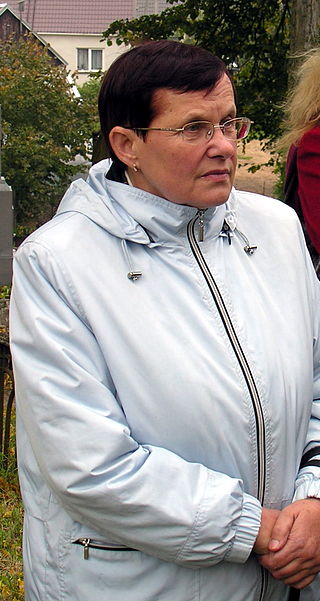
Viktorija Daujotytė-Pakerienė is a Lithuanian literary critic and philologist. She has written more than 30 scientific monographs, as well as essays and Lithuanian language textbooks for general education and higher education. She has also written about culture, feminism, and society.
Lithuania was represented at the Eurovision Song Contest 2002 with the song "Happy You" written and performed by Aivaras. The Lithuanian participating broadcaster, Lietuvos radijas ir televizija (LRT), organised the national final "Eurovizijos" dainų konkurso nacionalinė atranka in order to select its entry for the contest. The national final involved 15 competing entries and "We All" performed by B'Avarija was selected as the winner following the combination of votes from a jury panel, votes from the venue audience and a public vote, however the entry was later disqualified due to a Lithuanian version of the song being released on CD at the end of 2001 and replaced by runner-up "Happy You" performed by Aivaras.

Friedrich Kurschat was a Prussian Lithuanian linguist and professor at the University of Königsberg. He studied the Lithuanian language and published its grammar in 1876 in which he was the first to describe Lithuanian accentuation in detail.

Compendium Grammaticæ Lithvanicæ is a prescriptive printed grammar of the Lithuanian language, which was one of the first attempts to standardize the Lithuanian language. The grammar was intended for pastors who knew little or no Lithuanian so that they could learn the language and communicate with their Lithuanian-speaking parishioners.
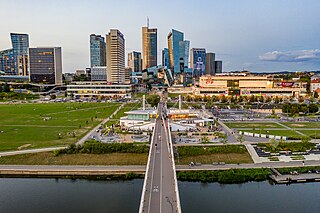
The Central Business District is a rapidly developing business district in Šnipiškės eldership of Vilnius, Lithuania. It is Lithuania's most important business district and the largest of its kind in the Baltic States.

Kurk Lietuvai, also known as KurkLT, is a strategic government initiative focused on fostering innovation and implementing best practices within the Lithuanian public sector. It is part of Invest Lithuania, country's foreign investment agency.


