Related Research Articles

A descriptive statistic is a summary statistic that quantitatively describes or summarizes features from a collection of information, while descriptive statistics is the process of using and analysing those statistics. Descriptive statistics is distinguished from inferential statistics by its aim to summarize a sample, rather than use the data to learn about the population that the sample of data is thought to represent. This generally means that descriptive statistics, unlike inferential statistics, is not developed on the basis of probability theory, and are frequently nonparametric statistics. Even when a data analysis draws its main conclusions using inferential statistics, descriptive statistics are generally also presented. For example, in papers reporting on human subjects, typically a table is included giving the overall sample size, sample sizes in important subgroups, and demographic or clinical characteristics such as the average age, the proportion of subjects of each sex, the proportion of subjects with related co-morbidities, etc.

Psychological statistics is application of formulas, theorems, numbers and laws to psychology. Statistical methods for psychology include development and application statistical theory and methods for modeling psychological data. These methods include psychometrics, factor analysis, experimental designs, and Bayesian statistics. The article also discusses journals in the same field.
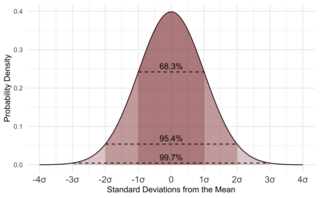
Statistics is the discipline that concerns the collection, organization, analysis, interpretation, and presentation of data. In applying statistics to a scientific, industrial, or social problem, it is conventional to begin with a statistical population or a statistical model to be studied. Populations can be diverse groups of people or objects such as "all people living in a country" or "every atom composing a crystal". Statistics deals with every aspect of data, including the planning of data collection in terms of the design of surveys and experiments.
In statistical hypothesis testing, a result has statistical significance when it is very unlikely to have occurred given the null hypothesis. More precisely, a study's defined significance level, denoted by , is the probability of the study rejecting the null hypothesis, given that the null hypothesis is true; and the p-value of a result, , is the probability of obtaining a result at least as extreme, given that the null hypothesis is true. The result is statistically significant, by the standards of the study, when . The significance level for a study is chosen before data collection, and is typically set to 5% or much lower—depending on the field of study.
Social statistics is the use of statistical measurement systems to study human behavior in a social environment. This can be accomplished through polling a group of people, evaluating a subset of data obtained about a group of people, or by observation and statistical analysis of a set of data that relates to people and their behaviors.
A case study is an in-depth, detailed examination of a particular case within a real-world context. For example, case studies in medicine may focus on an individual patient or ailment; case studies in business might cover a particular firm's strategy or a broader market; similarly, case studies in politics can range from a narrow happening over time to an enormous undertaking.

Quantitative research is a research strategy that focuses on quantifying the collection and analysis of data. It is formed from a deductive approach where emphasis is placed on the testing of theory, shaped by empiricist and positivist philosophies.

Herbert Ellis Robbins was an American mathematician and statistician. He did research in topology, measure theory, statistics, and a variety of other fields.
The general linear model or general multivariate regression model is a compact way of simultaneously writing several multiple linear regression models. In that sense it is not a separate statistical linear model. The various multiple linear regression models may be compactly written as
In statistics, a contingency table is a type of table in a matrix format that displays the (multivariate) frequency distribution of the variables. They are heavily used in survey research, business intelligence, engineering, and scientific research. They provide a basic picture of the interrelation between two variables and can help find interactions between them. The term contingency table was first used by Karl Pearson in "On the Theory of Contingency and Its Relation to Association and Normal Correlation", part of the Drapers' Company Research Memoirs Biometric Series I published in 1904.
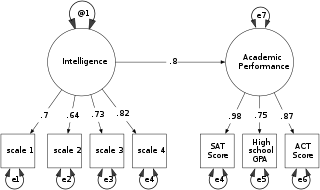
Structural equation modeling (SEM) is a label for a diverse set of methods used by scientists in both experimental and observational research across the sciences, business, and other fields. It is used most in the social and behavioral sciences. A definition of SEM is difficult without reference to highly technical language, but a good starting place is the name itself.
The "ceiling effect" is one type of scale attenuation effect; the other scale attenuation effect is the "floor effect". The ceiling effect is observed when an independent variable no longer has an effect on a dependent variable, or the level above which variance in an independent variable is no longer measurable. The specific application varies slightly in differentiating between two areas of use for this term: pharmacological or statistical. An example of use in the first area, a ceiling effect in treatment, is pain relief by some kinds of analgesic drugs, which have no further effect on pain above a particular dosage level. An example of use in the second area, a ceiling effect in data-gathering, is a survey that groups all respondents into income categories, not distinguishing incomes of respondents above the highest level measured in the survey instrument. The maximum income level able to be reported creates a "ceiling" that results in measurement inaccuracy, as the dependent variable range is not inclusive of the true values above that point. The ceiling effect can occur any time a measure involves a set range in which a normal distribution predicts multiple scores at or above the maximum value for the dependent variable.
The Shapiro–Wilk test is a test of normality in frequentist statistics. It was published in 1965 by Samuel Sanford Shapiro and Martin Wilk.

In statistics, a mediation model seeks to identify and explain the mechanism or process that underlies an observed relationship between an independent variable and a dependent variable via the inclusion of a third hypothetical variable, known as a mediator variable. Rather than a direct causal relationship between the independent variable and the dependent variable, a mediation model proposes that the independent variable influences the mediator variable, which in turn influences the dependent variable. Thus, the mediator variable serves to clarify the nature of the relationship between the independent and dependent variables.
In statistics, missing data, or missing values, occur when no data value is stored for the variable in an observation. Missing data are a common occurrence and can have a significant effect on the conclusions that can be drawn from the data.
In statistics, model specification is part of the process of building a statistical model: specification consists of selecting an appropriate functional form for the model and choosing which variables to include. For example, given personal income together with years of schooling and on-the-job experience , we might specify a functional relationship as follows:
In statistics, the Sobel test is a method of testing the significance of a mediation effect. The test is based on the work of Michael E. Sobel, a statistics professor at Columbia University in New York, NY, and is an application of the delta method. In mediation, the relationship between the independent variable and the dependent variable is hypothesized to be an indirect effect that exists due to the influence of a third variable. As a result when the mediator is included in a regression analysis model with the independent variable, the effect of the independent variable is reduced and the effect of the mediator remains significant. The Sobel test is basically a specialized t test that provides a method to determine whether the reduction in the effect of the independent variable, after including the mediator in the model, is a significant reduction and therefore whether the mediation effect is statistically significant.
Bruno D. Zumbo is a mathematical scientist trained in the tradition of research that combines pure and applied mathematics with statistical and algorithmic techniques to develop theory and solve problems arising in measurement, testing, and surveys in the social, behavioral, and health sciences. He is currently Professor and Distinguished University Scholar, the Tier 1 Canada Research Chair in Psychometrics and Measurement, and the Paragon UBC Professor of Psychometrics & Measurement at University of British Columbia.
Jean Dickinson Gibbons is an American statistician, an expert in nonparametric statistics and an author of books on statistics. She was the first chair of the Committee on Women in Statistics of the American Statistical Association, and the Jean Dickinson Gibbons Graduate Program in Statistics at Virginia Tech is named for her.
Howard Levene was an American statistician and geneticist. He received his Ph.D. from Columbia University in 1947, and joined the faculty there shortly thereafter. He remained on the faculty at Columbia, where he served as professor of mathematical statistics and genetics, until 1982. He is known for developing Levene's test, a modified form of the one-way analysis of variance. He served as president of the American Society of Naturalists in 1976.
References
- ↑ "Michael E. Sobel". Department of Statistics. Columbia University . Retrieved 2019-01-17.
- ↑ "Sobel Test". The SAGE Encyclopedia of Communication Research Methods. Thousand Oaks, CA: SAGE Publications. 2017. doi:10.4135/9781483381411.n570. ISBN 9781483381435.


