
Pedro Augusto del Valle was a United States Marine Corps officer who became the first Hispanic to reach the rank of lieutenant general. His military career included service in World War I, the Banana Wars, and in World War II, the Battle of Guadalcanal and the Battle of Okinawa.

The Meritorious Service Medal (MSM) is a military award presented to members of the United States Armed Forces who distinguish themselves with outstanding meritorious achievement or service to the United States.

James Arthur Williams was a United States Army lieutenant general. Williams served as Director of the Defense Intelligence Agency in the 1980s. He was a 1987 inductee of the Military Intelligence Hall of Fame and was the chairman of the board of directors for the National Military Intelligence Association.
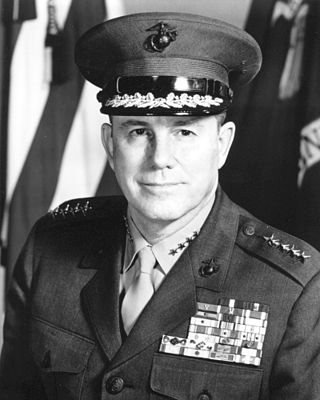
Robert Everton Cushman Jr. was a United States Marine Corps four-star general who served as the 25th commandant of the Marine Corps from January 1, 1972, to June 30, 1975. He was honored for heroism during World War II at the battles of Guam, Bougainville and Iwo Jima. He also commanded all Marine forces in the Vietnam War from June to December 1967, and served as deputy director of the Central Intelligence Agency (CIA) from 1969 to 1971.

The Marine Corps Intelligence is the intelligence arm of the United States Marine Corps (USMC) and an element of the United States Intelligence Community. The Director of Intelligence supervises the Intelligence Department of HQMC and is responsible for policy, plans, programming, budgets, and staff supervision of Intelligence and supporting activities within the U.S. Marine Corps as well as supervising the Marine Corps Intelligence Activity (MCIA). The department supports the Commandant of the Marine Corps (CMC) in his role as a member of the Joint Chiefs of Staff (JCS), represents the service in Joint and Intelligence Community matters, and exercises supervision over the MCIA.

Lieutenant General Wallace H. Robinson was a United States Marine Corps general. LtGen Wallace served in combat during World War II. He served as the 20th Quartermaster General of the Marine Corps (1969–1971) and as Director of the Defense Supply Agency (1971–1976).
The DCI Exceptional Collector National HUMINT Award is a decoration awarded annually by the U.S. Director of Central Intelligence to recognize individuals and groups for improved Human Intelligence (HUMINT) collection and reporting of information that is of significant value to the U.S. intelligence community.

Bruno Arthur Hochmuth was a United States Marine Corps major general who was killed in South Vietnam during the Vietnam War. He was the first and only Marine Corps division commander to be killed in any war. He was also the first American general officer to be killed in Vietnam, although U.S. Air Force Major General William Crumm had been killed on July 24, 1967, in a B-52 bomber collision over the South China Sea. Hochmuth, four other marines, and a South Vietnamese Army aide were killed when a UH-1E Huey helicopter they were riding in from VMO-3 exploded and crashed five miles northwest of Huế.

Michael Phillip "Rifle" DeLong was a United States Marine Corps lieutenant general who served as deputy commander, United States Central Command, MacDill Air Force Base, Florida. From 2000 until his retirement in 2003, DeLong was second-in-command to General Tommy Franks, who, as commander of United States Central Command, was in charge of the war on terror, including Operation Iraqi Freedom in Iraq and Operation Enduring Freedom in Afghanistan.

Thomas V. Draude is a retired United States Marine Brigadier General. Draude retired in 1993 after 31 years of military service. Since retirement, Draude served with USAA and the Marine Corps University Foundation. He is currently an adjunct faculty member of University of South Florida in Tampa, Florida, teaching on courses on The Vietnam War and U.S. Military War Doctrine.
Harry W. Jenkins is a former major general in the United States Marine Corps.
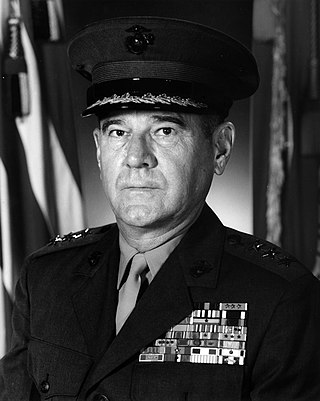
Leo John Dulacki was a highly decorated lieutenant general in the United States Marine Corps. During his 32 years of active service Dulacki held several important intelligence assignments including service in Moscow and Helsinki. He finished his career as director of personnel/deputy chief of staff for manpower at Headquarters Marine Corps.
Stephen A. Cheney is a retired United States Marine Corps Brigadier General who served for more than 30 years. He is a graduate of the United States Naval Academy, and held command positions at the Marine Corps Recruit Depots in San Diego and Parris Island, where he was Commanding General. He also served as Inspector General of the Marine Corps from 1997 to 1999, during which time he was also Deputy Inspector General for the Department of the Navy. He retired from active duty in 2001. Cheney currently serves on the American Security Project's board of directors, where he previously served as CEO.

William George Joslyn was a decorated officer in the United States Marine Corps with the rank of major general. A veteran of three wars, Joslyn distinguished himself in the Korean War and rose to the rank of general during the Vietnam War. He completed his career as commanding general, 2nd Marine Division.
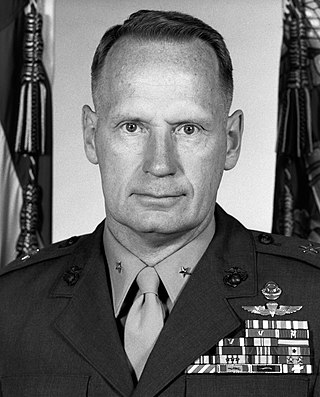
James Dale Beans is a retired officer of the United States Marine Corps with the rank of brigadier general. He is most noted for his service as the assistant chief of staff for Command, Control, Communications, and Computer, Intelligence and Interoperability Department and as director, Intelligence Division, Headquarters Marine Corps. He is the son of Brigadier General Fred D. Beans.
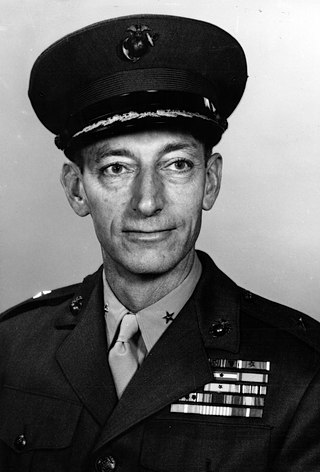
John Carroll Miller Jr. was a decorated officer in the United States Marine Corps with the rank of Brigadier general. A veteran of the Pacific War, he was wounded twice and received decorations for valor on Saipan and Okinawa. He remained in the Marines and retired as Brigadier general and Commanding general, Landing Force Training Command, Atlantic.

John Houghton Griebel was a decorated officer in the United States Marine Corps with the rank of Brigadier general. A veteran of Nicaraguan Campaign and Yangtze Patrol, he later distinguished himself as commanding officer, 5th Marine Regiment during the Battle of Okinawa.

Kenneth Wachter Benner was a decorated officer in the United States Marine Corps with the rank of Brigadier general. A graduate of the United States Naval Academy, he trained as Anti-Aircraft Artillery officer and participated in the Defense of Pearl Harbor, Guadalcanal Campaign and Battle of Okinawa.
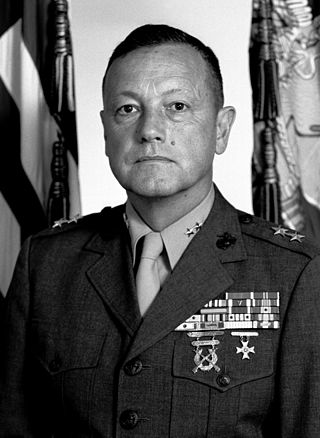
Stephen Goodwin Olmstead was a highly decorated officer in the United States Marine Corps with a rank of Lieutenant General. His last assignment was Deputy Assistant Secretary of Defense for Drug Policy and Enforcement and the Director of the Department of Defense Task Force on Drug Enforcement.

Michael S. Groen is a retired United States Marine Corps lieutenant general who last served as the Commander of the Joint Artificial Intelligence Center. Previously, he was the Deputy Chief of Computer Network Operations of the National Security Agency.

 United States of America
  United States Marine Corps
  Major general