Related Research Articles
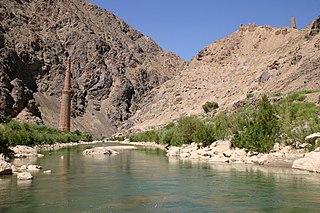
The Hari River or Herat River or Tejen River or Harirud is a river flowing 1,100 kilometres (680 mi) from the mountains of central Afghanistan to Turkmenistan, where it forms the Tejen oasis and disappears in the Karakum Desert. In its lower course, the river forms a northern part of the border between Afghanistan and Iran, and a southeastern part of the border between Turkmenistan and Iran.

Merv, also known as the Merve Oasis, was a major Iranian city in Central Asia, on the historical Silk Road, near today's Mary, Turkmenistan. Human settlements on the site of Merv existed from the 3rd millennium BC until the 18th century AD. It changed hands repeatedly throughout history. Under the Achaemenid Empire, it was the center of the satrapy of Margiana. It was subsequently ruled by the ancient Achaemenid, Macedonians, Seleucids, Parthians, Sasanians, Arabs, Ghaznavids, Seljuqs, Khwarazmians and Timurids, among others.

Turkmen is a Turkic language of the Oghuz branch spoken by the Turkmens of Central Asia. It has an estimated 4.3 million native speakers in Turkmenistan, and a further 719,000 speakers in northeastern Iran and 1.5 million people in northwestern Afghanistan, where it has no official status. Turkmen is also spoken to lesser varying degrees in Turkmen communities of Uzbekistan and Tajikistan and by diaspora communities, primarily in Turkey and Russia.
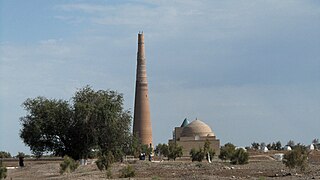
Daşoguz Region is one of the regions of Turkmenistan. It is in the north of the country, bordering Uzbekistan. The area of the province is 73,430 square kilometers, and the total population is 1,550,354. The capital is Daşoguz.

Magtymguly Pyragy, born Magtymguly, was a Turkmen spiritual leader, philosophical poet, Sufi and traveller who is considered the most famous figure in Turkmen literary history.

Sarakhs is a city in the Central District of Sarakhs County, Razavi Khorasan province, Iran, serving as capital of both the county and the district. Sarakhs was once a stopping point along the Silk Road, and in its 11th century heyday had many libraries. Much of the original city site is now just across the border at Serakhs in Turkmenistan.
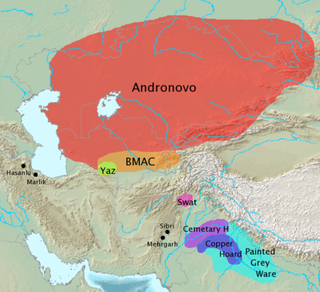
The Yaz culture was an early Iron Age culture of Margiana, Bactria and Sogdia. It emerges at the top of late Bronze Age sites (BMAC), sometimes as mud-brick platforms and sizeable houses associated with irrigation systems. Ceramics were mostly hand-made, but there was increasing use of wheel-thrown ware. Bronze and iron arrowheads, also iron sickles and carpet knives among other artifacts have been found.
Viktor Ivanovich Sarianidi or Victor Sarigiannides was a Soviet archaeologist. He discovered the remains of a Bronze Age culture in the Karakum Desert in 1976. The culture came to be known as the Bactria-Margiana Archaeological Complex.
Sarahs is an oasis city in Ahal Province, Turkmenistan, and the administrative center of Sarahs district. It is located at latitude 36°31' North; longitude 61°12' East and an elevation of 285m above sea level. It is one of the oases of the ancient Silk Road lying between Merv to the east and Mashhad to the west. In 1989 the city had a population of 9,585.
Sarahs District is a district of Ahal Province, Turkmenistan. Its capital is the city of Sarahs.

Gonur Depe is an archaeological site, dated from 2400 to 1600 BCE, and located about 60 km north of Mary, Turkmenistan consisting of a large early Bronze Age settlement. It is the "capital" or major settlement of the Bactria–Margiana Archaeological Complex (BMAC).
The Dauletabad–Sarakhs–Khangiran pipeline is a natural gas pipeline from the Dauletabad gas field in Turkmenistan to Khangiran in Iran, where it is connected with the Iran Gas Trunkline system. It is significant as it allows the diversification of Turkmenistan's gas export routes, doubling the nation's export of gas to Iran. For Iran, the pipeline allows the country to deal with gas shortages in its northern regions, and to improve its reputation as a trade partner in the Caspian region. Gas began pumping on 3 January 2010, and the pipeline was inaugurated in a ceremony in Turkmenistan on 6 January 2010.

Iranian Turkmens are a branch of Turkmen people living mainly in northern and northeastern regions of Iran. Their region is called Turkmen Sahra and includes substantial parts of Golestan Province of Iran. The number of Turkmens in Iran is estimated at 0.5 to 2.4 million people.
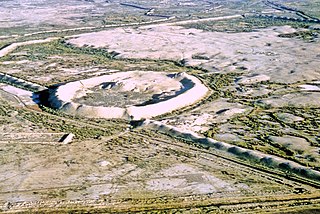
The South Turkmenistan Complex Archaeological Expedition (STACE), also called the South Turkmenistan Archaeological Inter-disciplinary Expedition of the Academy of Sciences of the Turkmen Soviet Socialist Republic (YuTAKE) was endorsed by the Turkmenistan Academy of Sciences. It was initially organized by the orientalist Mikhail Evgenievich Masson in 1946. The expedition had several excavations or "Brigades", based on sites and periods, and were spread over many years.

Citizens of all countries require a visa to enter Turkmenistan unless they have special passports. To obtain a tourist visa for Turkmenistan, all foreign citizens must supply an invitation letter issued by a travel agency licensed in Turkmenistan.
Ashgabat railway station is the main railway station in Ashgabat, Turkmenistan. It was originally built in 1888, but had to be rebuilt after an earthquake in 1948. The station is operated by the Türkmendemirýollary.
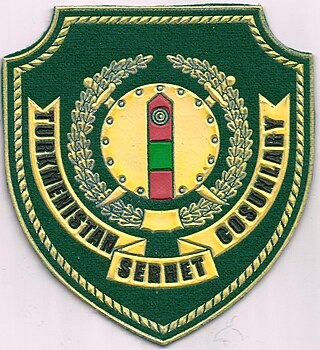
The State Border Service (SBS) (Turkmen: Döwlet Serhet Gullugy, DSG) also commonly known by its paramilitary force as the Turkmen Border Troops (Türkmenistan Serhet Garawul) is a border guard agency of the Armed Forces of Turkmenistan. It is currently a public service department of the government of the country and is under the command of the Ministry for National Security of Turkmenistan.
Berdysyčran-depe is an ancient Bronze Age settlement located in the former delta of Tejen River, 60 km south of Tejen (city), Turkmenistan.
Barbara Kaim is a Polish archaeologist, professor at the Faculty of Archaeology University of Warsaw. Her research focuses on the Achaemenid, Parthian and Sasanian periods in Iran and Central Asia.

Khone-ye Div – An archaeological site located in Iran, in the Razavi Khorasan Province. It is located on top of a rocky spur, in the Rivand mountain range, in the watershed of the river of the same name
References
- ↑ Kaim, B. (2003). "Ancient Fire Tempels in the Light of the Discovery at Mele Hairam". Iranica Antiqua. 29: 321–322.
- ↑ Kaim, B. (2011). "Historical and cultural sites of Turkmenistan: discoveries, researches and restoration for 20 years of independence". In Mamedov, M., Muradov, R. G. (eds.). Victorious fire at Mele Hairam. Turkmen state publishing service. pp. 303–335.
- ↑ Kaim, B. (2002). "Un temple du feu Sassanide découvert à Mele Hairam, Turkmenistan Méridional". Studia Iranica. 31 (2): 215–230.