
Augustus Welby Northmore Pugin was an English architect, designer, artist and critic with French and Swiss origins. He is principally remembered for his pioneering role in the Gothic Revival style of architecture. His work culminated in designing the interior of the Palace of Westminster in Westminster, London, and its iconic clock tower, later renamed the Elizabeth Tower, which houses the bell known as Big Ben. Pugin designed many churches in England, and some in Ireland and Australia. He was the son of Auguste Pugin, and the father of Edward Welby Pugin and Peter Paul Pugin, who continued his architectural firm as Pugin & Pugin.
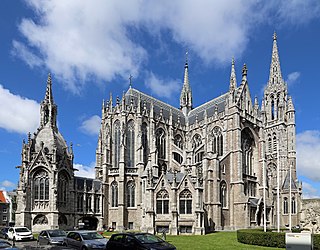
Gothic Revival is an architectural movement that began in the late 1840s in England. The movement gained momentum and expanded in the first half of the 19th century, as increasingly serious and learned admirers of the neo-Gothic styles sought to revive medieval Gothic architecture, intending to complement or even supersede the neoclassical styles prevalent at the time. Gothic Revival draws upon features of medieval examples, including decorative patterns, finials, lancet windows, and hood moulds. By the middle of the 19th century, Gothic Revival had become the preeminent architectural style in the Western world, only to fall out of fashion in the 1880s and early 1890s.

Queen's University Belfast officially the Queen's University of Belfast, is a public research university in Belfast, Northern Ireland, United Kingdom. The university received its charter in 1845 as "Queen's College, Belfast" and opened four years later.

The Royal Courts of Justice, commonly called the Law Courts, is a court building in Westminster which houses the High Court and Court of Appeal of England and Wales. The High Court also sits on circuit and in other major cities. Designed by George Edmund Street, who died before it was completed, it is a large grey stone edifice in the Victorian Gothic Revival style built in the 1870s and opened by Queen Victoria in 1882. It is one of the largest courts in Europe. It is a Grade I listed building.

Victorian architecture is a series of architectural revival styles in the mid-to-late 19th century. Victorian refers to the reign of Queen Victoria (1837–1901), called the Victorian era, during which period the styles known as Victorian were used in construction. However, many elements of what is typically termed "Victorian" architecture did not become popular until later in Victoria's reign, roughly from 1850 and later. The styles often included interpretations and eclectic revivals of historic styles (see Historicism). The name represents the British and French custom of naming architectural styles for a reigning monarch. Within this naming and classification scheme, it followed Georgian architecture and later Regency architecture, and was succeeded by Edwardian architecture.
The architecture of Ireland is one of the most visible features in the Irish countryside – with remains from all eras since the Stone Age abounding. Ireland is famous for its ruined and intact Norman and Anglo-Irish castles, small whitewashed thatched cottages and Georgian urban buildings. What are unaccountably somewhat less famous are the still complete Palladian and Rococo country houses which can be favourably compared to anything similar in northern Europe, and the country's many Gothic and neo-Gothic cathedrals and buildings.
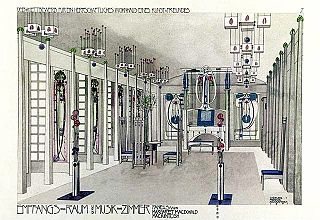
Interior architecture is the design of a building or shelter from inside out, or the design of a new interior for a type of home that can be fixed. It can refer to the initial design and plan used for a building's interior, to that interior's later redesign made to accommodate a changed purpose, or to the significant revision of an original design for the adaptive reuse of the shell of the building concerned. The latter is often part of sustainable architecture practices, whereby resources are conserved by "recycling" a structure through adaptive redesign.

The Albert Memorial Clock is a clock tower situated at Queen's Square in Belfast, Northern Ireland. It was completed in 1869 and is one of the best known landmarks of Belfast.

Sir Charles Lanyon DL, JP was an English architect of the 19th century. His work is most closely associated with Belfast, Northern Ireland.
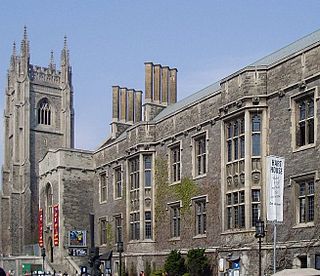
Gothic Revival architecture in Canada is an historically influential style, with many prominent examples. The Gothic Revival was imported to Canada from Britain and the United States in the early 19th century, and rose to become the most popular style for major projects throughout the late 19th and early 20th centuries.

Queen's Quarter is the southernmost quarter in Belfast, Northern Ireland and named after Queen's University Belfast, Northern Ireland's largest university. The Quarter is centred on the Lanyon Building, the University's most prominent building, designed by architect Sir Charles Lanyon, while Botanic Avenue, Stranmillis Road, University Road and Malone Road are the main thoroughfares through the area. The Quarter encompasses a region bounded by the Ormeau Road, the Holylands and Stranmillis Embankment to the east and the Lisburn Road to the west.

The buildings and structures of Belfast, Northern Ireland comprise many styles of architecture ranging from Edwardian through to state-of-the-art modern buildings like the Waterfront Hall. The city's beautiful Edwardian buildings are notable for their display of a large number of sculptures. Many of Belfast's Victorian landmarks, including the main Lanyon Building at Queens University in 1849, were designed by Sir Charles Lanyon.

William Joseph Barre was a prolific Irish architect who built many well known buildings in Belfast in a Gothic Revival style, but was always overshadowed by his great rival, Charles Lanyon.

William Henry Lynn (1829–1915) was an Irish-born architect with a practice in Belfast and the north of England. He is noted for his Ruskinian Venetian Gothic public buildings, which include Chester Town Hall and Barrow-in-Furness Town Hall.
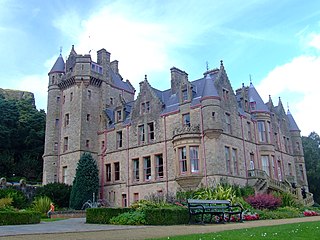
Lanyon, Lynn & Lanyon, Civil Engineers and Architects was a 19th-century firm working mainly in Dublin and Belfast, and the leading architectural firm in Belfast during the 1860s. Its partners were Charles Lanyon, William Henry Lynn, and Charles' son John Lanyon.

John Tarring FRIBA (1806–1875) was an English Victorian ecclesiastical architect active in the mid-nineteenth century. Based in London, he designed many Gothic Revival churches for Nonconformist clients.
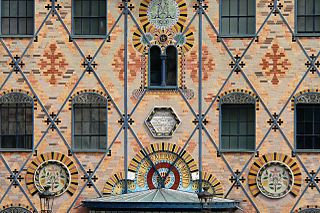
Polychrome brickwork is a style of architectural brickwork wherein bricks of different colours are used to create decorative patterns or highlight architectural features in the walls of a building. Historically it was used in the late Gothic period in Europe, and the Tudor period in England, and was revived in Britain in the 1850s as a feature of Gothic Revival architecture. Later in the 19th century and into the early 20th century it was adopted in various forms in Europe for all manner of buildings such as French eclectic villas, Dutch row houses, and German railway stations, and as far away as Melbourne, Australia, where the technique reached heights of popularity and elaboration in the 1880s.
The architecture of Belfast comprises architectural styles ranging from Georgian through to modernist buildings such as the Waterfront Hall and Titanic Belfast. The city's Victorian and Edwardian buildings are notable for their display of a large number of sculptures. Many of Belfast's Victorian era landmarks, including the main Lanyon Building at Queens University, were designed by Sir Charles Lanyon.


