Related Research Articles
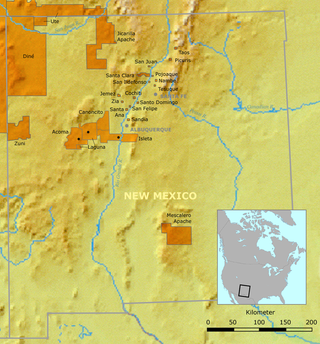
The Puebloans,or Pueblo peoples,are Native Americans in the Southwestern United States who share common agricultural,material,and religious practices. Among the currently inhabited Pueblos,Taos,San Ildefonso,Acoma,Zuni,and Hopi are some of the most commonly known. Pueblo people speak languages from four different language families,and each Pueblo is further divided culturally by kinship systems and agricultural practices,although all cultivate varieties of corn (maize).

The Hopi are Native Americans who primarily live in northeastern Arizona. The majority are enrolled in the Hopi Tribe of Arizona and live on the Hopi Reservation in northeastern Arizona;however,some Hopi people are enrolled in the Colorado River Indian Tribes of the Colorado River Indian Reservation at the border of Arizona and California.

A kachina is a spirit being in the religious beliefs of the Pueblo people,Native American cultures located in the south-western part of the United States. In the Pueblo cultures,kachina rites are practiced by the Hopi,Hopi-Tewa and Zuni peoples and certain Keresan tribes,as well as in most Pueblo tribes in New Mexico.

The Southwestern United States,also known as the American Southwest or simply the Southwest,is a geographic and cultural region of the United States that includes Arizona and New Mexico,along with adjacent portions of California,Colorado,Nevada,Oklahoma,Texas,and Utah. The largest cities by metropolitan area are Phoenix,Las Vegas,El Paso,Albuquerque,and Tucson. Before 1848,in the historical region of Santa Fe de Nuevo México as well as parts of Alta California and Coahuila y Tejas,settlement was almost non-existent outside of Nuevo México's Pueblos and Spanish or Mexican municipalities. Much of the area had been a part of New Spain and Mexico until the United States acquired the area through the Treaty of Guadalupe Hidalgo in 1848 and the smaller Gadsden Purchase in 1854.
Hopi is a Uto-Aztecan language spoken by the Hopi people of northeastern Arizona,United States.

Nampeyo was a Hopi-Tewa potter who lived on the Hopi Reservation in Arizona. Her Tewa name was also spelled Num-pa-yu,meaning "snake that does not bite". Her name is also cited as "Nung-beh-yong," Tewa for Sand Snake.

Kenneth Locke Hale,also known as Ken Hale,was an American linguist at the Massachusetts Institute of Technology who studied a huge variety of previously unstudied and often endangered languages—especially indigenous languages of North America and Australia. Languages investigated by Hale include Navajo,O'odham,Warlpiri,and Ulwa.

Jesse Walter Fewkes was an American anthropologist,archaeologist,writer,and naturalist.

The Hopi Reservation is a Native American reservation for the Hopi and Arizona Tewa people,surrounded entirely by the Navajo Nation,in Navajo and Coconino counties in northeastern Arizona,United States. The site has a land area of 2,531.773 sq mi (6,557.262 km2) and,as of the 2020 census had a population of 7,791.

The Awatovi Ruins,spelled Awat'ovi in recent literature,are an archaeological site on the Hopi Reservation in northeastern Arizona,United States. The site contains the ruins of a pueblo estimated to be 500 years old,as well as those of a 17th-century Spanish mission. It was visited in the 16th century by members of Francisco Vázquez de Coronado's exploratory expedition. In the 1930s,Hopi artist Fred Kabotie was commissioned by the Peabody Museum of Archaeology and Ethnology of Harvard University to reproduce the prehistoric murals found during the excavation of the Awatovi Ruins. The site was designated a National Historic Landmark in 1964.
Emory Sekaquaptewa was a Hopi leader and scholar from the Third Mesa village of Hotevilla. Known as the "First Hopi" or "First Indian," he is best known for his role in compiling the first dictionary of the Hopi language. He became assistant professor,Department of Anthropology,University of Arizona in 1972,and was Professor in its Bureau of Applied Research in Anthropology from 1990 to 2007. Emory received the 4th Annual Spirit of the Heard Award by the Heard Museum in October 2007.

Hopi Dictionary/Hopìikwa Lavàytutuveni:A Hopi–English Dictionary of the Third Mesa Dialect is a Hopi–English bilingual dictionary compiled by the Hopi Dictionary Project,a research team based at the Bureau of Applied Research in Anthropology at the University of Arizona. It was published in 1998 by the University of Arizona Press.
Hartman H. Lomawaima was a Hopi museum director. He served as the fifth director of the Arizona State Museum,and was the first Native American to hold the position. He also was the first Native American to hold a position as director of a state agency in Arizona,and was on the board of trustees for the Smithsonian's National Museum of the American Indian in Washington,D.C.

Charles Sequevya Loloma was a Hopi Native American artist known for his jewelry. He also worked in pottery,painting and ceramics.

Fendlera rupicola,commonly known as the cliff fendlerbush or the false mockorange,is a shrub that grows in dry locations in the south central mountain regions of North America.
Ekkehart Malotki is a German-American linguist,known for his extensive work on the documentation of the Hopi language and culture,specifically for his refutation of the myth that the Hopi have no concept of time. He is professor emeritus at Northern Arizona University. He studied with philosopher and linguist Helmut Gipper at the Westfälische Wilhelms-Universität at Münster and his early work was a continuation of his mentor's. Malotki conducted four years of research on the Third Mesa,studying Hopi spatial and temporal reference. He published two large volumes,one in German,Hopi-Raum and one in English,Hopi Time. Subsequently,he published a large number of texts and myths in the Hopi language. His work has been described as beginning a new phase of ethnographic study in which Hopi discourse was made available in their own language. He was also a principal data constructer and co-editor of the Hopi Dictionary:Hopìikwa Lavàytutuveni,and he supplied the Hopi subtitles for the Qatsi trilogy.
Matthew Sakiestewa Gilbert is a distinguished associate professor in the department of history and a Dean's Fellow and Conrad Humanities Scholar in the College of Liberal Arts and Sciences at the University of Illinois at Urbana-Champaign. He is an enrolled member of the Hopi Tribe. A graduate of The Master's College,Talbot School of Theology,and the University of California,Riverside,Gilbert specializes in researching and teaching on Native American history and the American West.

Iva Casuse Honwynum is a Hopi/Navajo artist,social activist,and cultural practitioner. A Native American,Honwynum is best known for her woven baskets and figurative sculpture. Honwynum's most important breakthrough was the development of the pootsaya basket,called "a rare innovation in Hopi basketry". She developed the pootsaya during her 2014 residency at the School for Advanced Research in Santa Fe,New Mexico,having been awarded the Eric and Barbara Dookin Artist Fellowship.
Thomas E. Sheridan is an anthropologist of Sonora,Mexico and the history and culture of Arizona and the Southwest. He was selected a Distinguished Outreach Professor at the University of Arizona,and has been affiliated with the Department of Anthropology and the Southwest Center since 2003.
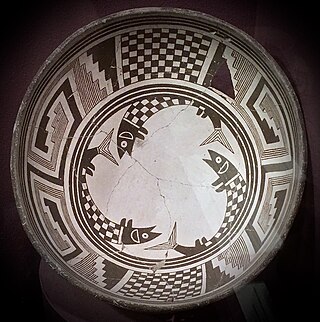
Pueblo pottery are ceramic objects made by the Indigenous Pueblo people and their antecedents,the Ancestral Puebloans and Mogollon cultures in the Southwestern United States and Northern Mexico. For centuries,pottery has been central to pueblo life as a feature of ceremonial and utilitarian usage. The clay is locally sourced,most frequently handmade,and fired traditionally in an earthen pit. These items take the form of storage jars,canteens,serving bowls,seed jars,and ladles. Some utility wares were undecorated except from simple corrugations or marks made with a stick or fingernail,however many examples for centuries were painted with abstract or representational motifs. Some pueblos made effigy vessels,fetishes or figurines. During modern times,pueblo pottery was produced specifically as an art form to serve an economic function. This role is not dissimilar to prehistoric times when pottery was traded throughout the Southwest,and in historic times after contact with the Spanish colonialists.
References
- 1 2 3 "Dr. Loma Ishii". Native American Science Curriculum. Retrieved 20 December 2018.
- 1 2 3 4 5 6 7 8 "Keynote Speaker – Dr. Lomayumtewa C. Ishii". Arrows of Time. 2017-07-25. Retrieved 20 December 2018.
- ↑ Šumi, Irena; Wilson, Thomas M.; Donnan, Hastings (2005). "Natives, newcomers and others: Metalepsis of belonging in the borderland of Val Canale, Italy" in Culture and Power at the Edges of the State: National Support and Subversion in European Border Regions. Münster: LIT Verlag. p. 124. ISBN 9783825875695.
- ↑ "Irving High School Class of 78" . Retrieved 21 December 2018.
- ↑ "Phi Alpha Theta Initiates". The Historian. 57 (1): 209–244. 1994. doi:10.1111/j.1540-6563.1994.tb01342.x. JSTOR 24449244.
- 1 2 3 4 Sakiestewa Gilbert, Matthew (18 May 2010). "Tenure and promotion awarded to Hopi historian". Beyond the Mesas. Retrieved 21 December 2018.
- ↑ "Welcome to the Fourth Annual Hawaii International Conference on Arts and Humanities" (PDF). Retrieved 21 December 2018.
- ↑ "NAU Faculty Awards 2010" . Retrieved 21 December 2018.
- ↑ "30TH AMERICAN INDIAN WORKSHOP Transgressing Borders – Defining Boundaries Identity, Emotion, and Politics in Indian Country" (PDF). Retrieved 21 December 2018.
- ↑ Johnson, Jennifer A. "Apache leaders: Spirits, acorns make land proposed for copper mine sacred". Tucson Sentinel. Retrieved 21 December 2018.
- ↑ Fonseca, Felicia. "Two Vie To Lead Hopi Tribe that Is in Political Turmoil". Albuquerque Journal. Retrieved 21 December 2018.