Contents

This is a list of swimming pools in Hungary.
This is a list of swimming pools in Hungary.
| Image | Pool | City | Length | Team | Capacity | Inaugurated | Notes |
|---|---|---|---|---|---|---|---|
 | Alfréd Hajós National Swimming Stadium's three swimming pools *Indoor (1930) *Outdoor (1937) *Tamás Széchy outdoor (c.2006) | Budapest | ? ? 50 m | Hungary men's national water polo team , Hungary women's national water polo team , UVSE | 1930 1937 2006 | The swimming pools and related diving facilities have been expanded and improved several times. [1] [2] Renovations c.2006 before the 2006 European Championship added outdoor 50-meter pool and diving pool, named after Tamás Széchy. Total of indoor and outdoor pools, including for diving, was then eight. | |
 | Danube Arena's swimming pools *Long *Long *Short | Budapest | 50 m 50 m 25 m | 5,000 | 2017 | Indoor | |
 | Debrecen Swimming Pool Complex's swimming pool | Debrecen | 50 m | 2,000 | 2006 | indoor | |
  | Rudas Baths' swimming pool | Budapest | 21.5 m [3] | 1896 [4] | indoor | ||
 | Gellért Baths's swimming pool | Budapest | 246 square metres (2,650 sq ft) surface area [5] | c.1912-18 [6] | indoor | ||
 | Lukács Baths's men's and women's swimming pools | Budapest | outdoor | ||||
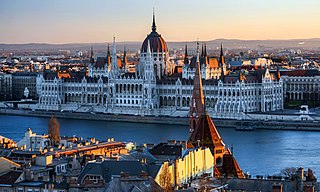
Budapest is the capital and most populous city of Hungary. It is the ninth-largest city in the European Union by population within city limits and it was the largest city on the Danube river; today it is the second largest one. The city has an estimated population of 1,752,286 over a land area of about 525 square kilometres. Budapest, which is both a city and municipality, forms the centre of the Budapest metropolitan area, which has an area of 7,626 square kilometres and a population of 3,303,786. It is a primate city, constituting 33% of the population of Hungary.

Mezőkövesd is a town in Borsod-Abaúj-Zemplén county, Northern Hungary. It lies 50 km (31 mi) from Miskolc and 15 km (9 mi) from Eger.
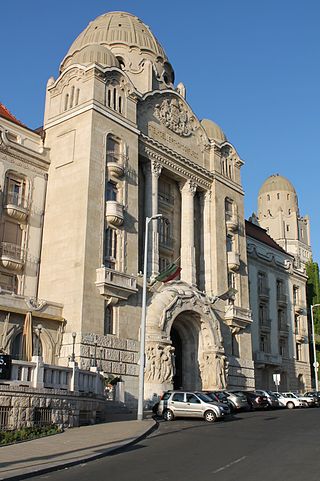
The Gellért Thermal Bath, also known as the Gellért Baths, is a bath complex in Budapest in Hungary. It is part of the famous Hotel Gellért in Buda.

Miskolctapolca or Miskolc-Tapolca is a suburb of Miskolc, and is one of the most popular tourist towns of Hungary. Not to be confused with Tapolca town in Veszprém County.

Elisabeth Bridge is the third newest bridge of Budapest, Hungary, connecting Buda and Pest across the River Danube. The bridge is situated at the narrowest part of the Danube in the Budapest area, spanning only 290 m. It is named after Elisabeth of Bavaria, a popular queen and empress of Austria-Hungary, who was assassinated in 1898. Today, her large bronze statue sits by the bridge's Buda side connection in the middle of a small garden.
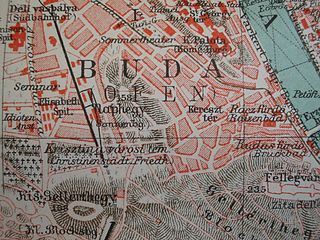
The Tabán usually refers to an area within the 1st district of Budapest, the capital of Hungary. It lies on the Buda side of the Danube, to the south of György Dózsa Square, on the northern side of Elisabeth Bridge and to the east of Naphegy. Several other Hungarian cities and towns also have districts called Tabán.

The Széchenyi Medicinal Bath in Budapest is the largest medicinal bath in Europe. Its water is supplied by two thermal springs, their temperatures being 74 °C (165 °F) and 77 °C (171 °F) respectively.

Rudas Bath or Rudas fürdő is a thermal bath in Budapest, Hungary which is claimed to have medicinal properties. It was founded in 1571/1572 during the time of Ottoman rule. To date, it retains many of the key elements of a Hammam, exemplified by its Ottoman dome and octagonal pool. It is located at Döbrentei tér 9 on the Buda side of Erzsébet Bridge. The bath has six therapy pools and one swimming pool where the temperature is in between 10 and 42 °C. The components of slightly radioactive thermal water includes sulfate, calcium, magnesium, bicarbonate and a significant amount of fluoride ion. A sight-seeing brochure claims the water can help to treat degenerative joint illnesses, chronic and sub-acute joint inflammations, vertebral disk problems, neuralgia and lack of calcium in the bone system.

The Hotel Gellért is a historic Art Nouveau hotel established in 1918 and located on the west bank of the Danube in Budapest, Hungary.

Central Hungary is one of the seven statistical regions in Hungary. It includes Budapest and Pest County.

The Gellért Hill Cave is part of a network of caves within Gellért Hill in Budapest, Hungary. The cave is also referred to as "Saint Ivan's Cave", regarding a hermit who lived there and is believed to have used the natural thermal water of a muddy lake next to the cave to heal the sick. It is likely that this same water fed the pools of the old Sáros fürdő, now called Gellért Baths.
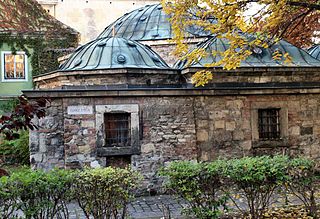
Király Bath or Király fürdő was a thermal bath that was built in Hungary between 1566-1572, during the time of Ottoman rule. It was commissioned by Sokollu Mustafa Pasha who was the longest-serving governor general (1566-1578) of the Ottoman province of Budin and who built similar baths at Rudas, Rác and Veli bej which are also operational in Budapest. The bath and its neighborhood then became part of the consolidated city of Budapest.

The Rác Thermal Bath, located in Budapest, Hungary, is an 8000-square metre bath and is renowned for its Turkish bath dating back to the 16th century, and its imperial pools and shower corridor built in the age of the Austro-Hungarian Monarchy. The bath is listed as a UNESCO World Heritage Site and is now part of the newly built complex of the Rác Hotel & Thermal Spa. Its name derives from an old Hungarian name for Serbs, one of the former inhabitants of diverse historical Tabán.

Rudas is a Hungarian word and surname, literally meaning "of rúd, pole-horse with carriage, wagon" :
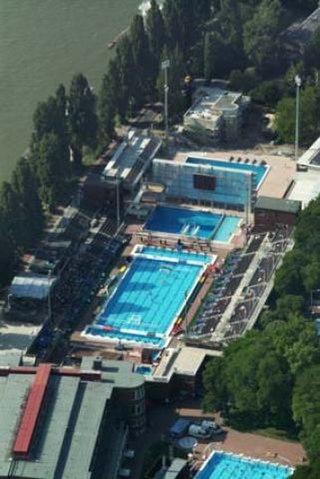
The Alfréd Hajós National Swimming Stadium is an aquatics complex located on Margaret Island in Budapest, Hungary.The facility has four floors, covers an area of about 80,000 square meters and has eight indoor and outdoor pools, including training pools, diving pools and competitive swimming pools both for short course and long course.

The Lukács Thermal Bath is a historic indoor/outdoor thermal bath spa in Budapest, Hungary, heated by natural hot springs. All pools and four saunas can be used by all guests except for the optional area of the sauna world, which contains five more saunas, ice cooling pool, igloo and heated roman bench.
Thermal baths or spas in Budapest are popular tourist attractions as well as public comforts for the city's residents.
Cinetrip and the sparties are bath parties in Budapest Cinetrip is a brand which has been organizing bath parties in several famous thermal baths of Budapest, Hungary. The first events were held in 1998, with silent films serving as visual backgrounds for the live electronic music.