Related Research Articles
This is a list of songs that have peaked at number one on the Billboard Hot 100 and the magazine's national singles charts that preceded it. Introduced in 1958, the Hot 100 is the pre-eminent singles chart in the United States, currently monitoring the most popular singles in terms of popular radio play, single purchases and online streaming.
Tina Charles is an English singer who achieved success as a disco artist in the mid to late 1970s. Her most successful single was the UK no. 1 hit "I Love to Love " in 1976.
Dance Club Songs was a chart published weekly between 1976 and 2020 by Billboard magazine. It used club disc jockeys set lists to determine the most popular songs being played in nightclubs across the United States.

"It Only Takes a Minute" is a 1975 song by American soul/R&B group Tavares, released as the first single from their third album, In the City (1975). The song was the group's only top-10 pop hit in the United States, peaking at number 10, and their second number one song on the American soul charts. On the US Disco chart, "It Only Takes a Minute" spent five weeks at number two and was the first of four entries on the chart. The song was subsequently covered by Jonathan King performing as 100 Ton and a Feather in 1976 and by boy band Take That in 1992.

"Since I Fell for You" is a blues ballad composed by Buddy Johnson in 1945 that was first popularized by his sister, Ella Johnson, with Buddy Johnson and His Orchestra.

"Murphy's Law," is the name of a single by the Canadian/American female dance music duo Chéri.
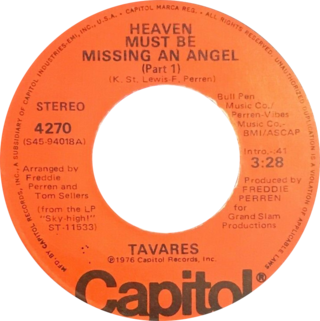
"Heaven Must Be Missing an Angel" is a disco song written by Freddie Perren and Keni St. Lewis. It was recorded by the American band Tavares in 1976. It was released as the first single from their fourth album, Sky High! (1976), and was split into two parts: the first part was 3 minutes and 28 seconds in length, while the second part was 3 minutes and 10 seconds. "Heaven Must Be Missing an Angel" was re-released in February 1986.

"Shame, Shame, Shame" is a 1974 hit song written by Sylvia Robinson, performed by American disco band Shirley & Company and released on the Vibration label. The female vocalist is Shirley Goodman, who was one half of Shirley & Lee, who had enjoyed a major hit 18 years earlier, in 1956, with the song "Let The Good Times Roll" for Aladdin Records. The male vocalist is Jesus Alvarez. The saxophone solo is by Seldon Powell, whose instrumental version, "More Shame", is the B-side.

"What Cha Gonna Do with My Lovin'" is a song by American singer and songwriter Stephanie Mills, released in July 1979 as the first single from the album of the same name (1979). It became a hit, reaching No. 22 on the US Billboard Hot 100. It was also a top 10 hit on the Billboard R&B chart, as well as a minor hit in Canada.
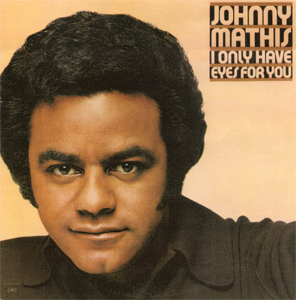
I Only Have Eyes for You is an album by American pop singer Johnny Mathis that was released on May 10, 1976, by Columbia Records and included two new songs, "Yellow Roses on Her Gown" and "Ooh What We Do", which was written specifically for him, as well as a contemporary arrangement of the 1934 title track that foreshadowed his recordings of standards that incorporated a disco beat a few years later.
Ace Spectrum was an American R&B, soul and disco musical group that was popular in the mid-1970s.
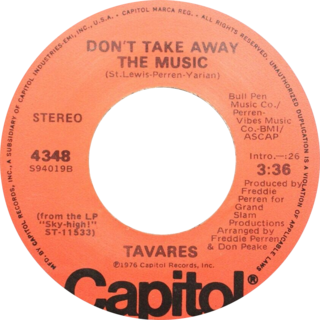
"Don't Take Away the Music" is a hit song by R&B/disco group Tavares, released in the fall of 1976. It peaked at number 34 on the US Billboard Hot 100 singles chart and at number four in the UK. Along with the track "Heaven Must Be Missing an Angel", the song spent two weeks at number 1 on the Hot Dance Club Play chart.
References
- Citations
- 1 2 Whitburn, Joel (2004). Billboard Hot Dance/Disco 1974-2003. Record Research. ISBN 0-89820-156-X.
- Sources
- Whitburn, Joel (2004), Joel Whitburn's Hot Dance/Disco 1974-2003, Menomonee Falls, WI: Record Research, ISBN 0-89820-156-X
- Some weeks may also be found at Billboard magazine courtesy of Google Books: 1975—1979.