
Olearia axillaris, commonly known as coastal daisy-bush, coast daisy-bush or coastal daisybush is a species of flowering plant in the family Asteraceae and is endemic to coastal areas of Australia. It is an erect, bushy shrub with densely cottony-hairy branchlets, aromatic, linear to narrowly elliptic or narrowly lance-shaped to egg-shaped leaves with the narrower end towards the base and small white and yellow, daisy-like inflorescences.

Eremophila willsii is a flowering plant in the figwort family, Scrophulariaceae and is endemic to Australia. It is an erect shrub with bright green, often serrated leaves and pinkish to deep pinkish-purple petals. It is mainly found in Western Australia, the Northern Territory and South Australia in deep sand.

Quoya dilatata is a flowering plant in the mint family Lamiaceae and is endemic to Western Australia. It is a low, spreading shrub with its branches and leaves densely covered with a layer of white, woolly hairs. The leaves are wrinkled or crinkly and the tube-shaped flowers are orange-red and hairy on the outside.

Pityrodia hemigenioides is a flowering plant in the mint family Lamiaceae and is endemic to the south-west of Western Australia. It is a spreading shrub with densely hairy branches and leaves, and pale white flowers near the ends of the branches.

Leucopogon tamminensis is a species of flowering plant in the heath family Ericaceae and is endemic to the southwest of Western Australia. It is a slender shrub with many branches, overlapping triangular to egg-shaped leaves and white, tube-shaped flower arranged singly in upper leaf axils.

Styphelia planifolia is a species of flowering plant in the heath family Ericaceae and is endemic to the south-west of Western Australia. It is a bushy shrub with narrowly oblong or lance-shaped leaves with a small, sharp point on the tip, and white, tube-shaped flowers.

Hibbertia desmophylla is a species of flowering plant in the family Dilleniaceae and is endemic to the south-west of Western Australia. It is a sprawling or erect, hairy shrub with spreading, densely clustered, linear leaves and yellow flowers with eleven to thirteen stamens.

Olearia exiguifolia commonly known as small-leaved daisy bush, is a species of flowering plant in the family Asteraceae and is endemic to south-western Australia. It is an erect or straggly shrub with broadly egg-shaped leaves with the narrower end towards the base, and white and yellow, daisy-like inflorescences.
Lasiopetalum laxiflorum is a species of flowering plant in the family Malvaceae and is endemic to the south-west of Western Australia. It is a sticky, straggling subshrub or shrub with many densely hairy stems, egg-shaped leaves, and bright pink and dark red flowers.
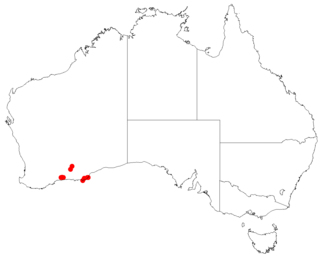
Leucopogon bossiaea is a species of flowering plant in the heath family Ericaceae and is endemic to a restricted area in the south-west of Western Australia. It is an erect shrub with elliptic to broadly egg-shaped leaves and white flowers in four to eleven upper leaf axils.

Leucopogon allittii is a species of flowering plant in the family Ericaceae and is endemic to the south-west of Western Australia. It is a rigid, glabrous shrub that typically grows to a height of about 30 cm (12 in) and has egg-shaped or lance-shaped leaves and tube-shaped, white flowers.

Leucopogon breviflorus is a species of flowering plant in the heath family Ericaceae and is endemic to the south-west of Western Australia. It is an erect, spindly, glabrous shrub that typically grows to a height of up to about 1.5 m. It has oblong to lance-shaped or linear leaves 4–9 mm (0.16–0.35 in) long on a short petiole and with a small, rigid point on the tip. The flowers are borne singly or in pairs in leaf axils on a short peduncle with small bracts and bracteoles about half as long as the sepals. The sepals are about 2 mm (0.079 in) long and the petals white and about 4 mm (0.16 in) long, the petal lobes longer than the petal tube.
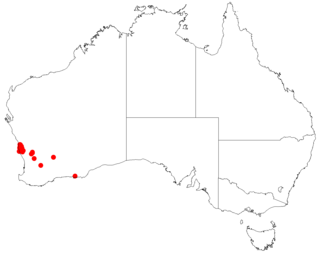
Leucopogon crassiflorus is a species of flowering plant in the heath family Ericaceae and is endemic to the south-west of Western Australia. It is an erect shrub with few branches and that typically grows to a height of 30–60 cm (12–24 in). Its leaves are broadly egg-shaped with the narrower end towards the base, to more or less round, 2–3 mm (0.079–0.118 in) long with a stem-clasping base. The flowers are borne singly or in pairs in upper leaf axils on a short peduncle, sometimes in small clusters, and with small bracts and bracteoles at the base. The sepals are about 4 mm (0.16 in) long and the petals about 6.5 mm (0.26 in) long, the petal lobes longer than the petal tube.

Leucopogon exolasius, commonly known as Woronora beard-heath, is a species of flowering plant in the heath family Ericaceae and is endemic to a small area of New South Wales. It is an erect shrub with oblong or elliptic leaves, and drooping, white, tube-shaped flowers.

Leucopogon opponens is a species of flowering plant in the heath family Ericaceae and is endemic to the south-west of Western Australia. It is an erect, slender shrub with its leaves arranged in opposite pairs, and white, tube-shaped flowers.
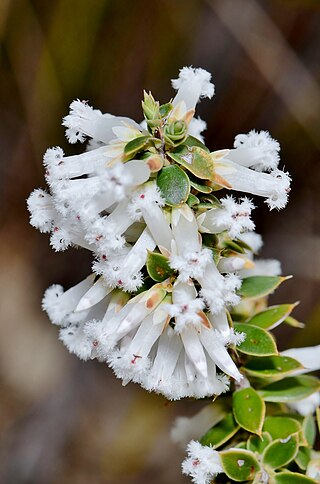
Leucopogon oxycedrus is a species of flowering plant in the heath family Ericaceae and is endemic to the south-west of Western Australia. It is an erect shrub with variably-shaped leaves with a small, sharp point on the tip, and white, pink or red, tube-shaped flowers.
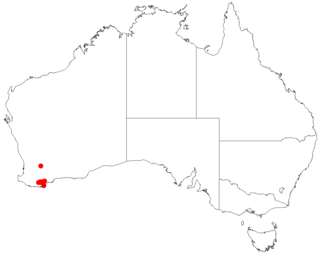
Leucopogon pogonocalyx is a species of flowering plant in the heath family Ericaceae and is endemic to a restricted part of the south-west of Western Australia. It is an erect shrub with wand-like branches. Its leaves are erect, egg-shaped, 4–6 mm (0.16–0.24 in) long with a rigid, sharply-pointed tip on the end. The flowers are borne in leaf axils in pairs or threes with bracts and broad bracteoles about one-third as long as the sepals. The sepals are about 2 mm (0.079 in) long with bearded edges, and the petals are about 4 mm (0.16 in) long, the petal lobes as long as the petal tube and densely bearded.

Leucopogon rotundifolius is a species of flowering plant in the heath family Ericaceae and is endemic to the south of Western Australia. It is an erect, bushy shrub with round or egg-shaped leaves, the narrower end towards the base, and white, tube-shaped flowers arranged in leaf axils in groups of 2 or 3.

Leucopogon strongylophyllus is a species of flowering plant in the heath family Ericaceae and is endemic to the southwest of Western Australia. It is an erect shrub with crowded egg-shaped or round leaves and white, tube-shaped flower arranged singly or in pairs in leaf axils.
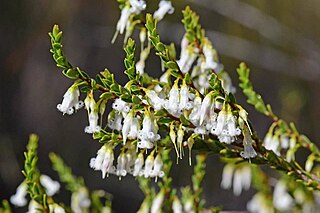
Leucopogon woodsii, commonly known as nodding beard-heath, is a species of flowering plant in the heath family Ericaceae and is endemic to southern continental Australia. It is a slender shrub with more or less erect, egg-shaped leaves, and pendent white, tube-shaped flowers with densely bearded lobes.


