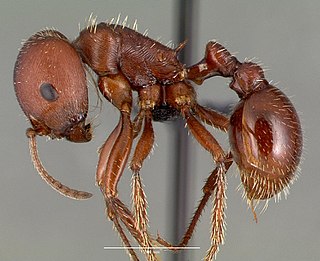
Pogonomyrmex is a genus of harvester ants, occurring primarily in the deserts of North, Central, and South America, with a single endemic species from Haiti.

The name army ant (or legionary ant or marabunta) is applied to over 200 ant species in different lineages. Because of their aggressive predatory foraging groups, known as "raids", a huge number of ants forage simultaneously over a limited area.

Leptanillinae is a subfamily of primitive ants consisting of three genera.
Leptanilla is a genus of ant in the subfamily Leptanillinae. Like other genera in this subfamily, the queen is fed by the hemolymph of their own larvae, which have specialized processes for this purpose.
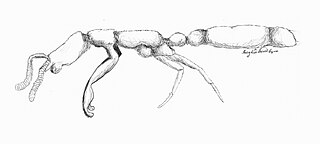
Leptanilla japonica is an uncommon highly migratory, subterranean ant found in Japan. They are tiny insects, with workers measuring about 1.2 mm and queens reaching to about 1.8 mm, and live in very small colonies of only a few hundred individuals at a time Its sexual development follows a seasonal cycle that affects the colony's migration and feeding habits, and vice versa. L. japonica exhibits specialized predation, with prey consisting mainly of geophilomorph centipedes, a less reliable food source that also contributes to their high rate of nest migration. Like ants of genera Amblyopone and Proceratium, the genus Leptanilla engages in larval hemolymph feeding (LHF), with the queen using no other form of sustenance. LHF is an advantageous alternative to the more costly cannibalism. Unlike any other ant, however, members of Leptanilla, including L. japonica, have evolved a specialized organ dubbed the “larval hemolymph tap” that reduces the damage LHF inflicts on the larvae. LHF has become this species' main form of nutrition.

Eulithomyrmex is an extinct genus of ant in the formicid subfamily Agroecomyrmecinae. The genus contains two described species, Eulithomyrmex rugosus and Eulithomyrmex striatus. Eulithomyrmex is known from a group of Late Eocene fossils which were found in North America.
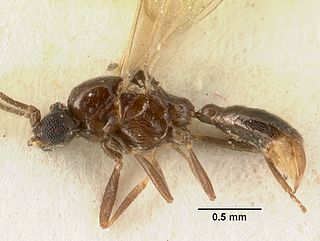
Yavnella is a genus of ants in the subfamily Leptanillinae. Its two species are distributed in India and Israel. The genus is known only from male specimens.

Anomalomyrma is an Asian genus of ants in the subfamily Leptanillinae. The genus was originally described in 1990 with the type species Anomalomyrma taylori, based on a single dealate queen from Borneo. Workers were unknown until 2011, when two new species were described from Peninsular Malaysia and the Philippines.

Protanilla is a genus of subterranean ants in the subfamily Leptanillinae. Known from the Indomalayan realm, the genus contains about thirteen species. The genus was erected by Taylor (1990) for the type species P. rafflesi, described from workers from Peninsular Malaysia. Species in this genus have long and downcurved mandibles with peg-like tooth on the inner margins. Four species are known from China, one from Taiwan, one from Sri Lanka and a couple from India.

Euprenolepis is a Southeast Asian genus of ants in the subfamily Formicinae with eight recognized species.
Leptanillini is a tribe of Leptanillinae ants with two extant genera.
Protanilla furcomandibula, formerly Furcotanilla furcomandibula, is a species of ant in the subfamily Leptanillinae. It is only known from Yunnan, China, where it nests in the soil and forages on the ground. Queens and males are unknown.
Yavnella argamani is a species of ant belonging to the Yavnella ant genus. Described by Kugler in 1987, it is one of the two species in its genus. It is native to Israel.

Yavnella indica is a species of ant belonging to the Yavnella ant genus. The species was described by Kugler in 1987, it is one of the two species in its genus. It is native to India.

Leptanilla copiosa is a species of ant in the subfamily Leptanillinae, first described by Petersen in 1968 as Noonilla copiosa based on a male specimen from the Philippines. Noonilla was initially placed in the subfamily Leptanillinae, but was later removed from the subfamily when Ogata, Terayama & Masuko (1995) reviewed the genus, leaving the genus incertae sedis in the family. It was later readded to Leptanillinae.

Leptanilla swani is a species of ant in the genus Leptanilla. Described by William Morton Wheeler in 1932, the species is endemic to Australia, and one of only two species of the genus Leptanilla to be found there. Workers are pale in colour, measuring 1.3 to 5 millimetres while queens are larger at 2 millimetres (0.079 in) long.

Leptanilla macauensis is a species of ant in the genus Leptanilla. Chi-Man Leong, an undergraduate student at National Taiwan University at the time, first collected specimens of this species. The species was subsequently formally described by Leong, Yamane & Guénard in 2018, the species is only known from specimens collected from Macau by means of a Winkler extractor. Workers are yellowish brown in colour, measuring 1.12 to 1.14 millimetres. The queen has yet to be described.

Leptanilla havilandi is a species of ant in the subfamily Leptanillinae. The species can be found in Singapore and Malaysia.

Leptanilla voldemort is a species of ant in the genus Leptanilla and was described in 2024.


