Most cited articles
 | This section is empty. You can help by adding to it. (November 2021) |
Laurence M. Ball | |
|---|---|
| Born | March 19, 1959 |
| Nationality | American |
| Occupation(s) | economist, college educator |
| Years active | 1986-present |
| Known for | macroeconomics, New Keynesian Economic Theory |
| Academic background | |
| Alma mater | Amherst College Massachusetts Institute of Technology |
| Academic work | |
| Institutions | New York University Princeton University Johns Hopkins University |
Laurence M. Ball (born March 19,1959) is an American economist,Professor and Chairman of the Economics Department at the Zanvyl Krieger School of Arts and Sciences of Johns Hopkins University in Baltimore,Maryland. He is a specialist in the field of macroeconomics. [1] [2] [3]
Born in Boston,Massachusetts, [3] he attended Groveton High School in Fairfax County,Virginia [ citation needed ] and received a Bachelor of Arts degree in economics in 1980 from Amherst College,then a Doctor of Economics degree in 1986 from the Massachusetts Institute of Technology,where he was the recipient of graduate fellowships from the National Science Foundation (1981–1982,1983–1985). [3] He was assistant professor of economics at the Graduate School of Business Administration at New York University from 1985 to 1989 and assistant professor of economics at Princeton University from 1989 to 1994. [3] He was appointed professor of economics at Johns Hopkins University in 1994 and was department chairman from 2015 to 2019. [3] He was Professorial Fellow in Monetary Economics,Victoria University of Wellington and Reserve Bank of New Zealand in 1996 and a visiting professor of economics at Harvard University in the autumn of 2008. [3] He received a Houblon-Norman Fellowship from the Bank of England in 2000–2001 and a Wim Duisenberg Fellowship from the European Central Bank in 2019. [3]
He has been a visiting scholar at reserve banks in numerous countries,including the Federal Reserve Bank of Philadelphia (1991–1993),the Bank of Italy (1993),the US Federal Reserve Board of Governors (1993,1996,1999,2008),the Federal Reserve Bank of Kansas City (1995–2000),the Reserve Bank of Australia (1996–1997),the Central Bank of Norway (1999),the Bank of Japan (2002),the Hong Kong Monetary Authority (2001–2002),and the Federal Reserve Bank of Boston (2009). [3] [4]
Ball is a research associate at the National Bureau of Economic Research, [3] an Honorary Senior Fellow at the Rimini Centre for Economic Analysis, [5] a visiting scholar in the Research Department of the International Monetary Fund,and an Honorary Senior Fellow of the International Centre for Economic Analysis. [3]
He became an associate editor for the magazine Open Economies Review in 2009,has authored 4 books and more than 50 articles and papers on economics. [3] His 2010 book The Fed and Lehman Brothers:Setting the Record Straight on a Financial Disaster was harshly critical of the Federal Reserve and its role in the collapse of Lehman Brothers during the economic crisis of 2008. [6] [7] [8]
His current research is focused on the long term effects of the Great Recession and the case being made for raising central banks inflation targets to four percent. [9]
| | This section is empty. You can help by adding to it. (November 2021) |

Stanley Fischer is an Israeli-American economist who served as the 20th vice chair of the Federal Reserve from 2014 to 2017. Fischer previously served as the 8th governor of the Bank of Israel from 2005 to 2013. Born in Northern Rhodesia, he holds dual citizenship in Israel and the United States. He previously served as First Deputy Managing Director of the International Monetary Fund and as Chief Economist of the World Bank. On January 10, 2014, President Barack Obama nominated Fischer to the position of Vice Chair of the Federal Reserve. He is a senior advisor at BlackRock. On September 6, 2017, Stanley Fischer announced that he was resigning as Vice-Chair for personal reasons effective October 13, 2017, two days before his 74th birthday.
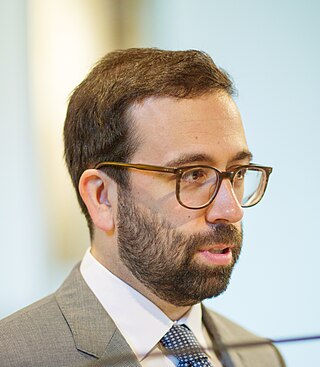
Ricardo A. M. R. Reis is a Portuguese economist and the A. W. Phillips professor of economics at the London School of Economics. He has published widely on macroeconomics, including both monetary and fiscal policy, inflation and business cycles, and for these he won the 2021 Yrjö Jahnsson Foundation medal awarded every two years by the European Economic Association for best economist under the age of 45. He writes a weekly op-ed for the Portuguese newspaper Expresso.

John Brian Taylor is the Mary and Robert Raymond Professor of Economics at Stanford University, and the George P. Shultz Senior Fellow in Economics at Stanford University's Hoover Institution.
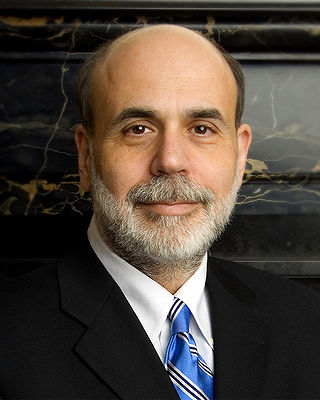
Ben Shalom Bernanke is an American economist who served as the 14th chairman of the Federal Reserve from 2006 to 2014. After leaving the Federal Reserve, he was appointed a distinguished fellow at the Brookings Institution. During his tenure as chairman, Bernanke oversaw the Federal Reserve's response to the 2007–2008 financial crisis, for which he was named the 2009 Time Person of the Year. Before becoming Federal Reserve chairman, Bernanke was a tenured professor at Princeton University and chaired the Department of Economics there from 1996 to September 2002, when he went on public service leave. Bernanke was awarded the 2022 Nobel Memorial Prize in Economic Sciences, jointly with Douglas Diamond and Philip H. Dybvig, "for research on banks and financial crises", more specifically for his analysis of the Great Depression.
Peter Bain Kenen was an American economist, who was the Walker Professor of Economics and International Finance at Princeton University, and senior fellow in international economics at the Council on Foreign Relations.

Timothy Jerome Kehoe is an American economist and professor at the University of Minnesota. His area of specialty is macroeconomics and international economics.

Frederic Stanley "Rick" Mishkin is an American economist and Alfred Lerner professor of Banking and Financial Institutions at the Graduate School of Business, Columbia University. He was a member of the Federal Reserve Board of Governors from 2006 to 2008.

Randall S. Kroszner is an American economist who served as a member of the Federal Reserve Board of Governors from 2006 to 2009. Kroszner chaired Fed's board Committee on Supervision and Regulation of Banking Institutions during the 2007–2008 financial crisis. He has been professor of economics at the University of Chicago since the 1990s, with various leaves, and named Norman R. Bobins Professor of Economics at the University of Chicago Booth School of Business in 2009, and serves as a senior advisor for Patomak Partners.

William Arnold Barnett is an American economist, whose current work is in the fields of chaos, bifurcation, and nonlinear dynamics in socioeconomic contexts, econometric modeling of consumption and production, and the study of the aggregation problem and the challenges of measurement in economics.
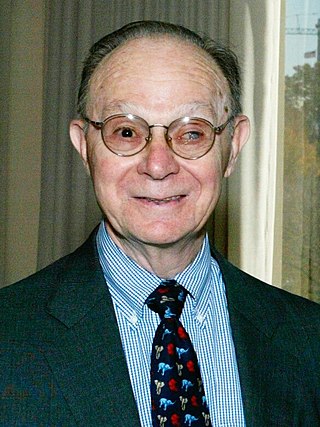
Allan H. Meltzer was an American economist and Allan H. Meltzer Professor of Political Economy at Carnegie Mellon University's Tepper School of Business and Institute for Politics and Strategy in Pittsburgh, Pennsylvania. Meltzer specialized on studying monetary policy and the US Federal Reserve System, and authored several academic papers and books on the development and applications of monetary policy, and about the history of central banking in the US. Together with Karl Brunner, he created the Shadow Open Market Committee: a monetarist council that deeply criticized the Federal Open Market Committee.
David Hibbard Romer is an American economist, the Herman Royer Professor of Political Economy at the University of California, Berkeley, and the author of a standard textbook in graduate macroeconomics as well as many influential economic papers, particularly in the area of New Keynesian economics. He is also the husband and close collaborator of Council of Economic Advisers former Chairwoman Christina Romer.
Vincent Raymond Reinhart is the Chief Economist for BNY Mellon Asset Management.

Carlos A. Végh is a Uruguayan academic economist who, since 2013, is the Fred H. Sanderson Professor of International Economics at the Johns Hopkins School of Advanced International Studies (SAIS), and holds a joint appointment with Johns Hopkins' Department of Economics. He is also a research associate at the National Bureau of Economic Research since 1998. He was the World Bank's chief economist for Latin America and the Caribbean from February 1, 2017 to June 30, 2019, while on leave from Johns Hopkins. He was previously a professor of economics and vice-chair of undergraduate studies at UCLA (1996-2005) and professor of economics at the University of Maryland (2005-2013). His research work on monetary and fiscal policy in emerging and developing countries has been highly influential in both academic and policy circles. In particular, his work on fiscal procyclicality in emerging markets has been instrumental in generating a copious literature on the subject, which has influenced the adoption of fiscal rules in many emerging markets.

Alan M. Taylor is an economist, academic, and policymaker. He is a professor at Columbia University. He is also a Research Associate at the National Bureau of Economic Research and a Research Fellow at the Centre for Economic Policy Research.

Karen Dynan is an American economist who is Professor of the Practice of Economics at Harvard University and a Non-resident Senior Fellow at the Peterson Institute for International Economics. She previously served as the Assistant Secretary of the Treasury for Economic Policy and Chief Economist of the United States Department of the Treasury, having been nominated to that position by President Barack Obama in August 2013 and confirmed by the U.S. Senate in June 2014. From 2009 to 2013, Dr. Dynan was the Vice President and Co-director of the Economic Studies program at the Brookings Institution. Prior to joining Brookings, she served on the staff of the Federal Reserve Board for 17 years. Dr. Dynan is an expert on macroeconomic policy, consumer behavior, household finance, and housing policy.
Reint E. Gropp is a German economist, the president of the Halle Institute for Economic Research (IWH) as well as professor of economics at Otto-von-Guericke University Magdeburg. His fields of research cover financial economics, macroeconomics, corporate finance as well as money and banking.
Marvin Seth Goodfriend was an American economist. He held the Allan H. Meltzer Professorship in economics at Carnegie Mellon University; he was previously the director of research at the Federal Reserve Bank of Richmond. Following his 2017 nomination to the Federal Reserve Board of Governors, the White House decided to forgo renominating Goodfriend at the beginning of the new term.

Paul James Sheard is an Australian-American economist. Most recently he was Research Fellow and earlier M-RCBG Senior Fellow at Harvard Kennedy School's Mossavar-Rahmani Center for Business and Government, after previously being Vice Chairman of S&P Global. Sheard has held chief economist positions at Lehman Brothers, Nomura Securities, Standard & Poor's Ratings Services, and S&P Global. Prior to entering financial markets in 1995, he was an academic economist based in Australia, Japan and the United States, specializing in the Japanese economy and the economics of firm organization. He was a member of the World Economic Forum's Global Future Council on the New Agenda for Fiscal and Monetary Policy (2020-2022), having been a member of the WEF's Global Future Council on the New Economic Agenda (2018-2020) and of its Global Agenda Council on the International Monetary System (2010-2012). He is a member of the board of the Foreign Policy Association and is a member of the advisory board of the Levy Economics Institute of Bard College. He is a member of the Bretton Woods Committee, the Council on Foreign Relations, the Economic Club of New York and the National Committee on U.S.-China Relations. He attends and speaks regularly at conferences around the world, and his views on the global economy and economic policy are frequently cited in the international press.

Christopher J. Waller is an American economist who is a member of the Federal Reserve Board of Governors since 2020. A nominee of then-President Donald Trump, he was confirmed by the Senate in December 2020, to serve through January 2030.
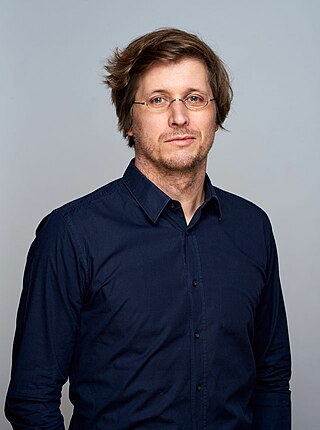
Moritz Schularick is a German economist, who is Professor of Economics at Sciences Po Paris and the University of Bonn. He works in the fields of macrofinance, banking and financial stability, as well as international finance, political economy, and economic history.
| International | |
|---|---|
| National | |
| Academics | |
| Other | |
