
The Chicago River is a system of rivers and canals with a combined length of 156 miles (251 km) that runs through the city of Chicago, including its center. Though not especially long, the river is notable because it is one of the reasons for Chicago's geographic importance: the related Chicago Portage is a link between the Great Lakes and the Mississippi River Basin, and ultimately the Gulf of Mexico.
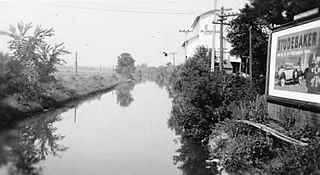
The Illinois and Michigan Canal connected the Great Lakes to the Mississippi River and the Gulf of Mexico. In Illinois, it ran 96 miles (154 km) from the Chicago River in Bridgeport, Chicago to the Illinois River at LaSalle-Peru. The canal crossed the Chicago Portage, and helped establish Chicago as the transportation hub of the United States, before the railroad era. It was opened in 1848. Its function was partially replaced by the wider and deeper Chicago Sanitary and Ship Canal in 1900, and it ceased transportation operations with the completion of the Illinois Waterway in 1933.

The Aerial Lift Bridge, earlier known as the Aerial Bridge or Aerial Ferry Bridge, is a landmark in the port city of Duluth, Minnesota. The span began life in 1905 as the United States' first transporter bridge: Only one other was ever constructed in the country, Sky Ride in Chicago. The span was converted in 1929–1930 to a vertical-lift bridge, also rather uncommon, although there are six such bridges along Ontario's Welland Canal. It remains in operation. The bridge is owned and operated by the City of Duluth. The bridge was added to the National Register of Historic Places on May 22, 1973. The United States Army Corps of Engineers maintains a nearby maritime museum.

Dr. John Alexander Low Waddell was a Canadian-American civil engineer and prolific bridge designer, with more than a thousand structures to his credit in the United States, Canada, as well as Mexico, Russia, China, Japan, and New Zealand. Waddell’s work set standards for elevated railroad systems and helped develop materials suitable for large span bridges. His most important contribution was the development of the steam-powered high-lift bridge. Waddell was a widely respected writer on bridge design and engineering theory, as well as an advocate for quality in higher education engineering programs. The company he founded in 1887, 'J.A.L. Waddell, Consulting Engineer,' would eventually become the modern day Hardesty & Hanover, a leading moveable bridge engineering firm. Many of Waddell's surviving bridges are now considered historic landmarks.
The Baltimore and Ohio Chicago Terminal Railroad is a terminal railroad in the Chicago area, formerly giving various other companies access to (Chicago's) Grand Central Station. It also served to connect those railroads for freight transfers, and is now controlled by CSX Corporation, the successor to the Baltimore and Ohio Railroad.

The Illinois Waterway system consists of 336 miles (541 km) of navigable water from the mouth of the Calumet River at Chicago to the mouth of the Illinois River at Grafton, Illinois. Based primarily on the Illinois River, it is a system of rivers, lakes, and canals that provide a commercial shipping connection from the Great Lakes to the Gulf of Mexico via the Illinois and Mississippi rivers.

The Burlington Bridge is a vertical-lift railroad bridge across the Mississippi River between Burlington, Iowa, and Gulfport, Illinois, United States. It is currently owned by BNSF Railway and carries two tracks which are part of BNSF's Chicago–Denver main line.

The Calumet-Saganashkee Channel, usually shortened to the Cal-Sag Channel, is a 16-mile-long (26 km) drainage and shipping canal in southern Cook County, Illinois, operated by the Metropolitan Water Reclamation District of Greater Chicago (MWRD). A component of the Chicago Area Waterway System, it connects the Little Calumet River at its eastern end to the Chicago Sanitary and Ship Canal at its western end.

The North Avenue Bridge can refer to one of three bridges that has carried North Avenue over the North Branch of the Chicago River on the north side of Chicago, Illinois. A center-pier swing bridge built in 1877 was replaced in 1907 by a bascule bridge, allowing river traffic more room for maneuvering in and out of the North Canal, just north of Goose Island.
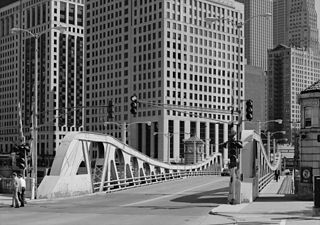
The Franklin–Orleans Street Bridge, commonly known as the Franklin Street Bridge, is a bascule bridge over the Chicago River, in Chicago, Illinois, United States. It was built in October 1920, and is located directly southwest of the Merchandise Mart. Connecting the Near North Side with "The Loop," is at the junction of the branches of the river, lying directly west of the Wells Street Bridge. It carries four lanes of traffic in the northbound direction, and sidewalks are available on both sides of the bridge.

The Chicago and North Western Railway's Kinzie Street railroad bridge is a single leaf bascule bridge across the north branch of the Chicago River in downtown Chicago, Illinois. At the time of its opening in 1908 it was the world's longest and heaviest bascule bridge. The previous bridges on the same site included a pedestrian span that was the first bridge across the Chicago River; a second bridge that served as Chicago's first railroad bridge; and a third bridge that was one of the first all-steel spans in the United States.

The Canal Street railroad bridge is a vertical-lift bridge across the south branch of the Chicago River in Chicago, Illinois. It was designated a Chicago Landmark on December 12, 2007.

The Cherry Avenue Bridge is an asymmetric bob-tail swing bridge in Chicago, Illinois, that carries the Chicago Terminal Railroad, pedestrians, and cyclists across the North Branch Canal of the Chicago River. It was constructed in 1901–02 by the Chicago, Milwaukee and St. Paul Railway, and it is a rare example of this type of bridge; it was designated a Chicago Landmark on December 12, 2007.

The Wabash Avenue Bridge over the Chicago River was built in 1930. Standing west of the Michigan Avenue Bridge and east of Marina City, the bascule bridge connects the Near North Side with "The Loop" area.
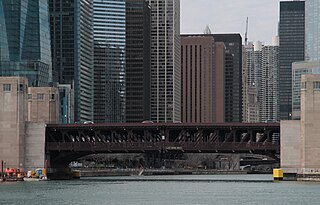
The Outer Drive Bridge, also known as the Link Bridge, is a double-deck bascule bridge carrying DuSable Lake Shore Drive across the Chicago River in Chicago, Illinois, United States. Construction was started in 1929 and was completed in 1937 as one of the Public Works Administration's infrastructure projects in Chicago. Completion of the bridge tied the north and south sections of the "outer" shore roadway, now called DuSable Lake Shore Drive, together. The bridge was officially named the Franklin Delano Roosevelt Memorial Bridge in 1982 to honor the centennial anniversary of the birth of Franklin Delano Roosevelt. It was planned by the Chicago Plan Commission, using Hugh E. Young as the consulting engineer, was designed by the Strauss Engineering Company, built by the American Bridge Company, and erected by Ketler and Elliot Company. It crosses near the mouth of the Chicago River.

The Ottawa Rail Bridge is a railroad bridge spanning the Illinois River in the municipality of Ottawa, LaSalle County, Illinois. The first rail crossing on this site was constructed in 1871 by the Chicago, Burlington and Quincy Railroad, along a route leased from the Ottawa, Oswego and Fox River Valley Railroad between Ottawa and Streator, Illinois. The current bridge was constructed in 1898 by the King Bridge Company and altered in 1932 to include a vertical-lift span designed by Waddell & Harrington. The Illinois Railway now operates trains over the bridge on its Ottawa Branch between Streator and Montgomery, Illinois.

Waddell & Harrington was an American engineering company that designed bridges from 1907 to 1915. It was formed in 1907 as a partnership of John Alexander Low Waddell (1854–1938) and John Lyle Harrington (1868–1942) and was based in Kansas City, Missouri, but had offices in Portland, Oregon, and Vancouver, British Columbia. The company designed more than 30 vertical-lift bridges for highways and railroads.

Thomas J. O'Brien Lock & Dam is a stop lock in the Hegewisch neighborhood on the South Side of Chicago at the confluence of the Grand Calumet River and Little Calumet River, which form the Calumet River. It is a component of the Chicago Area Waterway System (CAWS), which is, itself, a part of the Illinois Waterway, which links the Mississippi River and the Great Lakes.


