Portland ranked fourth in The Advocate's 2026 list of the fifteen safest American cities for LGBTQ+ travel,[1] and in 2025, Lonely Planet featured Portland as one of the top fifty most queer-friendly cities in world in The LGBTQ+ Travel Guide.[2]
Of all the large metropolitan areas in the United States, the Portland metropolitan area has the second-highest percent of LGBTQ adults per capita, with the Williams Institute reporting that 6.0% of Portland adults identify as LGBT as of 2021.[3]
History
The public bathroom in Lownsdale Square was a popular place for anonymous sex and gay cruising from 1909 to 1924. (Photo taken in 2023.)
In the late 19th and early 20th centuries, there was a thriving LGBTQ subculture in Portland, although this community was largely concealed from those outside of it in order to protect against societal homophobia, including the state's sodomy laws. In the early 19th century, Lownsdale Square was exclusively a mens' park and a popular place for anonymous sex and gay cruising;[5] the public bathroom there, known as a "T" room, was a focal point for this from about 1909 to 1929.[4][6] In 1906, lesbian physician Marie Equi, who lived in Portland at the time, became the first known LGBTQ hero to be publicly acclaimed in Oregon. She received a medal from the U.S. Army and press in Oregon praise her role in the Portland relief mission that helped victims of the 1906 San Francisco earthquake.[5] In 1907, Equi and her girlfriend Harriet Speckart won second prize for their carriage entry in the first ever Portland Rose Festival.[5]
In 1912, a shoplifting arrest led to investigations of Portland's LGBTQ community, and during 1912 to 1913 details about the subculture were revealed to the broader public in what would become known as the Portland vice scandal. Many gay men were outed and accused of various sex crimes, and some of these men were charged with violating sodomy law and tried in court. There were a few guilty verdicts, all of them on "charges involving private, consensual sexual activity."[5] Even though most of these verdicts were later reversed by the Oregon Supreme Court, the local LGBTQ community was rocked by these events; some were fired from their jobs, went into hiding, or attempted to flee the state. One person attempted suicide in the downtown YMCA, which had been reported as an important residence and sexual space for members of the local LGBTQ community, and another person committed suicide at the Byron Hotel in downtown Portland.[5] Many Oregonians first learned about Portland's LGBTQ subculture as a result of the Portland vice scandal.[7] The backlash spread when the U.S. Justice Department ordered its agents nationwide to turn over information about "vice conditions" to local officials, specifically citing the Portland vice scandal in the orders.[5]
In March 1970, less than a year after the Stonewall riots, LGBTQ activists in Portland started the Portland Gay Liberation Front and began organizing for gay liberation. They placed advertisements in a Portland counter-culture publication called the Willamette Bridge, and began to organize social events, rallies, press interviews and engagement, lobbying, and other actions to advocate for LGBTQ rights. The 1970s gay liberation movement in Portland saw the establishment of LGBTQ publications like the Fountain (est. 1971), as well as organizations like the Second Foundation,[a] which established the citt's first LGBTQ publication (the Fountain, est. 1971), opened the first gay community center in the state in 1972, and held the city's first pride celebration indoors.[11][12][13] Also in 1972, gay activist Lanny Swerdlow began to host the state's first program about LGBTQ issues on the KBOO radio channel.[11][14] In 1975, about 200 people attended Portland's first outdoor Pride Fair at the South Park Blocks near Portland State University, and the city's first Pride Festival with a parade was held in 1977, with 300 to 400 people marching along the route.[15]
Starting in the 1980s, the AIDS crisis had a major impact on Portland's LGBTQ community. The Juniper House opened in 1987 as the state's first residential specialty clinic for people affected by HIV/AIDS, serving a mostly LGBTQ clientele. Eventually, the organization outgrew the Juniper House and became a broader LGBTQ-centered organization now known as the Cascade AIDS Project.[16]
Ballot Measure 8 (1988), ruled unconstitutional in 1993
1989 Hate Crimes Law
Tanner v. OHSU domestic partner lawsuit, 1991
1992 Springfield anti-equal-rights ballot measure passes
In 1992, Multnomah County became the first U.S. public employer to extend health benefits to the domestic partners of county employees, with benefits coming into effect on July 1, 1993.[17]
On June 26, 2015, gay marriage was legalized in the United States with the Supreme Court ruling on Obergefell v. Hodges. Portland was one city where hundreds of people gathered to celebrate, and a rainbow pride flag was put up in Portland City Hall.[21] In 2018, the City of Portland renamed the 13-block stretch of Southwest Stark Street, in the historically LGBTQ area formerly known as the Burnside Triangle, to commemorate American gay rights activist Harvey Milk.[22][23][24][25]
Stomptown has been described by The Oregonian as "Portland's home for LGBTQ+ country-western dance"[33] and by Portland Monthly as a recurring "queer country dance party".[34] The event features line dancing and other types of partner dancing such as country-western two-step, swing, and waltz.[33][34] In 2025, Chiara Profenna of The Oregonian said Stomptown had a "friendly, mixed-age crowd and lots of partner rotation". Profenna wrote, "Rotating partners is always optional if you come with your own partner. No partner is required to attend. The vibe was inclusive and welcoming, and most of the line dances were beginner-friendly."[33]
Other recurring LGBTQ dance events in Portland have included Bearracuda, Blow Pony, Club Kai Kai, Lumbertwink, and Pants Off Dance Off. All of these events experienced pauses upon the arrival of the COVID-19 pandemic.[35] Monthly Blow Pony dances were established in Portland by Airick Redwolf in 2007. Inferno monthly dance parties hosted by Hot Flash Productions owner/operators DJ Wildfire (Jenn Davis) and Armida Hanlon that first began in Portland in 2004 and are now held regularly in Portland and Seattle.[36][37]Willamette Week has described Lumbertwink as a "patio party celebrating the most Pacific Northwest brand of gay subculture—flannel-fetishizing gay dudes with hairy chests who may very well 'chop wood' in their downtime".[38] The newspaper said of the event: "Chaps of all gender dispositions fall under the lumbertwink umbrella, so you won't be drinking exclusively with the man's man-loving 'masc for masc' crowd. This is a royal opportunity for you to knock back a few with a delicately specific sliver of the queer populace."[38] The Portland Mercury has recommended, "If you love dancing and seeing cozy clothes on fuzzy bodies of all sizes, this is for you."[39] Lumbertwink has been held at various venues, including the Funhouse Lounge, Star Theater, and the defunct Tonic Lounge.[39] Pants Off Dance Off is a clothing-optional dance party;[40] the event was held at Tonic Lounge, as of 2019.[41][42]
Film
The Portland Queer Film Festival, formerly known as the Portland Lesbian & Gay Film Festival, has been running for more than 20 years and takes place at Cinema 21.[43] The Portland Queer Documentary Film Festival screens LGBTQ documentaries.[44] Queer Horror is a bi-monthly film festival that is shown at the Hollywood Theatre.[45]Dan Savage's HUMP! film festival, which screens in Portland annually, showcases "diversity in orientations and identities, including straight, gay, lesbian, bisexual, trans, poly, genderqueer, and genderfluid perspectives", according to The Stranger.[46]
The City Nightclub, an all ages drug and alcohol free gay and lesbian nightclub, was established in 1983 by Lanny Swerdlow. According to author Linnea Due, it was the only all ages gay and lesbian club in the United States. An attempt by the Portland Police Bureau in 1996 to shut down the club sparked a demonstration which was covered on MTV News: Unfiltered. Ultimately, the club shut down in December of 1996.[citation needed]
The Roxy was an LGBTQ-friendly diner along Southwest Harvey Milk Street. The restaurant opened in 1994 and closed in March 2022. Sullivan's Gulch Bar & Grill (formerly known as Joq's Tavern,[63][64] or simply Joq's) has also been described as an LGBTQ establishment. Shine Distillery and Grill, which closed in 2023, was described as a gay bar.
Located at Northwest 5th Avenue and Davis Street in Old Town Chinatown, Barbarella (sometimes called Barbarella PDX) was a nightclub in a building which previously housed a "grimy" music venue called Someday Lounge, followed by the Las Vegas-inspired Fifth Avenue Lounge. The bar was part of a chain of nightclubs based in Austin, Texas. Andrew Jankowski of Willamette Week described Barbarella as "a dance club with dirt-cheap drinks, themed parties running from the '50s through the '80s and an overall vibe best described as 'a straight person's idea of a gay bar'".[65] He compared the bar to neighboring amusement arcade Ground Kontrol, but without the video games, and said, "Barbarella's aesthetic is as delightfully kitschy and low-budget as a bar named after a campy sci-fi cult classic should be."[65] Jankowski wrote:
On paper, Barbarella should be a sensation, particularly with central eastsiders who rarely deign to cross the river into the Old Town entertainment district. Sure, the lack of specialty drinks feels like a missed opportunity, and even the bartender recommended against ordering food. But with no cover charge and wells at or below $2 each, you'd imagine the place would be packed with people headed to or from the arcade bar, the gay strip club or the scores of other party spots in the neighborhood.[65]
Daily Xtra described Barbarella as a "video/dance dive bar" with dance parties, disc jockeys, and queer events in its 2019 overview of "gay Portland".[66] The venue had two dance floors and a loft. The interior featured lava lamps, pinball machines, and mid-century modern furniture. There was a painting of a topless woman on one wall, as well as two "tributes" to Jane Fonda, who starred in the 1968 science fiction film Barbarella. According to Jankowski, "The only 21st-century features are the video projections and gently rippling rainbow LED lights behind the pre-existing sheet-metal grates."[65]
Shoutout is the only active LGBTQ-focused news publication based in Portland.[87][88]Sus is another LGBTQ publication distributed in Portland, although it is based in Bend.[89] Defunct LGBTQ publications include the Alternative Connection,[90][91]Cascade Voice (later renamed the Eagle),[92][93]the Fountain (which was the first LGBTQ-focused publication in Oregon),[11][12][94]Just Out,[95]NW Gay Review, the Oregon Gay Rights Report, and PQ Monthly.[91][96]The Willamette Bridge was a counter-culture magazine based in Portland, and while it was not an LGBTQ-focused publication, it was one of the first public platforms for LGBTQ social and political organizing in the 1970s due to the advocacy of some of its employees.[11]
12"Portland's LGBTQ+ Historic Sites". portlandmaps.com. Portland Bureau of Planning and Sustainability. September 23, 2024. Retrieved February 8, 2026.
↑Nicola, George T. (June 16, 2015). "Milestones in LGBTQ Law". Oregon Queer History Collective. Archived from the original on October 15, 2025. Retrieved January 30, 2026.
↑Delzio, Melissa (January 2, 2023). "LGBTQ+ Community Collection". PDX Design History. Archived from the original on October 18, 2025. Retrieved January 27, 2026.
This page is based on this Wikipedia article Text is available under the CC BY-SA 4.0 license; additional terms may apply. Images, videos and audio are available under their respective licenses.


 Rainbow flag displayed in the Burnside Triangle, 2006
 Entrances to Darcelle XV Showplace and CC Slaughters, 2012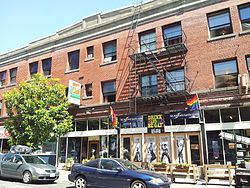
 Exterior of Embers Avenue, 2014
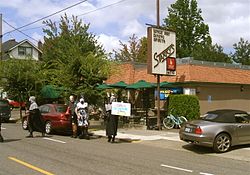 Portland Sisters of Perpetual Indulgence outside Starky's in 2009
 Activist and drag artist Poison Waters is celebrated at a Portland Trail Blazers game, 2025







