Related Research Articles

Computer science is the study of computation, information, and automation. Computer science spans theoretical disciplines to applied disciplines.
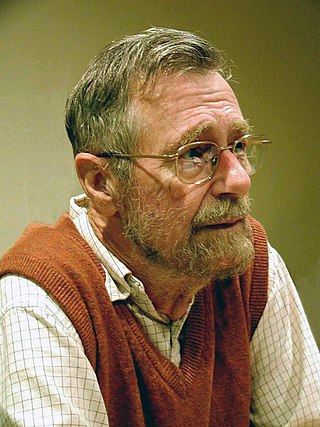
Edsger Wybe Dijkstra was a Dutch computer scientist, programmer, software engineer, mathematician, and science essayist.

Sir Charles Antony Richard Hoare, also known as C. A. R. Hoare, is a British computer scientist who has made foundational contributions to programming languages, algorithms, operating systems, formal verification, and concurrent computing. His work earned him the Turing Award, usually regarded as the highest distinction in computer science, in 1980.
In theoretical computer science, an algorithm is correct with respect to a specification if it behaves as specified. Best explored is functional correctness, which refers to the input-output behavior of the algorithm: for each input it produces an output satisfying the specification.
The Centrum Wiskunde & Informatica is a research centre in the field of mathematics and theoretical computer science. It is part of the institutes organization of the Dutch Research Council (NWO) and is located at the Amsterdam Science Park. This institute is famous as the creation site of the programming language Python. It was a founding member of the European Research Consortium for Informatics and Mathematics (ERCIM).
ALGOL 60 is a member of the ALGOL family of computer programming languages. It followed on from ALGOL 58 which had introduced code blocks and the begin and end pairs for delimiting them, representing a key advance in the rise of structured programming. ALGOL 60 was one of the first languages implementing function definitions. ALGOL 60 function definitions could be nested within one another, with lexical scope. It gave rise to many other languages, including CPL, PL/I, Simula, BCPL, B, Pascal, and C. Practically every computer of the era had a systems programming language based on ALGOL 60 concepts.
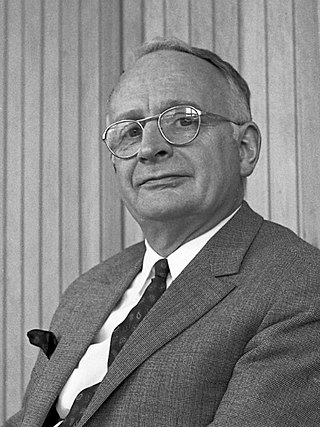
Adriaan "Aad" van Wijngaarden was a Dutch mathematician and computer scientist. Trained as a mechanical engineer, Van Wijngaarden emphasized and promoted the mathematical aspects of computing, first in numerical analysis, then in programming languages and finally in design principles of such languages.

Luca Andrea Cardelli is an Italian computer scientist who is a research professor at the University of Oxford, UK. Cardelli is well known for his research in type theory and operational semantics. Among other contributions, in programming languages, he helped design the language Modula-3, implemented the first compiler for the (non-pure) functional language ML, defined the concept of typeful programming, and helped develop the experimental language Polyphonic C#.
Johannes Aldert "Jan" Bergstra is a Dutch computer scientist. His work has focused on logic and the theoretical foundations of software engineering, especially on formal methods for system design. He is best known as an expert on algebraic methods for the specification of data and computational processes in general.

Kurt Mehlhorn is a German theoretical computer scientist. He has been a vice president of the Max Planck Society and is director of the Max Planck Institute for Computer Science.

Paul Michael Béla Vitányi is a Dutch computer scientist, Professor of Computer Science at the University of Amsterdam and researcher at the Dutch Centrum Wiskunde & Informatica.
Eugene Leighton (Gene) Lawler was an American computer scientist and a professor of computer science at the University of California, Berkeley.
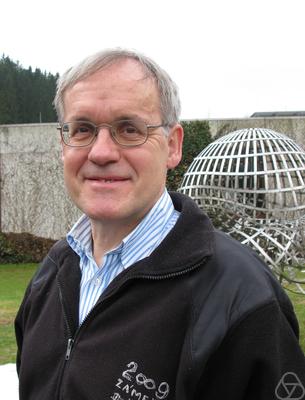
Alexander (Lex) Schrijver is a Dutch mathematician and computer scientist, a professor of discrete mathematics and optimization at the University of Amsterdam and a fellow at the Centrum Wiskunde & Informatica in Amsterdam. Since 1993 he has been co-editor in chief of the journal Combinatorica.

Martin L. Kersten was a computer scientist with research focus on database architectures, query optimization and their use in scientific databases. He was an architect of the MonetDB system, an open-source column store for data warehouses, online analytical processing (OLAP) and geographic information systems (GIS). He has been (co-) founder of several successful spin-offs of the Centrum Wiskunde & Informatica (CWI).
Ronald Michiel de Wolf is a Dutch Computer Scientist, currently a Senior Researcher at Centrum Wiskunde & Informatica (CWI) and a professor at the Institute for Logic, Language and Computation (ILLC) of the University of Amsterdam (UvA).
Ernst-Rüdiger Olderog is a German computer scientist. He is a full professor at the University of Oldenburg in Oldenburg, northern Germany. He heads the Correct Systems Design (CSD) group whose research is focused on programming language theory. Their research goal is methods for the systematic development of correct software for parallel and distributed systems under real-time constraints. In 1994, Olderog was awarded the Leibnitz Prize of the German Research Foundation (DFG) for his work. He authored a number of scientific books and served as editor-in-chief of the journal Acta Informatica and as chairman of the IFIP Working Group 2.2 on Formal Description of Programming Concepts. His work in this Working Group was awarded the IFIP Silver Core in 1998.
Nissim Francez is an Israeli professor, emeritus in the computer science faculty at the Technion, and former head of computational linguistics laboratory in the faculty.
In computer science, interference freedom is a technique for proving partial correctness of concurrent programs with shared variables. Hoare logic had been introduced earlier to prove correctness of sequential programs. In her PhD thesis under advisor David Gries, Susan Owicki extended this work to apply to concurrent programs.
Jacobus Willem (Jaco) de Bakker was a Dutch theoretical computer scientist and professor at the Vrije Universiteit Amsterdam.
Josephus C.M. Baeten is a Dutch computer scientist and mathematician, who has published on process calculus, concurrency theory, formal methods, model-based software engineering, model-based systems engineering and theory of computation.
References
- ↑ Krzysztof R. Apt at the Mathematics Genealogy Project
- ↑ "Meeting No. 828. The Minutes of the Board of Regents of the University of Texas System" (PDF). Board of Regents, University of Texas System. 13 August 1987. p. 109. Retrieved 2022-11-19.
- 1 2 "Krzysztof R. Apt". Academia Europaea - The Academy of Europe. 2006. Retrieved 2022-10-15.
- ↑ Apt's various positions are listed in his member webpage of the Academia Europaea: [3]
- ↑ "Krzysztof Apt". CWI Centrum Wiskunde & Informatica. Retrieved 2022-10-17.
- ↑ "Krzysztof Rafał Apt". University of Warsaw, Faculty of Mathematics, Informatics and Mechanics. 16 June 2015. Retrieved 2022-10-17.
- ↑ "ILLC Staff". University go Amsterdam, Institute for Logic, Language and Computation. Retrieved 2022-10-16.
- ↑ —; Blair, Howard A.; Adrian, Walker (1988). "Chapter 2 - Towards a theory of declarative knowledge". In Minker, Jack (ed.). Foundations of Deductive Databases and Logic Programming. Morgan Kaufmann Publishers. pp. 89–148. doi:10.1016/B978-0-934613-40-8.50006-3. ISBN 9780934613408.
- ↑ —; Olderog, Ernst-Rüdiger (December 2019). "Fifty years of Hoare's logic" (PDF). Formal Aspects of Computing . 31 (6). Springer Verlag, Berlin, Heidelberg: 751–807. doi: 10.1007/s00165-019-00501-3 . S2CID 102351597.
- ↑ "Membership". Academia Europaea - The Academy of Europe. Retrieved 2022-11-07.
- ↑ — (October 2005). "EDITORIAL". ACM Transactions on Computational Logic . 6 (4): 673. doi:10.1145/1094622.1094623. S2CID 263875068.
- ↑ "Witold Lipski Prize for Young Researchers in Computer Science" . Retrieved 2022-11-07.
- ↑ — (2001). "Viewpoint: One more revolution to make: free scientific publishing". Communications of the ACM . 44 (5): 25–28. doi:10.1145/374308.374325. S2CID 12485666.
- ↑ Welcome to the Computing Research Repository (CoRR), archived from the original on January 4, 2022
