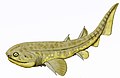
In terms of size, Keasius individuals were considerably smaller than extant basking sharks, with estimated total lengths around 4.5–6.8 metres (15–22ft) m based on gill raker-body proportions, versus the up to 11 metres (36ft) maximum for basking shark(C. maximus). [5][1] These morphological differences highlight Keasius as a basal form within the Cetorhinidae family, likely occupying a transitional role in the evolution of planktivorous lamniform sharks during the Eocene to Miocene. Fossil evidence places Keasius as a close relative or potential direct ancestor to Cetorhinus, with transitional forms appearing in the Oligocene-Miocenee that bridge archaic and derived traits, such as intermediate gill raker morphology observed in Sakhalin Island deposits.[6]
Paleobiology
Keasius species were specialized planktivores that employed a filter-feeding mechanism analogous to that of the modern basking sharkCetorhinus maximus. Fossilized gill rakers, teeth, and vertebral centra reveal a passive filtration system, where individuals swam with their mouths agape to draw in water via ram ventilation, straining zooplankton and small nektonic organisms from the water column. The close spacing and reduced size of teeth in preserved dentition further supported retention of minute prey particles while expelling excess water through the gills, as evidenced by specimens from Oligocene deposits in Germany.[7]
12Reinecke, T.; von der Hocht, F.; Dufraing, L. (2015). "Fossil basking shark of the genus Keasius (Lamniforme, Cetorhinidae) from the boreal North Sea Basin and Upper Rhine Graben: evolution of dental characteristics from the Oligocene to late Middle Miocene and description of two new species". Palaeontos. 28: 39–98.
This page is based on this Wikipedia article Text is available under the CC BY-SA 4.0 license; additional terms may apply. Images, videos and audio are available under their respective licenses.