
The Appalachian Mountains, often called the Appalachians, are a mountain range in eastern to northeastern North America. Here, the term "Appalachian" refers to several different regions associated with the mountain range, and its surrounding terrain. The general definition used is one followed by the United States Geological Survey and the Geological Survey of Canada to describe the respective countries' physiographic regions. The US uses the term Appalachian Highlands and Canada uses the term Appalachian Uplands..

Holbrook's southern dusky salamander, previously known as just the southern dusky salamander, is a species of salamander endemic to the southeastern United States. Older sources often refer to it as the eared triton. Formerly abundant, it has precipitously declined since the 1960s.

The seepage salamander is a small, terrestrial species of salamander in the family Plethodontidae. It is endemic to the United States. They are found in small areas of Tennessee, North Carolina, Georgia, and Alabama. Its natural habitats are temperate forests, intermittent rivers, and freshwater springs. It gets its name from the seepages around which it lives. It is very similar in its appearance and life history to the pygmy salamander. These two species differ greatly from the other Desmognathus species. They are the smallest salamanders in the genus, measuring only 3–5 cm (1–2 in) in length. They are also the only two terrestrial, direct-developing Desmognathus species. However, the two species are not often seen to coexist, differing in distribution by elevation; although there are exceptions. The seepage salamander is currently listed as Near Threatened, with its numbers declining in most of states in which it is found. It is threatened by habitat loss, with logging having a major effect.
The dwarf black-bellied salamander is a species of salamander in the family Plethodontidae. It is endemic to the United States.

The shovelnose salamander is a species of salamander in the family Plethodontidae. It is endemic to the United States.

The seal salamander is a species of lungless salamander that is endemic to the Eastern United States.

The ocoee salamander is a species of salamander in the family Plethodontidae. This salamander has a variety of colors and patterns, and got its name from Tennessee state wildflower. Its natural habitats are temperate forests, rivers, intermittent rivers, freshwater springs and wet rocks in mountainous areas of the Southeastern United States. It was first described by Nicholls in 1949. They are territorial and feed on small invertebrates. It is widely distributed in the southeastern United States and is listed as "Least Concern" by the International Union for Conservation of Nature.
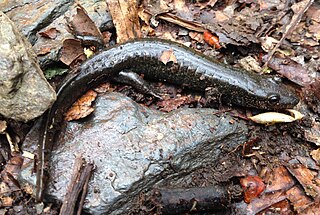
The blackbelly salamander is a species of salamander in the family Plethodontidae. It is endemic to the United States. Its natural habitats are rivers, intermittent rivers, and freshwater springs. It is threatened by habitat loss.
The black mountain salamander is a species of salamander in the family Plethodontidae.

The pygmy salamander is a species of salamander in the family Plethodontidae. It is endemic to the United States in the southern Appalachians in North Carolina and Tennessee. Desmognathus wrighti is a member of the family Plethodontidae and is commonly known as the pygmy salamander. As the name suggest the pygmy salamander is the smallest of the nineteen species in the genus Desmognathus. D. wrighti undergoes direct development and does not have a free-living larval stage. Only two other taxa in Desmognathus, D. aeneus and D. organi, exhibit direct development along with the pygmy salamander. In the genus Desmognathus, body size, habitat preferences, and patterns used by males during courtship are quite variable. D. wrighti courtship is noted by the male biting and seizing its partner in order to provide them with a chemical stimulus. The pygmy salamander can be found in the southern Appalachians of the United States in western North Carolina and eastern Tennessee. Geographical distribution of the Desmognathus wrighti is fragmented and the highest abundance of the species can be found at high elevations in spruce and fir tree forest.

The red-cheeked salamander, also known as the Jordan's salamander, Jordan's redcheek salamander, or Appalachian woodland salamander, is a species of salamander in the family Plethodontidae. It is endemic to the Appalachian Mountains in the southeastern United States.

The northern pygmy salamander is a terrestrial species of salamander in the family Plethodontidae and genus Desmognathus. Along with the southern pygmy and the seepage salamander, these are some of the smallest salamander species in North America and can be found in higher elevations in the southern Appalachians.
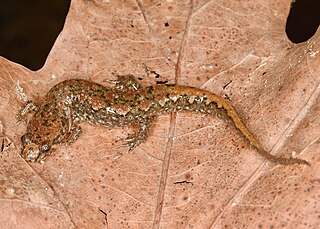
The spotted dusky salamander is a species of salamander in the family Plethodontidae. It is endemic to the United States.
The flat-headed salamander is a species of salamander in the family Plethodontidae. It is endemic to the United States, where it is known from Virginia and likely North Carolina.
The Nantahala black-bellied salamander or southern black-bellied salamander is a species of lungless salamander in the family Plethodontidae. It is endemic to the eastern United States, where it is only known from the southern Appalachian Mountains.
The Cherokee black-bellied salamander or Smoky Mountains black-bellied salamander is a species of lungless salamander in the family Plethodontidae. It is endemic to the eastern United States, where it is only known from the southern Appalachian Mountains.
The Pisgah black-bellied salamander or Blue Ridge black-bellied salamander is a species of lungless salamander in the family Plethodontidae. It is endemic to the eastern United States, where it is only known from the southern Appalachian Mountains.

