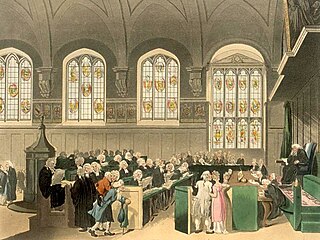
Estoppel is a judicial device in common law legal systems whereby a court may prevent or "estop" a person from making assertions or from going back on their word; the person so prevented is said to be "estopped". Estoppel may prevent someone from bringing a particular claim. Legal doctrines of estoppel are based in both common law and equity. Estoppel is also a concept in international law.
Jactitation or jactitation of marriage is an archaic cause of action in English and in Irish law. Where one person falsely asserts that he or she is married to another, the wronged party could obtain an order restraining further repetitions of the falsehood. The action was abolished in England in 1986 and in Ireland in 1995.

Commonwealth v Verwayen, also known as the Voyager case, is a leading case involving estoppel in Australia. Bernard Verwayen sued the Australian government for damages caused by a collision between two ships of the Australian Navy. A representative of the Government initially indicated to Bernard Verwayen that the Government would not raise the statute of limitations as a defence to their negligence. In court however, the Government relied on this defence. While the decision of the High Court was split, a majority of judges found that the Government could not rely on this statement as a defence. Justices Toohey and Gaudron came to this conclusion on the basis that the Government had waived their right to rely on this defence. However, Justices Deane and Dawson came to this conclusion under the doctrine of estoppel, which provides that a defendant can not contradict a previous representation or promise made that has established an assumed state of legal affairs. This case is most frequently referred to in relation to its influence on the doctrine of estoppel.

Adam v The Minister for Justice, Equality and Law Reform [2001] IESC 38 is a reported decision of the Irish Supreme Court, in which the Court, in affirming High Court orders to strike out two judicial review proceedings as frivolous, held that, to challenge the decision of a public authority, one must attempt to rely on proved individual circumstances.
Dunne v Donohoe [2002] IESC 35, [2002] 2 IR 533 was an Irish Supreme Court Case wherein the court held that a Garda Superintendent was a persona designata and that a guideline issued the Garda Commissioner that imposed fixed preconditions to applications for a firearm certificate would result in the superintendent acting Ultra Vires. By ruling that the guideline interfered with the status of a superintendent as a persona designata, the Court provided an important finding in establishing the limits of discretionary powers under the Irish constitution and the legal standing of guidelines issued under the auspices of a national body.
H v H, [2015] IESC 85, also known as JMH v KH, is an Irish Supreme Court case in which the husband was found to have vexatiously abused the court process by repeatedly pursuing legal action against his former wife. An Isaac Wunder order was made by the court against the husband which states that any legal proceedings against his wife and children will be halted. However, the court did not suspend all legal action from the husband; rather it ruled that further legal action would require a decision by a relevant court. This decision is significant because the Court established guidelines for when common law principles could be reinterpreted.
P.F v G.O'M [2000] IESC 81 is an Irish Supreme Court case concerning the grounds of nullity of marriage.The court believe that adultery is not a reason for nullity of the marriage but did serve as a basis for legal separation. The court ruled that "consent" was not undermined where a party to the marriage had concealed misconduct. This case is thus significant for establishing the principles for annulment and clarifying the nature of consent.
O'Connell & anor v The Turf Club, [2015] IESC 57, [2017] 2 IR 43 is an Irish Supreme Court case which explored the scope of judicial review in Ireland. It addressed whether the decisions of a sport's organizing body should be amenable to judicial review. In deciding that it was, this decision became a useful reminder that it is not only bodies created by statute, which are generally considered to be subject to public law, that are amenable to Judicial Review by the Courts.
J. McD v P.L and B.M[2007] IESC 28, [2008] ILRM 81 is an Irish Supreme Court case the rights of a sperm donor to access a child born through his donation. The Appellant, who was the biological donor, questioned whether he could be a guardian of the infant despite never having had a romantic relationship with the first named respondent who was the mother. The case raised important questions around the Irish legal definition of "family." The case is also important because the Supreme Court over-turned a High Court ruling that had relied on Article 8 of the European Convention of Human Rights.
Bank of Ireland v O'Donnell & ors[2015] IESC 90 is an Irish Supreme Court case that centred around whether the appellants had any right or capacity to bring a motion before the court. They wanted to seek an order of a stay on Mr Justice McGovern's order dated 24 July 2014. In their appeal, they referred to the principle of objective bias and Mr Justice McGovern's refusal to recuse himself. The Supreme Court rejected the application for a stay and held that the law regarding objective bias was clearly stated in the lower court.
N.H.V. v Minister for Justice & Equality [2017] IESC 35 was an Irish Supreme Court case in which the Court upheld a challenge to the absolute prohibition on employment of asylum seekers contained in Section 9(4) of the Refugee Act 1996 and held it to be contrary to the constitutional right to seek employment.
AAA & Anor v Minister for Justice & Ors, [2017] IESC 80, was an Irish Supreme Court case which arose from the judgment delivered by Cooke J in the High Court on 17 May 2012, due to the fact that the applicant AAA and her children were deported to Nigeria in 2011. The court held that "as a rule" there is no right to an oral hearing in an application for leave to remain on humanitarian grounds and subsidiary protection where there has already been oral hearings in relation to an application for asylum. This decision clarified the grounds under which a claim for subsidiary protection could be heard.
Delahunty v Player and Wills (Ireland) Ltd, [2006] 1 IR 304; [2006] IESC 21 was an Irish Supreme Court case in which the Court gave a woman permission to take action for damages against two major tobacco companies in what was the first step in the battle against 'Big tobacco'.
Ryan v Governor of Midlands Prison [2014] IESC 54 was a case in which the Irish supreme court ruled that, ordinarily, a Court order detaining a convicted individual that is not prima facie invalid should only be challenged through an appeal of the conviction or an application for judicial review rather than through an application for release under the constitutional principle of habeas corpus.
D.C. v DPP[2005] 4 IR 281, [2006] ILRM 348; [2005] IESC 77 was an Irish Supreme Court case in which the Court confirmed that the standard to be met for prohibiting a trial is "where there is a real or serious risk of an unfair trial".
T(D) v L(F) & Anor, [2003] IESC 59 is a reported Irish Supreme Court case in which the Court held that in relation to foreign divorce proceedings, the burden of proof is on the parties to establish their domicile. Thus, in this case the Supreme Court dismissed the appeal of the husband and upheld the judgement of the High Court as he was unable to establish his domicile.
A v Minister for Justice and Equality, Refugee Applications Commissioner, Ireland and the Attorney General [2013] IESC 18, (2013) 2 ILRM 457 is an Irish Supreme Court case where the Supreme Court concluded that a certificate of leave to appeal was not required in order to appeal to the Supreme Court a decision of the High Court to dismiss proceedings as frivolous or vexatious.
Child and Family Agency v O.A.[2015] IESC 52, also known as Child and Family Agency (Tusla) v OA, is an Irish Supreme Court case which determined the appropriateness of awarding costs in child care cases where there was an unsuccessful parental challenge to an application made by the Child and Family Agency (CFA). The Supreme Court established that there are circumstances where it might be suitable to award costs to unsuccessful parents who privately retained legal counsel; these being if the CFA "acted capriciously, arbitrarily or unreasonably in commencing or maintaining the proceedings", if "the outcome was particularly clear or compelling", or if it would be "particularly unjust towards the parents to award costs against them". It was stated that the District Court must outline its reasoning regarding a decision to award costs in such cases, holding that the Circuit Court should only reverse District Court decisions if the outlined principles and criteria are not followed.
McNulty v DPP[2009] IESC 12; [2009] 3 IR 572 is an Irish Supreme Court case where the appellant had been previously charged with possession of controlled drugs with an intent to supply contrary to the Misuse of Drugs Act 1977; the case was heard in the Dublin Circuit Criminal Court before Judge Michael White, where the jury were unable to reach a verdict and accordingly disagreed. The appellant claimed that the respondent had unfairly taken advantage of the jury's disagreement after what he claims was an incorrect decision by White J in allowing the admittance of additional evidence to make up for the "defects in proof at the first trial."
Gt v Kao[2007] IESC 55; [2008] 3 IR 567 is an Irish Supreme Court case which upheld the High Court's decision that, under article 3 of the Hague Convention on the Civil Aspects of Child Abduction, the appellant had acted unlawfully in taking her two children outside of Ireland without permission from the respondent.
