In 1989, strange animal attacks occur throughout Costa Rica. Evidence collected from the attacks points to Procompsognathus, an extinct dinosaur. Paleontologist Alan Grant and his paleobotanist colleague Ellie Sattler meet with an EPA official to discuss the attacks, but are abruptly whisked away by billionaire John Hammond, the founder of bioengineering firm InGen, for a weekend visit to a "biological preserve" he has established on the remote island of Isla Nublar.
The "preserve" is a cover for the construction of "Jurassic Park", a theme park showcasing living dinosaurs recreated using ancient DNA found in the blood inside insects that were fossilized and preserved in amber. Gaps in the genetic code were filled in with DNA from reptiles, birds, or amphibians. To control breeding, all of the park's specimens are raised as females with a genetic flaw that makes them lysine deficient and unable to survive outside captivity.
At the headquarters of the Biosyn Corporation in Cupertino, California, Lewis Dodgson delivers a speech marking InGen as a 'target of opportunity'. He describes his plan to ten executives from Biosyn, which includes obtaining dinosaur embryos from Isla Nublar itself. Dodgson meets an obese man for a final meeting on the mission. Dodgson gives the man a shaving-cream can with 48 hours of coolant for the embryos. He shows the man half the amount due to him. After doing so, both leave, and the man gets ready for his flight.
The recent attacks on workers have made Hammond's investors skittish. Hammond requests that Grant and Sattler tour the park and endorse it before the park opens. They are joined by mathematician and chaos theoristIan Malcolm, and a lawyer representing the investors, Donald Gennaro, both of whom are pessimistic about the park. Malcolm, consulted before the park's creation, is emphatic that it will collapse. Hammond also invites his grandchildren, Tim and Alexis 'Lex' Murphy, to join the tour. The park staff present comprise senior engineer John Arnold, biotechnologist Henry Wu, game warden Robert Muldoon, PR director Ed Regis, chief programmer Dennis Nedry, veterinarian Harding, and several laborers.
The visitors arrive at the visitor center, where Wu explains how they create dinosaurs. He also explains that, not only are the animals created female, but their gonadal tissue is irradiated as well. They also visit the control room, where they can see all the park's animals. Arnold explains that this is made possible by motion sensor tracking systems. He also shows them Poisson distribution graphs of Procompsognathus populations in the park. Malcolm expresses his concern to Gennaro that dinosaurs have indeed gotten off the island, based on the information Arnold had given, leaving Gennaro suspicious. Grant, Ellie, Malcolm, and Tim visit the raptor pen, where they are 'attacked' by raptors. Grant realizes that the raptors were testing the fences for weaknesses and followed a unique hunting strategy.
While touring the park, Grant finds a Velociraptor eggshell, seemingly proving Malcolm's assertion that the dinosaurs are breeding against the geneticists' design. Grant deduces that using frog DNA to fill gaps in the dinosaurs' genetic code created an environment conducive to dichogamy, causing some female dinosaurs to become males and establish a breeding population. The park's automated tally system failed to account for the newborns, having been programmed to allow operators to input the expected number of dinosaurs. Malcolm explains that the Poisson distributions Arnold showed them for Procompsognathus populations were reminiscent of a normal biological population, not a population under the controls desired for Jurassic Park.
Nedry, angered by Hammond refusing to pay him for months of overwork, commits corporate espionage for Lewis Dodgson. Activating a backdoor he wrote into the park's software, he disables the security systems and steals frozen embryos for the park's fifteen dinosaur species. Attempting to rendezvous with Dodgson's agent, he becomes lost due to a tropical storm. Nedry's sabotage disables the electric fences around the park's enclosures, allowing most of the dinosaurs to escape. He is killed by a Dilophosaurus during his attempted escape.
Meanwhile, the tour group, on their way back to the main lodge, discovers that dinosaurs have been escaping the island by stowing away on the supply boats. When the power is turned off, the tour group is left stranded next to the Tyrannosaurus rex enclosure because the tour cars are powered by underground wires connected to the main power grid. In the rain, Lex notices small dinosaurs on a ship in the distance. Regis identifies it as the supply ship that visits the island every week. Grant identifies the small animals as juvenile raptors. Regis makes it back to his car. A Tyrannosaurus rex breaks through the depowered electric fence and attacks the tour group. Before that, Ed Regis runs out of the car in fear. As Tim gets out to close the door, the Tyrannosaurus notices him and attacks his car. Tim is left trapped in the car when the Tyrannosaurus throws it off the road. The Tyrannosaurus then proceeds to the other car. Malcolm makes a run for it, but the animal grabs him and throws him sideways. Grant gets out of the car. He realizes that the animal's vision appears to be attuned to movement. He is accidentally kicked by the animal and becomes unconscious.
Tim comes to in the car, which is stuck in a tree. He escapes the tree as the car begins to fall. He spots Lex sitting in a drainpipe. Soon, Grant finds them. Malcolm is severely injured and left behind, while Regis is killed and eaten by a juvenile Tyrannosaurus. Muldoon and Gennaro, while searching for the tour group, find Malcolm and leave him in Harding's care. They bring news to Hammond that Grant and the kids are definitely alive and are probably somewhere in the park.
Arnold tries to reboot the control room's systems and undo Nedry's meddling while repair crews begin patching up the park. By the morning, the power systems were back on. Grant and the kids, who had been resting overnight in a shed, wake up. They witness the Tyrannosaurus attack a herd of hadrosaurs and flee to the trees. In the trees, Grant tests his hypothesis that animals' vision is attuned to movement by observing an adult Maiasaura and her baby. They make it back to the shed, where they find plans for an inflatable raft. They find the raft on a dock nearby, next to a river. However, they notice that the Tyrannosaurus was sleeping right next to the dock. They seemingly escape, but a tremendous sneeze by Lex wakes the animal, and it chases them down the river. Soon, it is attracted back to its meal after being taunted by the juvenile tyrannosaur.
Grant and the kids make it downriver to the unfinished aviary, where they narrowly escape an attack by several Cearadactlyus. Meanwhile, Muldoon and Gennaro enter the sauropod paddock to hunt down the tyrannosaur. Soon, they find it close to the jungle river. Muldoon shoots it with a large tranquilizer dart. However, there is no observable effect on the animal as it charges at the jeep. Muldoon and Gennaro escape. Grant and the kids fall off the edge of a waterfall, where the tyrannosaur is at the base. Grant and Tim make it to shore and see Lex unconscious on the water. Soon, Lex regains consciousness. As the tyrannosaur is distracted by a life vest, the three make it to a small maintenance shed behind the waterfall. Grant goes through a door to scout a path, while Lex and Tim wait. However, the kids are attacked by the tyrannosaur. Tim narrowly escapes the tyrannosaur, as the animal faints because of the tranquilizer dart that was fired at it by Muldoon earlier.
Meanwhile, the Jurassic Park staff do not realize that a flaw in the rebooting process has left the main generators turned off, leaving only the overtaxed auxiliary generator operational. It quickly breaks down, disabling the entire island's power. At the waterfall, the door clicks open, and the water is reduced to a trickle. Grant had found a small electric cart and a raptor chick, which he found to be male. Grant and the kids use the cart to get back to the visitor center, and bring the baby raptor along too. Back at the center, the park's dangerous and untamed Velociraptors escape their enclosure. Arnold goes out to the maintenance shed to turn the power back on, and Wu stays at the control room in case he succeeds, while the others hide at the lodge.
Muldoon and Gennaro go out to help Arnold reach the shed safely. Muldoon uses a rocket launcher to shoot one of the raptors, resulting in the animal exploding. The other raptors chase Muldoon, while Gennaro escapes in the opposite direction. In the shed, Arnold holds the door open using his shoe. However, a raptor enters the shed, and Arnold dies. Wu makes it to the lodge. Gennaro gets to the maintenance shed, where he is attacked by a raptor. By then, Grant and the kids make it back to the visitor center. Grant uses a radio to contact the others and is instructed to restore power. Tim takes Lex to the kitchen, as she wanted ice-cream. There, they are pursued by a raptor. Tim lures the raptor into the freezer and locks it in. The two escape to the control room. Sattler decides to distract the raptors away from the maintenance shed. Wu tries to get Sattler back inside, but is attacked by a raptor in the process and dies. Muldoon quickly closes the door and escapes. Sattler escapes to the roof and is pursued by raptors. In a final attempt to escape, she jumps into the pool. She, too, makes it back to the lodge.
In the lodge, a delirious Malcolm starts ranting on how genetics was the next great scientific endeavor after the atomic bomb. When Hammond argued back, Malcolm dismissed him, saying that Hammond was arrogant enough to think he could control Nature. Meanwhile, Grant reaches the shed and notices Gennaro in a corner. Soon, Grant turns the generator back on.
Tim and Lex are pursued by the raptors through the visitor center. In the nursery, they see a juvenile raptor and use it as a distraction to keep the adults away. However, the adults quickly dispatched the chick. The kids meet Grant and Gennaro soon. Grant, with a plan, enters the hatchery. Grant uses a highly toxic substance to kill the raptors. He manages to defeat three raptors. Grant, the kids, and Gennaro reach the control room and turn the power back on. The telephone lines worked again. Warned by Grant that raptors are aboard, Gennaro contacts the island's departing supply ship and recalls it seconds before it makes landfall. The animals are found and are killed by the crew members on the ship. Hammond, walking outdoors while contemplating InGen's future, is killed by a pack of Procompsognathus after he falls down a hill and breaks his ankle. Grant, Sattler, Muldoon, and Gennaro search for the surviving raptors using the wild raptor chick Grant found, and discover a vast nest hidden in the park's waterworks. Grant, Sattler, and Gennaro find out that the animals were migrating to the mainland.
Malcolm seemingly dies from his injuries. Everyone is evacuated by the Air Vigilance Service, which declares the dinosaurs hazardous and razes the island with napalm. The survivors are detained in a Costa Rican hotel. Weeks later, Grant is visited by Dr. Martin Gutierrez, an American doctor who lives in Costa Rica. Gutierrez informs Grant that an unknown pack of animals has been migrating through the Costa Rican jungle, implying that the surviving dinosaurs have been reintroduced into Earth's ecosystem.
Crichton began working on the project in 1981, but soon set it aside because there "seemed to be an enormous mania about dinosaurs" at the time, and he was hesitant to "ride a current fashion". He eventually proceeded after concluding that the public's fascination with dinosaurs "was permanent."[3] The novel began as a screenplay, completed by Crichton in 1983, about a graduate student who recreates a pterosaur.[3][4] According to Crichton, "It was a very different story. It was about the person who did the cloning, operating alone and in secret. It just wasn't satisfactory."[5] He said further, "I just waited to see if I could ever figure out how to make it work. It took quite a few years."[5] He struggled, in part, to make the story believable from a scientific perspective.[6]
Crichton revived the idea around 1988.[7] Given his reasoning that genetic research is expensive and "there is no pressing need to create a dinosaur", Crichton concluded that it would emerge from a "desire to entertain", leading to a wildlife park of extinct animals.[8] Crichton initially avoided the park idea, finding it too similar to his 1973 film Westworld.[7] Once he accepted it, Crichton chose to proceed with the story as a novel rather than a screenplay, later explaining "it wasn't clear that anyone would ever make this story into a movie, because it would be very expensive."[5] He sought to avoid certain ideas that had already been done in media, such as dinosaurs in a city, instead setting the story on a tropical island.[5]
The novel was originally told from the perspective of Hammond's grandchildren, who are present at the park as the dinosaurs escape.[7] Crichton had a handful of people whom he relied upon to give opinions on his early drafts; the group unanimously "hated" his first draft of Jurassic Park but could not pinpoint why. Crichton wrote two more drafts, which also failed to impress the group. One of the readers then realized that the story would function better if it were told from an adult point of view. Crichton followed this advice and eventually won over the group.[3] He also added "a tremendous amount of material" on chaos theory that would come from Malcolm, who had been only a minor character up to that point in development.[7]
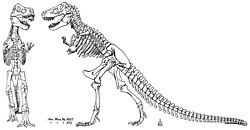
In May 1990, Crichton submitted his manuscript to publisher Alfred A. Knopf.[7]Chip Kidd, then a junior designer at Knopf, was told to create a cover that would suggest live dinosaurs without actually featuring a flesh and blood animal in it. After going by unsuccessful ideas like shadows, footprints, and close-ups of dinosaur skin, Kidd eventually sought inspiration visiting the dinosaur exhibit of the American Museum of Natural History. He concluded that "You’ve got all different kinds of animals represented, but the T. rex sort of commands the room." He made a sketch of its skeleton and bought a textbook on dinosaurs at the gift shop, where he found an illustration of the Tyrannosaurus by Henry Fairfield Osborn that served as the basis for the final product. Kidd noted that his option for the silhouette of a skeleton "brings to mind somewhere in between the remains of the animal and the animal itself." That concept saw approval along with the suggestion that it would be a wraparound image that extended to the spine and back cover, to "get a sense that it’s big, that it can’t be contained on one surface. It has to be free to roam around the entire jacket. Not just the front." The font aimed to be as utilitarian as the signage in an actual amusement park.[9][10]
Jurassic Park was released in October 1990.[11][12][13] For the novel's 30th anniversary, the Folio Society published a special edition in 2020, featuring six illustrations based on scenes in the book.[14][15]
Themes
Jurassic Park critiques the dystopian potentialities of modern science. Ian Malcolm is the conscience that reminds John Hammond of the immoral and unnatural path that has been taken. The final condition of the park is epitomized by the word "hell" which highlights the sacrilegious nature of Hammond's attempt.[16]
The plot of Crichton's novel has similarities to Mary Shelley's 1818 novel Frankenstein; or, The Modern Prometheus, where humanity creates something without truly knowing anything about it. Henry Wu is unable to name the things that he creates, which alludes to Victor Frankenstein not knowing what to call his flawed imitation of God's creation. The immorality of these actions lead to human destruction, echoing the creature's vengeance on his creator.[17]
As Dale Speirs notes at p.18 of "Vanished Worlds: Part 6" in Opuntia 483 (Sept. 2020),[18]Jurassic Park resembles Katharine Metcalf Roof's November 1930 Weird Tales story "A Million Years After", about dinosaurs hatching from millions-of-years-old eggs.[19]
Similar to how his other novels represent science and technology as both hazardous and life-changing, Crichton's novel highlights the hypocrisy and superiority complex of the scientific community that inspired John Hammond to re-create dinosaurs and treat them as commodities, which only lead to eventual catastrophe. Crichton uses the opening of the book to highlight the shift of scientific research from occurring in universities for the betterment of all mankind, to private labs where research is conducted "...in secret...in haste, and for-profit". The similar fears of atomic power from the Cold War are adapted by Crichton onto the anxieties evoked by genetic manipulation.[20]
Reception
The book became a bestseller and Crichton's signature novel, with largely favorable reviews by critics. In a review for The New York Times, Christopher Lehmann-Haupt described it as "a superior specimen of the [Frankenstein] myth" and "easily the best of Mr. Crichton's novels to date".[21] Writing for Entertainment Weekly, Gene Lyons held that the book was "hard to beat for sheer intellectual entertainment" largely because it was "[f]illed with diverting, up-to-date information in easily digestible form".[22] Both Lyons' Entertainment Weekly piece and Andrew Ferguson's review in the Los Angeles Times, however, criticized Crichton's characterization as heavy-handed and his characters as clichéd. Ferguson further complained about Ian Malcolm's "dime-store philosophizing" and predicted that the film adaptation of the book would be "undoubtedly trashy". He conceded that the book's "only real virtue" was "its genuinely interesting discussions of dinosaurs, DNA research, paleontology and chaos theory".[23]
Jurassic Park had sold nine million copies as of 1993.[24] Three years later, it was awarded the Secondary BILBY Award.[25]
Sean Guynes, writing for Tor.com in 2022, felt that Jurassic Park overlooked the dinosaurs as mere plot devices, and was critical of the prose and character development. He simultaneously praised the book for posing questions about the impact of scientific advancements on society, calling it Crichton's "smartest novel" for this reason. He wrote that Jurassic Park "was a bestseller, but it was never acclaimed and isn't remembered with much fondness. It was, for all intents and purposes, a mediocre thriller novel. But it asked big questions and it started something even bigger—a franchise". He went on to call the novel "an important look at scientific ethics and possibility that deserves to be reconsidered as a masterpiece" of the science fiction genre.[26]
The film adaptation excised much of the scientific dialogue, with Crichton saying, "I feel very strongly that books should be the best books they can be, and you should not worry about what the movie will do. In movies, a little bit of that kind of dialogue goes a long way. A movie like Jurassic Park is not the format to have extended discussions on the scientific paradigm."[5] Crichton had also included explicit violence in his novel, including evisceration, believing that it worked well to immerse the reader by establishing the dinosaurs as serious threats. However, he considered film to be a poor format for such violence, believing that it distracts audiences and breaks viewer immersion.[5][27]
The film was a critical and commercial success,[28] leading to a sequel novel by Crichton, titled The Lost World and published in 1995. Spielberg returned to direct the 1997 film adaptation, titled The Lost World: Jurassic Park. No further novels were written by Crichton, although the film series would continue, with Spielberg involved as executive producer. Jurassic Park III was released in 2001, and the Jurassic World series began in 2015. Although not based directly on the novels, these films do include elements from the novel that were unused in the first film.[29]
12345Shay, Don; Duncan, Jody (1993). The Making of Jurassic Park: An Adventure 65 million Years in the Making. Boxtree Limited. pp.3–5. ISBN1-85283-774-8.
↑"Return to Jurassic Park: Dawn of a New Era", Jurassic Park Blu-ray (2011)
↑"A Reading on New Books". The Windsor Star. Canada. October 29, 1990. Retrieved March 10, 2025– via Newspapers.com. Due out soon are Cold Fire, by writer Dean Koontz, and the thriller Jurassic Park by Michael Crichton. Each has been released in floods of about 350,000 copies.
↑"Jurassic Park miscellaneous notes". Turner Classic Movies. Archived from the original on December 6, 2011. Retrieved March 10, 2025. Michael Crichton's novel was published by Alfred A. Knopf in October 1990.
↑Roof, Katherine (1930). "A Million Years After". Weird Tales. Vol.16, no.5. Retrieved November 6, 2022.
↑Geraghty, Lincoln (2018). "Jurassic Park". In Grant, Barry Keith (ed.). Books to Film: Cinematic Adaptations of Literary Works. Vol.1. Retrieved August 2, 2018– via Gale Academic OneFile.
↑"Previous Winners of the BILBY Awards: 1990 – 96"(PDF). www.cbcaqld.org. The Children's Book Council of Australia Queensland Branch. Archived from the original on November 19, 2015. Retrieved November 4, 2015.
This page is based on this Wikipedia article Text is available under the CC BY-SA 4.0 license; additional terms may apply. Images, videos and audio are available under their respective licenses.