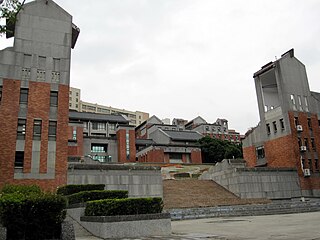
The Taipei National University of the Arts is a national university in Guandu, Beitou District, Taipei, Taiwan.

Jack C.K. Teng, was a Chinese educator, writer, politician, diplomat and Olympic pioneer. He is best known as the Chairman of the Chinese National Olympic Committee during the 1960 Summer Olympics, the first time a Chinese athlete won an Olympic medal.
Taiwan campus folk song, campus folk song, or campus folk rock is a genre of Taiwanese Music with its roots as student songs in the campuses of Taiwanese universities during the 1970s. The genre was highly popular from the mid-1970s to the early 1990s, with its focus on themes from the Chinese cultural sphere in reaction to the prevalence of Western rock music in Taiwan as well as being edged out by the People's Republic of China from the United Nations and from the world political stage. This genre of music became very popular in mainland China during the 1990s with the increased cultural exchanges between Taiwan and the mainland during this period.

National Dong Hwa University (NDHU) is a national research university located in Hualien, Taiwan. Established in 1994, NDHU is widely ranked as Top 10% university in Taiwan by THE, QS, U.S. News, which offers sixth widest range of disciplines in Taiwan, including the sciences, engineering, computer science, environmental studies, oceanography, law, arts, design, humanities, anthropology, social sciences, education sciences, music, and business.
Martino Yu, a Taiwanese artist, who was born in Taoyuan, North Taiwan. He had studied Chinese calligraphy and painting since the childhood. In Taipei, he majored in Chinese painting for the B.F.A and M.F.A. degree. Also good at singing, the artist obtained the certificates of classic vocal in Spain and Italy, respectively. After completing the PhD. study of design in 2010, he was awarded the Golden Melody Awards in 2011 with his tutor, Wen-bin Chou. Both of them are the rarely seen countertenors in Taiwan.
I Lo-fen is a Taiwanese scholar and writer. She received her Chinese Literature Ph.D. from National Taiwan University. She has been an associate professor in the Division of Chinese in Nanyang Technological University’s School of Humanities and Social Sciences since July 2006, and was the Head of the Division (2014-2016). She had formerly committed in institutes like the National Taiwan University, Tamkang University, Fu Jen Catholic University, and the Institute of Chinese Literature and Philosophy at Academia Sinica. In addition, she was also a visiting professor at Stanford University in the United States and East Asian Institute at Sungkyunkwan University, South Korea. Her research expertise lies in Text and Image Studies, Su Shi studies, East Asian literature and intercultural exchanges in Classical Chinese, and Singapore literature, history, and arts studies. She is also a board member of the China Su Shi Studies Society, and an international board member of the Korea Society of East Asian Comparative Literature. She is the Founder and Honorary President of the "Text and Image Studies Society"(文图学会) that was official registered in Singapore on 18 December 2017. By integrating the history of Chinese literature and arts, she has accomplished a series of researches on poems in paintings and poetic imagery. She then proposed the idea of the “Text and Image Studies”(文图学) and focused on the relations, comparison and intertextuality between poems and paintings. From there, she has established her literary theory in arts creation and culture of aesthetics. She is also a column writer of Singapore Lianhe Zaobao (2007-), and she hosts podcast "Lofen says".

Literary Day is observed annually on May 4 in Taiwan, in honor of the May Fourth Movement. It was first celebrated on this day in 1945, and its establishment was affected by the dispute over whether the Kuomintang or the Communist Party was the legitimate successor to the May Fourth Movement, disagreements about how to interpret the movement, and other cultural struggles.
Liao Chi-chun (1902–1976) was a Taiwanese painter and sculptor.
Chinese traditional music includes various music genres which have been inherited for generations in China. Specifically, this term refers to the music genres originated in or before Qing dynasty. According to the appearance, the genres can be classified into instrumental ensemble, instrumental solo, theatre, shuochang, dance music and song. It is now the primary classification in both research and education, although some genres contain different forms of performance and thus do not belong to a single category. The genres could also be classified into literati music, folk music, religious music and palace music, according to their cultural connotations or purpose.
Wang Chiu-Hwa was a Taiwanese architect noted for her work with libraries in Taiwan. Due to the many libraries she designed and the fact she pioneered the earliest modern university library in Taiwan, Wang was given the unofficial title of "Taiwan’s 'Mother of Libraries'".

Sheng-Ching Chang is a Taiwanese art historian. She serves as the director of the Graduate Institute of Museum Studies at Fu Jen Catholic University and the professor at the Department of History of Fu Jen Catholic University in Taipei.

Lin Ying-meng is a Taiwanese politician. She has served as a councillor of Taipei City Council since 2018. She was elected councillor representing Taipei City District 6 during the local elections, and is one of the first openly LGBT people voted into local legislatures in Taiwanese history.

Si̍t-chûn Movement, inasmuch as the Kyoto School, Neo-Confucianism and other prominent philosophical movements in the early-twentieth-century East Asia, is a significant philosophical movement during the Japanese colonial rule in Taiwan, in which the intellectuals in the 1920s formulated their reflections on the Taiwanese community through the western values and thoughts and wedged against the colonial domination and imperial assimilation. Si̍t-chûn Movement was intensely bond with political and cultural counter-imperialism, involving intellectuals e.g. Lin Mosei(zh:林茂生), Hung Yao-hsün(zh:洪耀勳), Wen Kwei Liao(zh:廖文奎), Mingdian Liu(zh:劉明電), Shao-Hsing Chen(zh:陳紹馨), Lin Qiu-wu(zh:林秋悟), Hsiang-yu Su(zh:蘇薌雨), Shenqie Zhang(zh:張深切), Chin-sui Hwang(zh:黃金穗), Shoki Coe(zh:黃彰輝), Isshū Yō(zh:楊杏庭), C K Wu(吳 振坤), and so forth. 'At the begin,' according to the Taiwanese cultural sociologist Ren-yi Liao 's 1988 grounding formulation, 'Taiwanese Philosophy has been a civil intellectual movement against domination, rather than an academic form of conception.' 'Si̍t-chûn Movement', however, has yet ratified and systemically studied until 2014.
Philosophy in Taiwan is the set of philosophical traditions in Taiwan, while Taiwanese philosophy is taken to mean philosophical work from the country. Philosophical thought in Taiwan is diverse, drawing influence from Chinese philosophy during Qing rule from the 17th and 18th century, and Western philosophy through the Kyoto School during Japanese rule in the 19th and early 20th century. Taiwanese philosophy took a more endogenous turn during the modern era, with burgeoning philosophical debate regarding Taiwanese Gemeinschaft.
Kwan Sung-sing was a Chinese construction engineer, architect, entrepreneur, founder of the architectural firm “Kwan, Chu and Yang Architects” and a member of Hongmen. He was also an activist who promoted track and field sports in the Republic of China during the 1950s, and was thus hailed as "the father of track and field in Taiwan." He was born in Weihai, Shandong, Qing China.
Hsin-Chien Huang is an artist and director working in mixed media. Science, technology, new media, programming, and algorithms are tools he uses to bring the universe of his imagination to life. He served as artistic director for SEGA and Sony. Huang collaborated with pioneering American media artist Laurie Anderson on their VR work La Camera Insabbiata/Chalkroom which won the Best VR experience Award at the 74th Venice International Film Festival(it was the first edition of the festival that introduced its virtual-reality section); he also designed her 1995 CD-ROM, Puppet Motel. His work Bodyless was also nominated in the 76th of the festival. In 2011,Huang received the "Pride of Taiwan" honor from president of Taiwan Ma Ying-jeou.

Sophie Chang is a Taiwanese philanthropist, author and painter. She is chairperson of the TSMC Charity Foundation, chairperson of the Weiyi Social Welfare Charity Foundation, director of the Dunan Foundation and director of the Modern Women's Foundation. Chang met with the Dalai Lama in 2007, and has shaped her work according to his teachings.
Zepp New Taipei is a music hall located in Xinzhuang District, New Taipei, Taiwan. The venue was inaugurated in 2020 and belongs to the Zepp group of concert halls in Japan and across Asia.
Saqacengalj is an abandoned or so-called a former indigenous settlement of a Paiwan tribe in Gaoshi Village, Mudan Township, Pingtung County, Taiwan. The term “Saqacengalj” has the meaning of “a tool for chiseling slate,” and the site is believed to be the first settlement of the tribe when they moved to Hengchun. The site, dating back to 500-600 years ago, is about 200-300 meters above sea level, and covers an area of 3.5 hectares. 6-7 times of migrations happened after the site was abandoned, the tribe settled down at the location of Gaoshi Village nowadays at the last migration happened around 50 years ago. The location of the site is about 7 kilometers away from the current settlement of Gaoshi Village, there are still about 83 slate houses at present, which are arranged in parallel rows along the mountain steps

Zoo-anthropomorphic jade earring is a jade ornament that dates back to the Neolithic Period in Taiwan.. It is believed to have been worn as a pendant on the ears, given its notches and the evidence from unearthed contexts. The earring features two human figures with their hands on their waists and their legs spread wide apart. On top of their heads is a beast that resembles a cat, pig, or deer. The feet of the beast are connected to the heads. The feet of the human figures. While there are variations, including single-person or multiple-ring designs, such jade pendants are primarily found in Taiwan, making them highly unique.
 Hong Kong Tsing Yi station《海洋大關園》
 Taiwan Chiayi District Court 大門前《真善美的臨界點-法:平等石》


