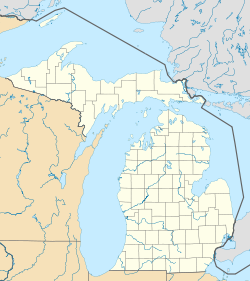
Wayne County is the most populous county in the U.S. state of Michigan. As of 2020, the United States Census placed its population at 1,793,561, making it the 19th-most populous county in the United States. The county seat is Detroit. The county was founded in 1796 and organized in 1815. Wayne County is included in the Detroit-Warren-Dearborn, MI Metropolitan Statistical Area. It is one of several U.S. counties named after Revolutionary War-era general Anthony Wayne.

Kent County is located in the U.S. state of Michigan. As of the 2020 Census, the county had a population of 657,974, making it the fourth most populous county in Michigan, and the largest outside of the Detroit area. Its county seat is Grand Rapids. The county was set off in 1831, and organized in 1836. It is named for New York jurist and legal scholar James Kent, who represented the Michigan Territory in its dispute with Ohio over the Toledo Strip.

Hamtramck is a city in Wayne County in the U.S. state of Michigan. An enclave of Detroit, Hamtramck is located roughly 5 miles (8.0 km) north of downtown Detroit, and is surrounded by Detroit on most sides. As of the 2020 census, the city had a population of 28,433, and was by far the most densely populated municipality in Michigan. It is notable as the only Muslim-majority city in the United States.

Manayunk is a neighborhood in the section of Lower Northwest Philadelphia in the state of Pennsylvania. Located adjacent to the neighborhoods of Roxborough and Wissahickon and also on the banks of the Schuylkill River, Manayunk contains the first canal begun in the United States.

St. Florian Church is a Roman Catholic Church at 2626 Poland Street in Hamtramck, Michigan. The church was designed by Ralph Adams Cram of the firm Cram and Ferguson.

Hillcrest Historic District is an historic neighborhood in Little Rock, Arkansas that was listed on the National Register of Historic Places on December 18, 1990. It is often referred to as Hillcrest by the people who live there, although the district's boundaries actually encompass several neighborhood additions that were once part of the incorporated town of Pulaski Heights. The town of Pulaski Heights was annexed to the city of Little Rock in 1916. The Hillcrest Residents Association uses the tagline "Heart of Little Rock" because the area is located almost directly in the center of the city and was the first street car suburb in Little Rock and among the first of neighborhoods in Arkansas.
The neighborhoods of Omaha are a diverse collection of community areas and specific enclaves. They are spread throughout the Omaha metro area, and are all on the Nebraska side of the Missouri River.

The Boston–Edison Historic District is a neighborhood located in Detroit, Michigan. It consists of over 900 homes built on four east-west streets: West Boston Boulevard, Chicago Boulevard, Longfellow Avenue and Edison Avenue, stretching from Woodward Avenue in the east to Linwood Avenue in the west. It is one of the largest residential historic districts in the nation. It is surrounded by Sacred Heart Major Seminary to the west, the Arden Park-East Boston Historic District and the Cathedral of the Most Blessed Sacrament to the east, and the Atkinson Avenue Historic District to the south. The district was designated a Michigan State Historic Site in 1973 and listed on the National Register of Historic Places in 1975.

This is a list of the National Register of Historic Places listings in Detroit, Michigan.

The West Canfield Historic District is a neighborhood historic district located primarily on Canfield Avenue between Second and Third Streets in Detroit, Michigan. A boundary increase enlarged the district to include buildings on Third Avenue between Canfield and Calumet. The district was designated a Michigan State Historic Site in 1970 and listed on the National Register of Historic Places in 1971; a boundary increase was added in 1997. The revitalized 1870s era neighborhood is one of the residential areas surrounding the city's Cultural Center Historic District in Midtown. Nearby, East Canfield Avenue leads to the Detroit Medical Center complex, the Romanesque Revival styled St. Josaphat's Catholic Church, and the Gothic revival styled Sweetest Heart of Mary Catholic Church.
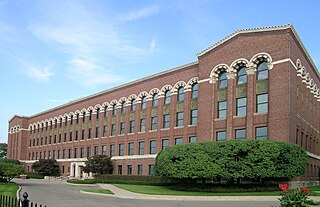
The historic River Place is located in Detroit, Michigan, bounded by Joseph Campau Avenue, Wight Street, McDougall Street, and the Detroit International Riverfront. It was formerly the Parke-Davis and Company Pharmaceutical Plant. The complex was listed on the National Register of Historic Places in 1985.

The East Jefferson Avenue Residential District in Detroit, Michigan, includes the Thematic Resource (TR) in the multiple property submission to the National Register of Historic Places which was approved on October 9, 1985. The structures are single-family and multiple-unit residential buildings with construction dates spanning nearly a century, from 1835 to 1931. The area is located on the lower east side of the city.

The Annapolis Park Historic District is a historic district located along Julius, Matthew, Hanover, Farnum, Alan, and Paul Streets in Westland, Michigan, covering 71 acres (290,000 m2) and 354 buildings. It was listed on the National Register of Historic Places in 2006.

This is a list of the National Register of Historic Places listings in Downtown and Midtown Detroit, Michigan. It is intended to be a complete list of the properties and districts on the National Register of Historic Places in Downtown and Midtown neighborhoods in Detroit, Michigan, United States. Latitude and longitude coordinates are provided for many National Register properties and districts; these locations may be seen together in online maps.
As of 2001, the Metro Detroit area had the U.S.'s second largest Polish ethnic concentration after Chicago. As a whole, Michigan has the second-largest percentage of Polish ancestry of any U.S. state.
Joseph Campau Street, also known as Joseph Campau Avenue, is a city street in Hamtramck and Detroit in the southeastern part of the U.S. state of Michigan. Jos. Campau Historic District is located along the street in Hamtramck. Along Joseph Campau Street and the Detroit River are River Place and The Roberts Riverwalk Hotel and Residence Detroit.
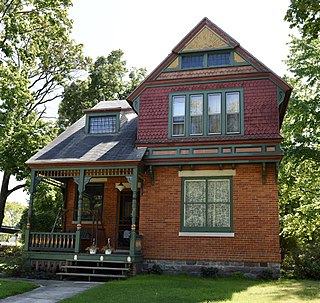
The Buchanan North and West Neighborhoods Historic District is a residential historic district located in Buchanan, Michigan and roughly bounded by Main, 4th, Chippewa, West Front, South Detroit, Chicago, Clark, Roe, and Charles Streets. It was listed on the National Register of Historic Places in 2011.
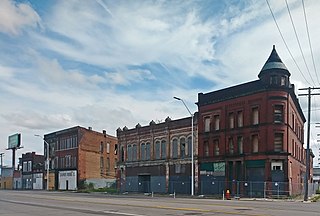
The Michigan Avenue Historic Commercial District in Detroit is a group of commercial buildings located along the south side of two blocks of Michigan Avenue, from 3301–3461. This section of buildings is the most intact collection along this stretch of Detroit's Michigan Avenue. The district was listed on the National Register of Historic Places in 2020.

High Street is a major thoroughfare in Central Ohio, predominantly in Franklin County and Columbus. It stretches from the northern border of Columbus in Delaware County south to the southern boundary of Franklin County just past Columbus's municipal boundaries. The street is considered one of Columbus's two main roads, along with Broad Street.