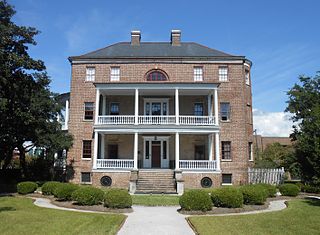
The Joseph Manigault House is a historic house museum in Charleston, South Carolina that is owned and operated by the Charleston Museum. Built in 1803, it was designed by Gabriel Manigault to be the home of his brother, and is nationally significant as a well-executed and preserved example of Adam style architecture. It was declared a National Historic Landmark in 1973.

The Perry McAdow House is a Renaissance Revival house located at 4605 Cass Avenue in Midtown Detroit, Michigan. It was designated a Michigan State Historic Site in 1976 and added to the National Register of Historic Places in 1980.
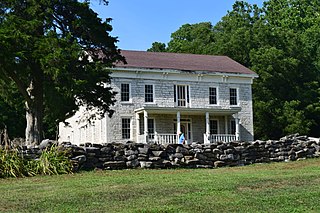
The James John Eldred House is a historic house located in Bluffdale Township near Eldred, Illinois. The house was built in 1861 by James J. Eldred, who lived in the home with his family until 1901. The house was designed in the Greek Revival style and also includes features of the Italianate style. The front of the house has five symmetrical bays and a front porch. The main entry, located in the porch, is bordered by sidelights and a transom. The house's cornice features Greek Revival dentils and pediments and Italianate bracketing. Palladian windows are located on the house's east and west sides. Many of the interior details of the house are original, including its fireplace mantels and much of its woodwork.

St. Mary's Catholic Church is a parish church of the Diocese of Davenport. The church is located at the corner of St. Mary's and Washburn Streets in the town of Riverside, Iowa, United States. The entire parish complex forms an historic district listed on the National Register of Historic Places as St. Mary's Parish Church Buildings. The designation includes the church building, rectory, the former church, and former school building. The former convent, which was included in the historical designation, is no longer in existence.

The George Tromley Sr. House is a historic building located in Le Claire, Iowa, United States. It has been listed on the National Register of Historic Places since 1979. The property is part of the Houses of Mississippi River Men Thematic Resource, which covers the homes of men from LeClaire who worked on the Mississippi River as riverboat captains, pilots, builders, and owners. It is also a contributing property in the Cody Road Historic District.
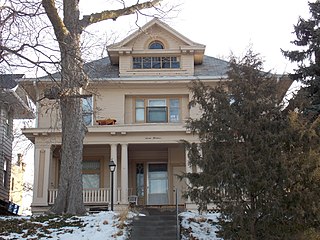
The Fred Finch House is a historic building located on the hill above downtown Davenport, Iowa, United States. It has been listed on the National Register of Historic Places since 1983.

The Sears–Ferris House, at 311 W Third Street in Carson City, Nevada, is a historic house built in 1863. It was owned from 1868 to 1890 by George Washington Gale Ferris Sr., father of George Washington Gale Ferris Jr., future inventor of the Ferris wheel. It has also been known as the G. W. G. Ferris House.

The George Johnson House is an historic building located near Calamus, Iowa, United States. It was listed on the National Register of Historic Places in 2000.
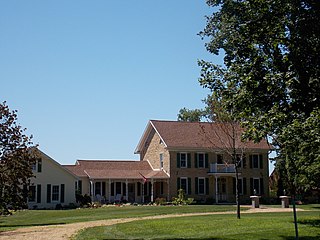
The Peter Dierks House, also known as the Preston Creveling House, is an historic residence located in rural Clinton County, Iowa, United States. It was listed on the National Register of Historic Places in 1998.

The James M. Forney House is a historic building located in Burlington, Iowa, United States. It was listed on the National Register of Historic Places in 1986. Forney was a cabinet maker in Pennsylvania who came to Burlington in 1850 and opened a saw mill. By 1857 he sold his business to his competitors and entered into a partnership with his brother-in-law, Samuel Mellinger, in a tin and coopersmith firm. By 1866 he put his wealth into real estate. In 1875 Forney started another commercial venture with M. C. Buffington, the inventor and patent holder for the Improved Sarven Wheel, also known as the Buffington Wheel. They formed a partnership and opened Buffington, Forney & Company, a carriage wheel manufacturer. They patented and manufactured the Universal Wheelwright Machine, which was considered the finest wheel making machine in the world.

The Hiram Palmer House is a historic house located at 703 East Fort Street in Farmington, Illinois. Hiram and Philynder Palmer built the house in 1851–52 but sold it the year it was completed. In 1856, the house was purchased by Riley Bristol, a local pharmacist and founder of Farmington's First Congregational Church; Bristol lived in the house until 1882. The house has a Greek Revival design, a nationally popular stylistic choice in the first half of the nineteenth century. The wraparound front porch is supported by Tuscan columns. The house's low hip roof features a plain frieze and cornice at the roof line and is topped by a lantern with a cornice and pediment. The house's interior features decorative Greek Revival woodwork, including carved door and window moldings, ornamental panels by the windows, and a fireplace mantel supported by pilasters.
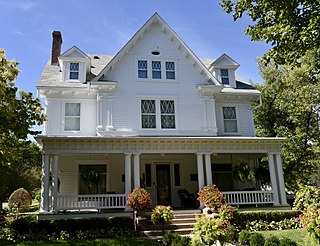
The W.T.S. White House and Carriage House are historic buildings located in Clarinda, Iowa, United States. White created his fortune as president of the Clarinda Poultry Butter and Egg Company. He hired local architect William W. Welch to design his house. It and the carriage house were completed in 1906, and White moved to Chicago the following year. He sold the property to A.U. and Agnes Hunt for $8,000. The house and carriage house were listed together on the National Register of Historic Places in 1994. Both structures are Colonial Revival in style. The 2½-story frame house features Tuscan columns on the front porch, dentil cornice, and diamond lights in the second floor windows. The two-story carriage house measures 25 by 30 feet, and is located behind the main house. It originally housed a horse and buggy, and has been transformed into an automobile garage.
The J.G. and Regina Long House, also known as Maple Grove Hill Farm, is a historic residence located southeast of Prairie City, Iowa, United States. Joseph Grayson "Joe" Long was a native of Greene County, Pennsylvania. He and his brother Jesse relocated to Jasper County, Iowa where they each bought extensive land holdings and farmed. Joe had married Mary Bussey in Pennsylvania, but she died before he relocated to Iowa. He married Regina Hiskey, a native of Richland County, Ohio. They had two sons. Mental illness plagued the family. Jesse committed suicide on his farm and Joe was institutionalized near the end of his life. He died here in 1901, and Regina died here in 1925. Their son Charles owned the farm from 1902 to 1934. This Italianate style house was originally built just outside of the city limits of Monroe, Iowa. The person who bought the property in 2012 didn't want the house so it was sold and relocated to a site similar to its historic rural setting in 2013, southeast of Prairie City. The Iowa State Historic Preservation Office assisted with the move. The two-story frame house follows an L-shaped plan. It features a double and triple bracketed cornice, and a two-story porch in the ell of the house. The house was listed on the National Register of Historic Places in 1997.

The Henry Weis House is a historic building located in Waterloo, Iowa, United States. Weis was a factory owner that produced egg case fillers, which were used to protect eggs during shipping. He engaged the local architectural firm of Murphy & Ralston to design this house, which was completed in 1902. Architecturally, the two-story frame structure is "transitional" in its design, featuring elements of the Queen Anne and the Colonial Revival styles. The Queen Anne is found in its irregular plan, wraparound porch, full-height bays, small second floor porch, and the small screened porch. The Colonial Revival is found in the Ionic fluted porch columns, and the consoles with a row of dentils located along the cornice. The house also features foliated designs on the gable ends. It remained in the Weis family into the 1930s when it was converted into apartments. It has subsequently been converted into a bed and breakfast. The house was listed on the National Register of Historic Places in 1989.
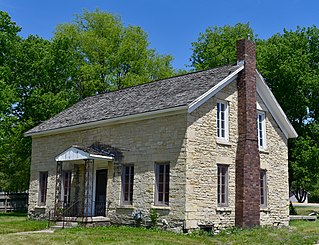
The Dunsmore House is a historic building in Waterloo, Iowa, United States. Thomas Chadwick, a master stonemason originally from England, built this house from native rusticated limestone about 1866. It is one of the earliest extant houses, and the only house made of limestone block still extant in the Waterloo-Cedar Falls area.

The Byron A. Beeson House, also known as Mission Temple Academy, is a historic building located in Des Moines, Iowa, United States. Built c. 1890, the 2½-story structure features balloon frame construction, a complex roof system, and wrap-around front porch. Its flared cornice is considered unusual. It was originally a single-family dwelling that later became and education facility associated with the Church of God in Christ. It is also associated with Byron A. Beeson who served as Treasurer of Iowa from 1891 to 1895, and as Adjutant General of the Iowa National Guard around the same time. The house's significance is derived from its location in suburban North Des Moines and its complex roof system. It was listed on the National Register of Historic Places in 1996. A stable along the alley behind the house shares the historic designation.

The Professor Charles O. Denny House is a historic building located in Des Moines, Iowa, United States. It is a 2½-story dwelling that follows an irregular plan. It features a hipped roof with gablets and additional gables, fishscale shingles, bargeboards, reeded panels that form the cornice, and a wraparound porch with a pedimented entry. The property on which it stands is one of ten plats that were owned by Drake University. The University sold the lot to C.O. Denny in 1892, and he had the house built the following year. Denny was a Latin professor at Drake and lived nearby. He seems to have bought the property for speculative purposes. Its significance is attributed to the effect of the University's innovative financing techniques upon the settlement of the area around the campus. The house was listed on the National Register of Historic Places in 1988.
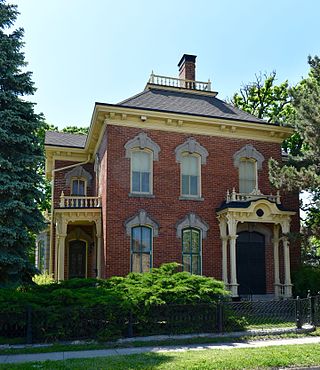
The Naylor House is a historic building located in Des Moines, Iowa, United States. Thomas Naylor was born in England and became a prominent grocer in Des Moines. He had this two-story brick Victorian house built in 1869. It is believed to have been designed by Des Moines architect William Foster. The house features an irregular plan, a combination gable-hip roof, two Carpenter Gothic wood porches, a bay window, pre-cast cement window hoods in an Eastlake design, paired roof brackets, and cornice returns on the gable ends. It remained in the Naylor family for almost 100 years. The house was listed on the National Register of Historic Places in 1974.
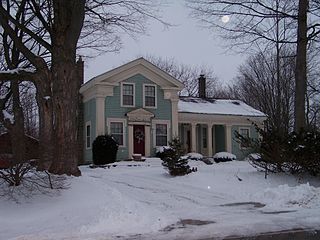
The Jacob Fishbeck Farmstead is a farm located at 5151 Crooked Lake Road in Genoa Township, Michigan. It was listed on the National Register of Historic Places in 2003.
The Bostwick Historic District, in Bostwick, Georgia, is a historic district which was listed on the National Register of Historic Places in 2002. The listing included 64 contributing buildings, a contributing structure, and four contributing sites on 145 acres (59 ha).