Related Research Articles
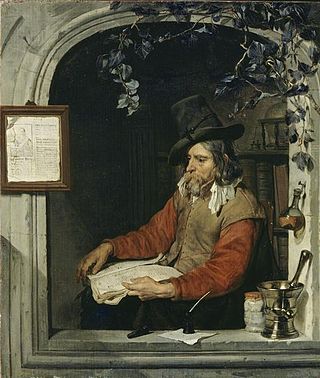
A chemist is a graduated scientist trained in the study of chemistry, or an officially enrolled student in the field. Chemists study the composition of matter and its properties. Chemists carefully describe the properties they study in terms of quantities, with detail on the level of molecules and their component atoms. Chemists carefully measure substance proportions, chemical reaction rates, and other chemical properties. In Commonwealth English, pharmacists are often called chemists.

Some chemical authorities define an organic compound as a chemical compound that contains a carbon–hydrogen or carbon–carbon bond; others consider an organic compound to be any chemical compound that contains carbon. For example, carbon-containing compounds such as alkanes and its derivatives are universally considered organic, but many others are sometimes considered inorganic, such as halides of carbon without carbon-hydrogen and carbon-carbon bonds, and certain compounds of carbon with nitrogen and oxygen.
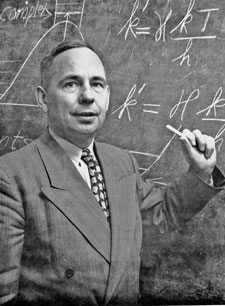
Henry Eyring was a Mexico-born United States theoretical chemist whose primary contribution was in the study of chemical reaction rates and intermediates. Eyring developed the Absolute Rate Theory or Transition state theory of chemical reactions, connecting the fields of chemistry and physics through atomic theory, quantum theory, and statistical mechanics.

Robert Burns Woodward was an American organic chemist. He is considered by many to be the preeminent synthetic organic chemist of the twentieth century, having made many key contributions to the subject, especially in the synthesis of complex natural products and the determination of their molecular structure. He worked closely with Roald Hoffmann on theoretical studies of chemical reactions. He was awarded the Nobel Prize in Chemistry in 1965.
Furan is a heterocyclic organic compound, consisting of a five-membered aromatic ring with four carbon atoms and one oxygen atom. Chemical compounds containing such rings are also referred to as furans.

Medicinal or pharmaceutical chemistry is a scientific discipline at the intersection of chemistry and pharmacy involved with designing and developing pharmaceutical drugs. Medicinal chemistry involves the identification, synthesis and development of new chemical entities suitable for therapeutic use. It also includes the study of existing drugs, their biological properties, and their quantitative structure-activity relationships (QSAR).

Sir Robert Robinson was a British organic chemist and Nobel laureate recognised in 1947 for his research on plant dyestuffs (anthocyanins) and alkaloids. In 1947, he also received the Medal of Freedom with Silver Palm.

Philip Patrick Power is a Distinguished Professor of Chemistry at the University of California, Davis. He has contributed to the synthesis, structure, and physical and chemical characterization of inorganic and organometallic compounds. His research focuses on low-coordinate main group and transition metal compounds. Much of this work hinges on the use of sterically crowded ligands to stabilize unusual geometries.
Steven Victor Ley is Professor of Organic Chemistry in the Department of Chemistry at the University of Cambridge, and is a Fellow of Trinity College, Cambridge. He was President of the Royal Society of Chemistry (2000–2002) and was made a CBE in January 2002, in the process. In 2011, he was included by The Times in the list of the "100 most important people in British science".
The School of Chemistry is a school of the University of Edinburgh, in Scotland. In the 2008 Research Assessment Exercise (RAE) the school was ranked sixth in the UK.
Mercury polycations are polyatomic cations that contain only mercury atoms. The best known example is the Hg2+
2 ion, found in mercury(I) (mercurous) compounds. The existence of the metal–metal bond in Hg(I) compounds was established using X-ray studies in 1927 and Raman spectroscopy in 1934 making it one of the earliest, if not the first, metal–metal covalent bonds to be characterised.
Robert J. Forster is a professor of Physical Chemistry at Dublin City University. He is a member of the Royal Irish Academy.
Tia Emmetine Keyes is a professor of physical chemistry at the School of Chemical Sciences, and a member of the National Centre for Sensor Research at Dublin City University.

Peter Michael Maitlis, FRS was a British organometallic chemist.
Sydney Young, FRS was an English chemist.

John Paul Attfield is a Professor of Materials science in the School of Chemistry at the University of Edinburgh and Director of the Centre for Science at Extreme Conditions (CSEC).

Bernard Lucas Feringa is a Dutch synthetic organic chemist, specializing in molecular nanotechnology and homogeneous catalysis. He is the Jacobus van 't Hoff Distinguished Professor of Molecular Sciences, at the Stratingh Institute for Chemistry, University of Groningen, Netherlands, and an Academy Professor of the Royal Netherlands Academy of Arts and Sciences. He was awarded the 2016 Nobel Prize in Chemistry, together with Sir J. Fraser Stoddart and Jean-Pierre Sauvage, "for the design and synthesis of molecular machines".

Yurii Gun'ko, born in USSR, is a Belarusian scientist, professor of Inorganic Chemistry at School of Chemistry of Trinity College Dublin, and head of the International Research and Education Centre for Physics of Nanostructures.
Usha Ranjan Ghatak (1931–2005) was an Indian synthetic organic chemist, stereochemist and the director of the Indian Association for the Cultivation of Science (IACS). He was known for his contributions in developing novel protocols of stereoselective synthesis of diterpenoids. He was an elected fellow of the Indian Academy of Sciences and the Indian National Science Academy. The Council of Scientific and Industrial Research, the apex agency of the Government of India for scientific research, awarded him the Shanti Swarup Bhatnagar Prize for Science and Technology, one of the highest Indian science awards, in 1974, for his contributions to chemical sciences.
References
- ↑ "Prof Han Vos". DCU – School of Chemical Sciences. Dublin City University. 29 January 2015. Retrieved 23 June 2021.
- ↑ Book Review by Rajendra Rathore Marquette University, J. Am. Chem. Soc., 2003, 125 (44), p 13620
| International | |
|---|---|
| National | |

  | This biography of an Irish academic is a stub. You can help Wikipedia by expanding it. |