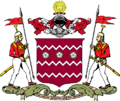
Jammu and Kashmir | |
|---|---|
| 1846–1947 | |
| Jammu and Kashmir in 1946 | |
| Status | Princely state |
| Capital | |
| Common languages | |
| Religion | Islam (majority), Hinduism, Buddhism, Jainism, Sikhism |
| Government | Monarchy |
| Maharaja | |
• 1846–1857 | Gulab Singh (first) |
• 1925–1947 | Hari Singh (last) |
| Dewan | |
• 1917–1921 | Daljit Singh (first) |
• 1947 | Mehr Chand Mahajan (last) |
| History | |
• Foundation of Jammu and Kashmir | 16 March 1846 |
• End of British Crown Suzerainty | 15 August 1947 |
• Beginning of the First Kashmir War | 22 October 1947 |
| 26–27 October 1947 | |
| Today part of | Disputed; see Kashmir conflict |
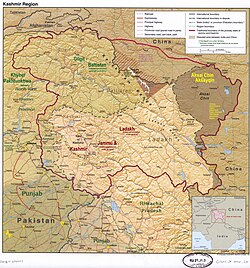
Jammu and Kashmir, also known as Kashmir and Jammu, [1] was a princely state in a subsidiary alliance with the British East India Company from 1846 to 1858, and under the paramountcy (or tutelage [2] [3] ) of the British Crown from 1858 until British withdrawal and the partition of British India in 1947. Following the subsequent First Kashmir War between India and Pakistan, it became a disputed territory, now administered by three countries: China, India, and Pakistan. [4] [5] [6] After the First Anglo-Sikh War, Kashmir was annexed by British India (Company Raj), [7] from the Sikhs as war indemnity, on 9 March 1846. Later, Jammu and Kashmir was formed, when Kashmir was sold to the Raja of Jammu, Gulab Singh, for 75 lakh rupees, on 16 March 1846.
At the time of the partition of India and the political integration of India, Hari Singh, the ruler of the state, delayed making a decision about the future of his state. However, an uprising in the western districts by the Gilgit Scouts against Hari Singh supported by informal militias from the neighbouring Northwest Frontier Province, and the Pakistani army personnel, forced his hand. On 26 October 1947, Hari Singh acceded [8] to India in return for the Indian military being airlifted to Kashmir to counter the invasion by tribal militias from Pakistan, which were assisted by the Pakistani government and military leadership. [9] [10] The western and northern districts now known as Azad Kashmir and Gilgit-Baltistan passed to the control of Pakistan with the support of Gilgit Scouts, [11] while the remaining territory stayed under Indian control, later becoming the Indian administered state of Jammu and Kashmir. [12] India and Pakistan defined a cease-fire line dividing the administration of the territory with the intercession of the United Nations which was supposed to be temporary but still persists. [13] [14]
According to the census reports of 1911, 1921 and 1931, the administration was organised as follows: [15] [16]
In the 1941 census, further details of the frontier districts were given: [15]
| # | Name | Took office | Left office |
|---|---|---|---|
| 1 | Raja Sir Daljit Singh | 1917 | 1921 |
| 2 | Raja Hari Singh | 1925 | 1927 |
| 3 | Sir Albion Banerjee | January 1927 | March 1929 |
| 4 | G. E. C. Wakefield | 1929 | 1931 |
| 5 | Hari Krishan Kaul [17] | 1931 | 1932 |
| 6 | Elliot James Dowell Colvin [17] | 1932 | 1936 |
| 7 | Sir Barjor J. Dalal | 1936 | 1936 |
| 8 | Sir N. Gopalaswami Ayyangar | 1937 | July 1943 |
| 9 | Kailash Narain Haksar | July 1943 | February 1944 |
| 10 | Sir B. N. Rau | February 1944 | 28 June 1945 |
| 11 | Ram Chandra Kak | 28 June 1945 | 11 August 1947 |
| 12 | Janak Singh | 11 August 1947 | 15 October 1947 |
| 13 | Mehr Chand Mahajan | 15 October 1947 | 27 October 1947 |
| Year | Pop. | ±% |
|---|---|---|
| 1873 | 1,534,972 [b] | — |
| 1891 | 2,543,952 | +65.7% |
| 1901 | 2,905,578 | +14.2% |
| 1911 | 3,158,126 | +8.7% |
| 1921 | 3,320,518 | +5.1% |
| 1931 | 3,646,243 | +9.8% |
| 1941 | 4,021,616 | +10.3% |
| Sources: Census in British India | ||
| Census Year | Jammu Province | Kashmir Province | Frontier Regions | Jammu & Kashmir Princely State | ||||
|---|---|---|---|---|---|---|---|---|
| Pop. | % | Pop. | % | Pop. | % | Pop. | % | |
| 1873 [b] [18] | 938,641 | 61.15% | 491,846 | 32.04% | 104,485 | 6.81% | 1,534,972 | 100% |
| 1891 [18] | 1,439,543 | 56.59% | 949,041 | 37.31% | 155,368 | 6.11% | 2,543,952 | 100% |
| 1901 [19] | 1,521,307 | 52.36% | 1,157,394 | 39.83% | 226,877 | 7.81% | 2,905,578 | 100% |
| 1911 [20] | 1,597,865 | 50.6% | 1,295,201 | 41.01% | 265,060 | 8.39% | 3,158,126 | 100% |
| 1921 [21] | 1,640,259 | 49.4% | 1,407,086 | 42.38% | 273,173 | 8.23% | 3,320,518 | 100% |
| 1931 [22] | 1,788,441 | 49.05% | 1,569,218 | 43.04% | 288,584 | 7.91% | 3,646,243 | 100% |
| 1941 [23] | 1,981,433 | 49.27% | 1,728,705 | 42.99% | 311,478 | 7.75% | 4,021,616 | 100% |
| Religious group | 1891 [18] | 1901 [19] | 1911 [20] | 1921 [21] | 1931 [22] | 1941 [23] | ||||||
|---|---|---|---|---|---|---|---|---|---|---|---|---|
| Pop. | % | Pop. | % | Pop. | % | Pop. | % | Pop. | % | Pop. | % | |
| Islam | 1,793,710 | 70.51% | 2,154,695 | 74.16% | 2,398,320 | 75.94% | 2,548,514 | 76.75% | 2,817,636 | 77.28% | 3,101,247 | 77.11% |
| Hinduism | 691,800 | 27.19% | 689,073 | 23.72% | 690,390 | 21.86% | 692,641 | 20.86% | 736,222 | 20.19% | 809,165 | 20.12% |
| Buddhism | 29,608 | 1.16% | 35,047 | 1.21% | 36,512 | 1.16% | 37,685 | 1.13% | 38,724 | 1.06% | 40,696 | 1.01% |
| Tribal | 16,615 | 0.65% | N/a | N/a | N/a | N/a | N/a | N/a | 134 | 0% | 51 | 0% |
| Sikhism | 11,399 | 0.45% | 25,828 | 0.89% | 31,553 | 1% | 39,507 | 1.19% | 50,662 | 1.39% | 65,903 | 1.64% |
| Jainism | 593 | 0.02% | 442 | 0.02% | 345 | 0.01% | 529 | 0.02% | 597 | 0.02% | 910 | 0.02% |
| Christianity | 218 | 0.01% | 422 | 0.01% | 975 | 0.03% | 1,634 | 0.05% | 2,263 | 0.06% | 3,509 | 0.09% |
| Zoroastrianism | 9 | 0% | 11 | 0% | 31 | 0% | 7 | 0% | 5 | 0% | 29 | 0% |
| Judaism | N/a | N/a | N/a | N/a | N/a | N/a | N/a | N/a | N/a | N/a | 10 | 0% |
| Others | 0 | 0% | 60 | 0% | 0 | 0% | 1 | 0% | 0 | 0% | 95 | 0% |
| Total population | 2,543,952 | 100% | 2,905,578 | 100% | 3,158,126 | 100% | 3,320,518 | 100% | 3,646,243 | 100% | 4,021,616 | 100% |
| Note: The Princely State of Jammu and Kashmir includes the contemporary administrative divisions of Jammu, Kashmir, Ladakh, Azad Kashmir, and Gilgit-Baltistan. | ||||||||||||
Paramountcy was the 'vague and undefined' feudatory system whereby the British, as the suzerain power, dominated and controlled India's princely rulers. ... These 'loyal collaborators of the Raj' were 'afforded [British] protection in exchange for helpful behavior in a relationship of tutelage, called paramountcy'.
... the problem of the 'princely states'. These states had accepted the tutelage of the British Crown under the terms of the doctrine of 'paramountcy' under which they acknowledged the Crown as the 'paramount' authority in the subcontinent.
This article incorporates text from the Imperial Gazetteer of India , a publication now in the public domain.