The Levi F. Warren Jr. High School is a former public junior high school building located at 1600 Washington Street, in the village of West Newton, in Newton, Massachusetts. It was named for Levi F. Warren, who graduated in 1854 from what is now Bridgewater State College and taught 21 years in grammar schools in Salem and in Newton, where he was a principal in West Newton.
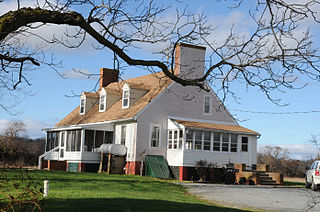
Bachelor's Hope is a historic house in Centreville, Maryland. Built between 1798 and 1815, it was added to the National Register of Historic Places in 1984.

Rockdale, also known as The Robinson/Stirling Place, is a historic home and farm complex located at Fallston, Harford County, Maryland, United States. It is a farm developed from the late 18th century through the early 20th century. The dwelling is in three parts. The east room of the east wing is the earliest section dating from the 18th century. The largest or main portion of the dwelling dates from between 1815 and 1830. The north wing, a bay centered in the south façade of the second story, and a small conservatory, date from the very early 20th century. The main house is five bays in length, two and a half stories, of stone construction, stuccoed and scored. The home is surrounded by several outbuildings, trees, and other plantings, and the remains of formal gardens and garden structures developed in the early 20th century. It was the residence of William E. Robinson (1860-1935), an entrepreneur in the local canning industry.

Central Office Building is a historic building located in downtown Davenport, Iowa, United States. It has been individually listed on the National Register of Historic Places since 1983. In 2020 it was included as a contributing property in the Davenport Downtown Commercial Historic District. It is located in the center of a block with other historic structures. It now houses loft apartments.

Argyle Flats is a historic building located on a busy thoroughfare in Davenport, Iowa, United States. It was listed on the National Register of Historic Places in 1983.

Short Homestead, also known as the James Baxter House, is a historic home and farm located near Georgetown, Sussex County, Delaware. The earlier section is dated to the mid-18th century, and is a two-story, three-bay, double-pile brick structure. A two-story, two-bay frame wing was built in the mid-19th century. Both sections have gable roofs. The house was once the center of a 500-acre plantation. The house was "modernized" in the late-19th century.
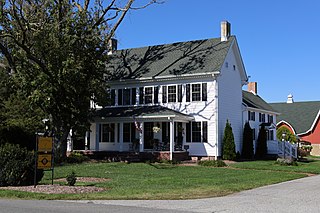
Hopkins Covered Bridge Farm is a historic home and farm located near Lewes, Sussex County, Delaware. The house was built about 1868, and is a rectangular, two-story, five-bay, single-pile, center-hall passage, frame dwelling with vernacular Gothic style details. It has a rectangular, two-story, three-bay, single pile, center passage, frame ell or wing. Both sections have gable roofs. The front facade has a three-bay, hipped roof porch. Also on the property are a contributing dairy barn designed by Rodney O'Neil, milk house (1925), and silo.

The James Steel House is a historic home located at Newark, New Castle County, Delaware. The original section, a two-story, two-bay, double-pile, stuccoed brick structure, is dated to the late 18th century. It was doubled in size about 1882, with the facade addition of a two-story, two-bay, frame wing. It features a two-story bay window on the endwall, a pointed-arch attic window, and German siding. The main block has had a series of rear additions during the late 19th and early 20th centuries, creating an overall T-plan.

Henry Miller House is a historic home located near Mossy Creek, Augusta County, Virginia. The original section was built about 1785, and expanded in the mid-19th century. It is a two-story, stone and brick dwelling with a combined gable and hipped roof. It consists of a square, four-bay, double-pile section with a three-bay, single-pile attached wing to form unbroken seven-bay facade. It features a full-width, one-story porch. Also on the property are a contributing two-story, one-cell rubble stone kitchen and two-story, three-bay, single-cell spring house.

John Beaver House, also known as the Thomas Shirley House, is a historic home located near Salem, Page County, Virginia. It was built in 1825–1826, and is a two-story, four-bay, single pile brick dwelling. It has two entryways, a three-course molded brick cornice under the eaves of the gable roof, and exterior end chimneys. A two-story, five-bay kitchen/dining room ell was added in the late-19th century.

Montebello is a historic home located at Charlottesville, Virginia. The central section was built in 1819–1820, and consists of three-part facade, with a three bay, two-story central block with single-story flanking wings. The original section has a single pile, brick I-house plan with a central hall flanked by a room on each side. Also on the property is a contributing 1+1⁄2-story, brick, two-car garage. The house was built by John M. Perry, one of the workmen who worked with Thomas Jefferson at Monticello and on his many building projects at the University of Virginia. The University of Virginia purchased the house and property in 1963 and it currently serves as a residence for faculty.

Cherry Grove Plantation is a historic plantation in Natchez, Mississippi.

The Rufus Piper Homestead is a historic house on Pierce Road in Dublin, New Hampshire. The house is a well-preserved typical New England multi-section farmhouse, joining a main house block to a barn. The oldest portion of the house is one of the 1+1⁄2-story ells, a Cape style house which was built c. 1817 by Rufus Piper, who was active in town affairs for many years. The house was listed on the National Register of Historic Places in 1983. The home of Rufus Piper's father, the Solomon Piper Farm, also still stands and is also listed on the National Register of Historic Places.

The James Robbe Jr. House is a historic house on Old Peterborough Road in Dublin, New Hampshire, United States. Built about 1825, it is a well-preserved example of a typical early Cape-style farmstead. The house was listed on the National Register of Historic Places in 1983.

The Capt. Richard Strong House is a historic house at 1471 Peterborough Road in Dublin, New Hampshire. This two story wood-frame house was built c. 1821, and was the first house in Dublin to have brick end walls. It was built by Captain Richard Strong, a grandson of Dublin's first permanent settler, Henry Strongman. The house has later ells added to its right side dating to c. 1882 and c. 1910. In the second half of the 19th century the house was owned by the locally prominent Gowing family. The house was listed on the National Register of Historic Places in 1983.

The Townsend Farm is a historic farmstead on East Harrisville Road in Dublin, New Hampshire. Built about 1780 and enlarged about 1850 and again at the turn of the 20th century, it is one of Dublin's older houses, notable as the home and studio of artist George DeForest Brush, one of the leading figures of Dublin's early 20th-century art colony. The house was listed on the National Register of Historic Places in 1983.

The Woodman Road Historic District of South Hampton, New Hampshire, is a small rural residential historic district consisting of two houses on either side of Woodman Road, a short way north of the state line between New Hampshire and Massachusetts. The Cornwell House, on the west side of the road, is a Greek Revival wood-frame house built c. 1850. Nearly opposite stands the c. 1830 Verge or Woodman House, which is known to have been used as a meeting place for a congregation of Free Will Baptists between 1830 and 1849.
Hickory Hill, also known as the Price-Everett House, is a historic home located near Hamilton, Martin County, North Carolina. The original Greek Revival style section was built about 1847, and is a two-story double-pile, frame building with a center-hall plan. It is three bays by two bays, and has a low hipped roof and two interior chimneys with stuccoed stacks. The present one-story, hipped roof, full-facade Victorian porch was added in the 1880s. The house was considerably refurbished in the Colonial Revival style during the early-20th century.

James Dexter Ledbetter House is a historic home located near Forest City, Rutherford County, North Carolina. It built in 1914, and is a 2+1⁄2-story, three-bay, double pile frame dwelling with Classical Revival and Colonial Revival style design elements. It sits on a low brick foundation and has a hipped roof. The front facade features a two-story engaged portico supported by Tuscan order columns, with a one-story wraparound section also supported by Tuscan columns.

Graves-Stewart House is a historic home located at Clinton, Sampson County, North Carolina. It was built about 1840, and is a two-story, five-bay, double-pile, temple form, Greek Revival style frame dwelling. The front features a three-bay, one-story hip roofed porch, supported by Doric order pillars. Also on the property is a contributing carriage house. It is the only surviving structure associated with the Clinton Female Academy. It was restored and renovated for use by the First American Federal Savings and Loan Association in 1980–1981.