
Ramon del Fierro Magsaysay was a Filipino statesman who served as the seventh President of the Philippines, from December 30, 1953, until his death in an aircraft disaster on March 17, 1957. An automobile mechanic by profession, Magsaysay was appointed military governor of Zambales after his outstanding service as a guerrilla leader during the Pacific War. He then served two terms as Liberal Party congressman for Zambales's at-large district before being appointed Secretary of National Defense by President Elpidio Quirino. He was elected president under the banner of the Nacionalista Party. He was the youngest to be elected as president, and second youngest to be president. He was the first Philippine president born in the 20th century and the first to be born after the Spanish colonial era.
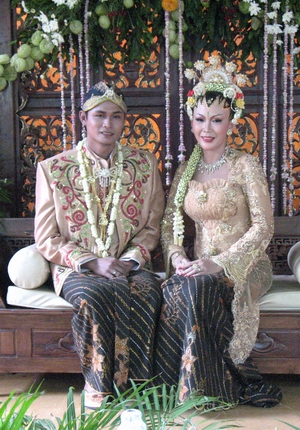
The Javanese are an Austronesian ethnic group native to the central and eastern part of the Indonesian island of Java. With more than 100 million people, Javanese people are the largest ethnic group in both Indonesia and in Southeast Asia as a whole. Their native language is Javanese, it is the largest of the Austronesian languages in number of native speakers and also the largest regional language in Southeast Asia. As the largest ethnic group in the region, the Javanese have historically dominated the social, political, and cultural landscape of both Indonesia and Southeast Asia.

Laskar Jihad was an Islamist and anti-Christian Indonesian militia, which was founded and led by Jafar Umar Thalib. At present, the militia is believed to have disbanded.

Benedict Richard O'Gorman Anderson was an Anglo-Irish political scientist and historian who lived and taught in the United States. Anderson is best known for his 1983 book Imagined Communities, which explored the origins of nationalism. A polyglot with an interest in Southeast Asia, he was the Aaron L. Binenkorb Professor of International Studies, Government & Asian Studies at Cornell University. His work on the "Cornell Paper", which disputed the official story of Indonesia's 30 September Movement and the subsequent anti-Communist purges of 1965–1966, led to his expulsion from that country. Benedict Anderson was the elder brother of the historian Perry Anderson.

The Balinese people are an Austronesian ethnic group native to the Indonesian island of Bali. The Balinese population of 4.2 million live mostly on the island of Bali, making up 89% of the island's population. There are also significant populations on the island of Lombok and in the easternmost regions of Java.

Oei Tiong Ham, Majoor-titulair der Chinezen was a Chinese Indonesian tycoon and the son of Oei Tjie Sien, the founder of the Kian Gwan, a multinational trading company. Born in Semarang, Central Java, Dutch East Indies, he became the wealthiest person in Asia at the start of the twentieth century. Part of his wealth originated in his involvement in the sugar industry. He served as Luitenant der Chinezen in the Dutch colonial administration in Semarang, and was raised to the rank of titular Majoor upon retirement.
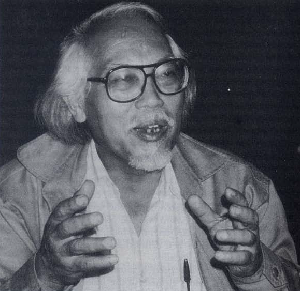
Yusuf Bilyarta Mangunwijaya, was an Indonesian architect, writer, and Catholic religious leader. He was popularly known as Romo Mangun.

Ali Sadikin was an Indonesian politician who served as the fourth governor of Jakarta from 1966 until 1977. Prior to becoming governor, he served as Minister of Transportation from 1963 until 1966 and Coordinating Minister for Marine Affairs from 1964 until 1966. He also served as Chairman of the Football Association of Indonesia from 1977 until 1981. Born to parents of ethnic-Sundanese descent, Ali attended the Semarang Shipping Science Polytechnic during the Japanese occupation period. During the Indonesian National Revolution, he joined the People's Security Agency Navy, the predecessor to the Indonesian Navy, and fought against the Dutch during Operation Product and Operation Kraai. Following the end of the national revolution, Ali remained in the navy and fought against the Permesta rebel movement in the late 1950s.

Many Armenian merchants from Amsterdam went to Southeast Asia in the 19th century to trade, and to set up factories and plantations. Armenian merchants settled in parts of Java, then part of the Dutch East Indies, as did Armenians moving east from the Persian Empire, establishing a community of Armenians in Java.
Merle Calvin Ricklefs was an American-born Australian scholar of the history and current affairs of Indonesia.

Peter Carey is a British historian and author who specialises in the modern history of Indonesia, Java in particular, and has also written on East Timor and Myanmar. He was the Laithwaite fellow of Modern History at Trinity College, Oxford, from 1979 to 2008. His major early work concentrated on the history of Diponegoro, the British in Java, 1811–16 and the Java War (1825–30), on which he has published extensively. His biography of Diponegoro, The Power of Prophecy, appeared in 2007, and a succinct version, Destiny; The Life of Prince Diponegoro of Yogyakarta, 1785–1855, was published in 2014. He has conducted research in Lisbon and the United Kingdom amongst the exile East Timorese student community for an oral history of the Indonesian occupation of East Timor, 1975–99, part of which was published in the Cornell University journal Indonesia.
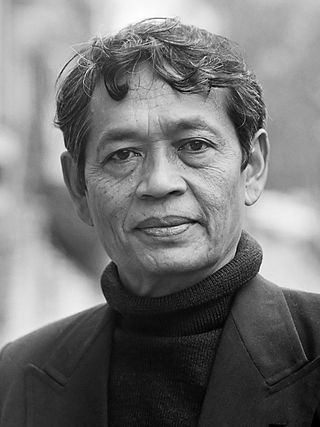
Mochtar Lubis was an Indonesian journalist and novelist who co-founded Indonesia Raya and monthly literary magazine Horison. His novel Senja di Jakarta was the first Indonesian novel to be translated into English. He was a critic of Sukarno and was imprisoned by him, as well as by Suharto on several later occasions. He held strong anti-leftist views and was seen by critics as aligned with military and pro-US forces that were opposed to Sukarno’s non-aligned policies, a charge that he himself denied.

Totok is an Indonesian term of Javanese origin, used in Indonesia to refer to recent migrants of Arab, Chinese, or European origins. In the eighteenth and nineteenth centuries it was popularised among colonists in Batavia, who initially coined the term to describe the foreign born and new immigrants of "pure blood" – as opposed to people of mixed indigenous and foreign descent, such as the Peranakan Arabs, Chinese or Europeans.

The Dutch East Indies, also known as the Netherlands East Indies, was a Dutch colony with territory mostly comprising the modern state of Indonesia, which declared independence on 17 August 1945. Following the Indonesian War of Independence, Indonesia and the Netherlands made peace in 1949. In the Anglo-Dutch Treaty of 1824, the Dutch ceded the governorate of Dutch Malacca to Britain, leading to its eventual incorporation into Malacca (state) of modern Malaysia.

Robert Nieuwenhuys was a Dutch writer of Indo descent. The son of a 'Totok' Dutchman and an Indo-European mother, he and his younger brother Roelof, grew up in Batavia, where his father was the managing director of the renowned Hotel des Indes.

Colonial buildings and structures in Jakarta include those that were constructed during the Dutch colonial period of Indonesia. The period succeeded the earlier period when Jakarta, governed by the Sultanate of Banten, were completely eradicated and replaced with a walled city of Batavia. The dominant styles of the colonial period can be divided into three periods: the Dutch Golden Age, the transitional style period, and Dutch modernism. Dutch colonial architecture in Jakarta is apparent in buildings such as houses or villas, churches, civic buildings, and offices, mostly concentrated in the administrative city of Central Jakarta and West Jakarta.

Batara Guru is the name of a supreme god in Indonesian Hinduism. His name is derived from Sanskrit Bhattaraka which means “noble lord". He has been conceptualized in Southeast Asia as a kind spiritual teacher, the first of all Gurus in Indonesian Hindu texts, mirroring the guru Dakshinamurti aspect of Hindu god Shiva in the Indian subcontinent. However, Batara Guru has more aspects than the Indian Shiva, as the Indonesian Hindus blended their spirits and heroes with him. Batara Guru's wife in Southeast Asia is Shiva's consort Durga.

Josias Cornelis Rappard was a Dutch soldier and artist. Some of his paintings were made into lithographs and illustrations. He spent time in the Dutch East Indies (Indonesia) and made artworks there.
Lintong Mulia Sitorus, in pre-1948 spelling Lintong Moelia Sitoroes, was an Indonesian intellectual, writer, translator, lawyer, and Socialist Party of Indonesia politician. He was a key follower of the independent-minded Indonesian nationalist Sutan Sjahrir in the 1940s and 1950s.

Lie Loan Lian Nio was one of the earliest known woman translators of Chinese language novels into Malay in the Dutch East Indies. She was active in the 1920s and mostly translated for the magazine Tjerita Baroe.

