英文互译镜像站

Iris subg. Iris

Last updated

Iris subg. Iris
Purple-Iris pn.jpg
Purple bearded iris
Scientific classification OOjs UI icon edit-ltr.svg
Kingdom: Plantae
Clade: Tracheophytes
Clade: Angiosperms
Clade: Monocots
Order: Asparagales
Family: Iridaceae
Subfamily: Iridoideae
Tribe: Irideae
Genus: Iris
Subgenus: Iris subg. Iris
Type species
Iris germanica

Subgenus Iris is one subgenus of Iris.

Iris as a plant was originally named by Carl Linnaeus in his book Systema Naturae (in 1735), with a great number of species being added into the genus. Including new ones that were found after the book's publication. The division of irises into various subgroups, has taken various forms over the years. By the 19th century botanists had created new genera such as Evansia, Hermodactylus, Moraea, Oncocyclus, and Xiphion. Opinion was often divided whether to split the genus into several parts or lump them back into Iris. From J. G. Baker, who separated some such as Moraea and Xiphion from Iris in his book 'Handbook of the Irideae' (published in London) in 1892. Then William R. Dykes, who clarified the situation by a compromise in his monograph The Genus Iris (by Cambridge University Press, 1913; later reprinted in 1974 by Dover). He was the first to term the subgroup as Iris sect. Iris. G. Rodionenko  [ ru ]'s 1961 reclassification in The Genus Iris (written in Russian, Moscow, 1961) was more comprehensive in that he split the genus into five genera: Iris (which included all rhizomatous irises). [1] A taxonomic revision by Brian Mathew in 1981 (The iris, New York: Universe Books), recognized six subgenera: Nepalensis Dykes, Xiphium (Miller) Spach, Scorpiris Spach, Hermodactyloides Spach, Iris L. and Limniris Tausch. [2] Recently, DNA analysis has been used to determine groupings. [3]

Contents

Taxonomy

The subgenus Iris subg. Iris is an autonym. [4] It has been divided into six sections: [5]

Sections Oncocyclus and Regelia are also called aril irises.[ citation needed ]

Section bearded irises (or pogon irises)

Close-up of the flower, showing the yellow hairs of the 'beard' Bearded Iris (8057585814).jpg
Close-up of the flower, showing the yellow hairs of the 'beard'

This is the largest section of the subgenus, the true bearded irises. Most irises come from Southern or eastern Europe. [2] 'Pogon' refers to the Greek word for beard. [6] It has several species of iris including;

ImageScientific nameDistribution
Iris adriatica Trinajstic ex Mitic 2002Croatia
Iris alberti.jpg Iris albertii Regel 1877Kazakhstan
Iris alexeenkoi Grossh. 1950Azerbaijan
Iris sp. (17164262520).jpg Iris aphylla L. 1753—stool iris, table iris, leafless iris.Azerbaijan, Russian Federation, Czech Republic, Germany, Hungary, Poland, Belarus, Ukraine, Bulgaria, Albania, Former Yugoslavia, Italy, Romania and France.
Iris attica (17023278349).jpg Iris attica (Boiss. & Heldr.) Hayek 1859North Macedonia, Turkey, Greece
Iris benacensis A.Kern. ex Stapf 1887Italy
Iris bicapitata Colas., Fl. Medit. 6- 214 (1996).jpg Iris bicapitata Colas. 1996Italy
Iris florentina AH.9170 L.- Syst. Nat. ed. 10- 2- 863 (1759). 20240218 225310.jpg Iris florentina L. 1759 — white flag Iris, white cemetery iris.Saudi Arabia, Yemen
Plants of Artavaz 4.jpg Iris furcata Bieb. 1832—forked iris.Turkey, Ukraine
Iris germanica Valais2.JPG Iris × germanica L. 1753—German iris (I. pallida × I. variegata).Balkan Peninsula
Iris glaucescens.jpg Iris glaucescens Bunge 1829Russia, Kazakhstan, Mongolia and China
Iris griffithii Baker 1892Afghanistan
Iris hellenica Mermygkas 2010Greece
Iris imbricata kz03.jpg Iris imbricata Lindl. 1845Iran, Armenia, Azerbaijan and Georgia
Iris junoniana0.jpg Iris junonia Schott ex Kotschy 1854Turkey
Iris kashmiriana-2-bsi-yercaud-salem-India.JPG Iris kashmiriana Baker 1877India
Iris lutescens1.jpg Iris lutescens Lam. 1789 (including I. italica)Spain, Southern France and Italy
Iris Marsica 3.jpg Iris marsica I.Ricci & Colas. 1973 publ. 1974Italy
Iris orjenii Brauchler & Cikovac plant ex situ from Bijela gora.jpg Iris orjenii Bräuchler & Cikovac 2007 —Orjen irisMontenegro and Bosnia and Herzegovina
Iris pallida specie.jpg Iris pallida Lam. 1789 —sweet iris, Dalmatian irisCroatia
Iris illyrica kz02.jpg Iris pallida subsp. illyrica (Tomm. ex Vis.) K.Richt. 1890endemic to Balkan Peninsula.
Iris pallida ssp. cengialti PID1626-2.jpg Iris pallida subsp. cengialti (Ambrosi ex A.Kern.) Foster 1886Iris cengialtiItaly
Iris perrieri Simonet ex P.Fourn. 2003France, Italy
Iris pseudopumila02.jpg Iris pseudopumila Tineo 1827Italy, Sicily, Malta
Iris pumila 21(17). Serednya Khortitsa.jpg Iris pumila L. 1753Albania, Austria, Bulgaria, Central European Russia, Czechoslovakia, East European Russia, Hungary, Kazakhstan, Krym, North Caucasus, Romania, South European Russia, Transcaucasus, Ukraine
Iris relicta Colas. 1996Italy
Iris reichenbachii 01.jpg Iris reichenbachii Heuff. 1858—Reichenbach's irisBulgaria, Montenegro, Serbia, North Macedonia, and Greece
Iris revoluta Colas. 1978Italy
Iris scariosa1.jpg Iris scariosa Willd. ex Link 1820Russia, Kazakhstan, Mongolia and China
DIris schachtii kz04.jpg Iris schachtii Markgr. 1957Turkey
Irus Aram Naharayim.JPG Iris sicula Tod. 1858 —Mesopotamian irisIraq, Turkey, Syria and Israel
Iris suaveolens purple.jpg Iris suaveolens Boiss. & Reut. 1854 (including I. iliensis)Bulgaria, Romania, Albania, Macedonia, Turkey, and Greece.
Iris taochia Woronow ex Grossh. 1928Turkey
Iris timofejewii Woronow 1924Russia (Dagestan)
Iris variegata 03.JPG Iris variegata L. 1753—Hungarian irisAustria, Bulgaria, Czechoslovakia, Germany, Greece, Hungary, Romania, Ukraine, Yugoslavia
Bearded iris cultivar 'Stepping Out' Iris 'Stepping out' 2007-05-13 388.jpg
Bearded iris cultivar 'Stepping Out'

It also includes thousands of ornamental plant cultivars, which have been divided into various height categories. [7]

Psammiris

This section of irises was first described by Spach. Most of the Irises come from Russia and Northwest China. Mostly rhizomatous, and flowering in late spring. [2] 'Psammiris' is derived from the Greek word psammos for sand. [6] The type species for this section is Iris arenaria

Iris humilis subsp. arenaria Iris humilis subsp. arenaria sl7.jpg
Iris humilis subsp. arenaria

It includes;

ImageScientific nameDistribution
Iris humilis subsp. arenaria sl19.jpg Iris arenaria Waldst. 1801 and Kit. Hungary, Austria, Romania, Czech Republic and Ukraine.
Iris bloudowii Bunge. 1830Russia (Siberia), Kazakhstan, Mongolia, China (Xinjiang)
Iris curvifolia Zhao [8] China (Xinjiang)
Iris humilis (Iridaceae) (34955849814).jpg Iris humilis Georgi 1775China ( Heilongjiang, Jilin, Nei Monggol, Ningxia and Xinjiang), Russia (Buryatia, Chita, Irkutsk, Magadan, Primorye and Tuva.), Mongolia, Japan, Austria, Czechoslovakia, Hungary, Kazakhstan, and Romania
Iris kamelinii Alexeeva 2006Mongolia
Iris mandshurica Maxim. 1880China (Heilongjiang, Jilin, Liaoning), Korea, Russia
Iris potaninii 41536926.jpg Iris potaninii Maxim. 1880Russia (Siberia), Mongolia and China (Gansu, Qinghai, Sichuan, Xizang )
Iris vorobievii N.S.Pavlova 1987Russia (Primorye, Primorsky Krai)

Oncocyclus

Iris atropurpurea from Israel IrisHaArgemanZE001.jpg
Iris atropurpurea from Israel

Oncocyclus irises are rhizomatous perennials. They also generally need rich soils that drain easy and are in full sun. Most also prefer a dry period after flowering. [9] The Oncocyclus irises are mostly from Turkey, Caucasus and Iran. The plants usually have only one flower, [2] which is veined or spotted. [10] Some of these species have been bred with bearded irises to create unique colours and markings. [2] Oncocyclus is a Greek word, with onco meaning mass, or bulk, and cyclus meaning circle. [11] In 1846, the term 'Oncocyclus' was first used by C.H. Siemssen as the Genus Oncocyclus in 1846 in Botanische Zeitung. Baker then re-classified it to a subgenus in 1877, than Dykes lowered it to a section in 1914, where it currently remains. [12]

ImageScientific nameDistribution
Iris helena-IMG 2212.jpg Iris acutiloba C.A.Mey. 1831 (including I. ewbankiana )Turkey, Armenia, Azerbaijan, Turkmenistan, Dagestan, Iran
Iris antilibanotica Dinsmore 1933 publ. 1934Syria
Iris assadiana Chaudhary, Kirkw. & C.Weymolauth 1975 publ. 1976Syria
Iris aurantiaca in southern Syria.jpg Iris auranitica Dinsmore 1933 publ. 1934Syria
Ayrvs SHKHvm.jpg Iris atrofusca Bak. 1889Israel, Palestine, and Jordan.
IrisHaArgemanZE001.jpg Iris atropurpurea Bak. 1889Israel
Nature of Iran IMG 8784 Lar National Park, Iran (34048266205).jpg Iris barnumiae Bak. & Fost.Armenia, Azerbaijan, Iran, Iraq, and Turkey.
Iris basaltica Dinsmore 1933 publ. 1934Iran, Iraq, Lebanon-Syria, Turkey
PikiWiki Israel 42166 Iris Bismarkia (cropped).jpg Iris bismarckiana Reg. 1890 – Nazareth irisIsrael, Lebanon, Jordan and Syria
Iris bostrensis (6945052038).jpg Iris bostrensis Mouterde 1955Syria and Jordan
Iris camillae Grossh. 1928Azerbaijan
Iris cedreti Dinsm. ex Chaudhary 1972Lebanon
Iris damascena Mouterde 1966Syria (Jabl Qasyoun)
Iris gatesii Foster 1890Turkey and Iraq
Iris grossheimii Woronow ex Grossh. 1928Georgia, Armenia and Azerbaijan.
Iris haynei (photo by Pixie).jpg ] Iris haynei Baker 1876 – Gilboa irisIsrael and Palestine
Iris heylandiana Boiss. & Reut. 1882Iraq
PikiWiki Israel 42124 Iris Hermona.JPG Iris hermona Dinsmore 1933 publ. 1934 – Hermon irisIsrael and Syria.
Qax r. AxarBaxar silsil@si. Iberiya sus@nl@ri.jpg Iris iberica Hoffm. 1808Armenia, eastern Georgia, and western Azerbaijan.
Iris kirkwoodi Chaudhary 1972 (including I. calcarea)Syria and Turkey
Iris-lortetii-56-Zachi-Evenor.jpg Iris lortetii Barbey ex Boiss. 1882Israel, Palestine, Lebanon, and Syria
PikiWiki Israel 19174 Negev Iris blooming.jpg Iris mariae Barbey. 1891Israel, Egypt and Palestine
Iris meda Stapf 1885Iran and Azerbaijan.
Iris nigricans 104379460.jpg Iris nigricans Dinsm. 1933 publ. 1934Jordan
Iris paradoxa-IMG 6535.JPG Iris paradoxa Steven 1817Iran, Turkey, Armenia and in Azerbaijan.
Yeruham-iris-reserve-b.jpg Iris petrana Dinsm. 1933 publ. 1934Jordan and Israel.
Iris sari-IMG 6515.JPG Iris sari Schott ex Bak. 1876Turkey
Iris sofarana.jpg Iris susiana L. 1753 – mourning irisLebanon, Syria and Turkey
Iris westii Dinsm. 1933 publ. 1934Lebanon
Iris yebrudii Dinsm. ex Chaud. 1972Syria

Regelia

Mostly from the mountainous regions of Iran, Afghanistan and the Altai Mountains. [13] Most irises have a stem that has 2 flowers. [2] It was named in 1904 by Robert Lynch in his book The Book of The Iris after Dr Regel. [14] The type species for this section is Iris korolkowii
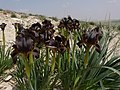
ImageScientific nameDistribution
Iris afghanica Wend 1972Afghanistan
Wildflowers in Tajikistan 1.jpg Iris darwasica Regel 1884Tajikistan and northern Afghanistan
Iris heweri Grey-Wilson & B. Mathew 1974Afghanistan.
Iris hoogiana - Fleur.jpg Iris hoogiana Dykes 1916Turkestan, Tajikistan, and Uzbekistan
Iris korolkowii var. violacea-IMG 6522.JPG Iris korolkowii RegelAfghanistan and Uzbekistan
Iris kuschkensis Grey-Wilson & B. Mathew 1974Afghanistan.
Iris lineata Foster ex Regel 1887Tajikistan and Afghanistan
Iris stolonifera-IMG 2186.jpg Iris stolonifera Maxim. 1880Tajikistan, Uzbekistan and Afghanistan

Hybrids of Regelia irises and Oncocyclus irises are known as Regelicyclous. [15]

Hexapogon

Mostly from the desert area of Central Asia, Iran and Afghanistan. The type species for this section is Iris falcifolia Most irises have beards on the falls and standards. [2] Etymologically, hexa refers to the number 6 and pogon refers to the Greek word for beard. [6]

ImageScientific nameDistribution
Iris falcifolia Bunge 1852Uzbekistan, Kazakhstan, Afghanistan, Iran and Pakistan.
Iris longiscapa Ledeb. 1852Kazakhstan, Tajikistan, Turkmenistan and Uzbekistan

Pseudoregelia

Mostly from the mountainous regions of Eastern Asia. Most irises have flowers that have blotches or colour spots on. [2] The type species for this section is Iris tigridia

ImageScientific nameDistribution
Iris cuniculiformis Noltie & K.Y.Guan 1995China (Sichuan, Yunnan)
Iris dolichosiphon Noltie 1990China (Sichuan, Xizang, Yunnan), Bhutan, India and Myanmar
Iris goniocarpa Bak. 1876China (Gansu, Hubei, Qinghai, Shaanxi, Sichuan, Yunnan, Xizang), Bhutan, Myanmar, Nepal, India (Sikkim)
Iris hookeriana Foster, Gard. Chron., ser. 3, 1 611 (1887) (49903182298).jpg Iris hookeriana Fost. 1887Pakistan (Chitral, Swat, Gilgit, Hazara), India (Himachal Pradesh, Kashmir).
Iris ivanovae Doronkin 1987Russia, China, and Mongolia
Iris kemaonensis kz03.jpg Iris kemaonensis Wall. 1839China (Xizang), Bhutan, India (Kashmir) and Nepal
Iris leptophylla Lingelsheim 1922China (Gansu, Sichuan)
Iris narcissiflora Diels. 1924China (Sichuan)
Iris psammocola Y.T.Zhao 1992China (Ningxia)
Iris sikkimensis Dykes 1913 (Iris hookeriana x Iris kumaonensis.)India (Sikkim)
Iris tigridia.JPG Iris tigridia Bunge ex Ledeb. 1829China(Gansu, Heilongjiang, Jilin, Liaoning, Nei Mongol, Qinghai, Shanxi, Sichuan), Kazakhstan, Mongolia, Russia

References

  1. "The Genus Iris". mathcs.clarku.edu. Retrieved 29 July 2021.
  2. 1 2 3 4 5 6 7 8 Stebbings, Geoff (1997). The Gardener's Guide to Growing Irises . Newton Abbot: David and Charles. p.  18. ISBN   0-7153-0539-5.
  3. Samad, Nour Abdel; Dagher-Kharrat, Magda Bou; Hidalgo, Oriane; El Zein, Rana; Douaihy, Bouchra; Siljak-Yakovlev, Sonja (15 August 2016). "Unlocking the Karyological and Cytogenetic Diversity of Iris from Lebanon: Oncocyclus Section Shows a Distinctive Profile and Relative Stasis during Its Continental Radiation". PLOS ONE. 11 (8) e0160816. Bibcode:2016PLoSO..1160816A. doi: 10.1371/journal.pone.0160816 . PMC   4985135 .
  4. Iris L. subg. Iris. (n.d.). Australian National Species List (auNSL). Retrieved February 8, 2025, from https://biodiversity.org.au/nsl/services/rest/name/apni/77600
  5. USDA, Agricultural Research Service, National Plant Germplasm System. 2025. Germplasm Resources Information Network (GRIN Taxonomy). National Germplasm Resources Laboratory, Beltsville, Maryland. URL: https://npgsweb.ars-grin.gov/gringlobal/taxon/taxonomygenus?type=subgenus&id=19542. Accessed 8 February 2025.
  6. 1 2 3 Stearn, William (1972). A Gardenerer's Dictionary of Plant Names. London: Cassell. p. 211. ISBN   0-304-93721-5.
  7. Morris, Jim (2011). "Bearded Iris Classifications". www.irises.org (American Iris Society). Archived from the original on 21 June 2014. Retrieved 24 July 2014.
  8. British Iris Society A Guide to Species Irises: Their Identification and Cultivation , p. 60, at Google Books 1982
  9. Christopher Brickell RHS Encyclopedia of Plants and Flowers , p. 521, at Google Books
  10. "Aril Irises". pacificbulbsociety.org. Retrieved 1 March 2016.
  11. Saad, Layla; Khuri, Sawsan (4 August 2003). "Hanging in There by a Fall – The Oncocyclus Irises of Lebanon" (PDF). orbi.ulg.ac.be. Retrieved 23 July 2014.
  12. Pries, Bob (11 June 2014). "Section Oncocyclus". wiki.irises.org. Retrieved 2 March 2015.
  13. Cassidy, G.E.; Linnegar, S. (1987). Growing Irises (Revised ed.). Bromley: Christopher Helm. pp. 144–145. ISBN   0-88192-089-4.
  14. The book of the iris, by R. Irwin Lynch. www.biodiversitylibrary.org. p. 116. Retrieved 24 July 2014.
  15. Christopher Brickell RHS Encyclopedia of Plants and Flowers , p. 610, at Google Books
蜘蛛池+镜像 镜像站群系统 开源整站镜像工具 自动镜像站群 镜像站群系统