英文互译镜像站

Improvement District No. 4

Last updated

Improvement District No. 4
Improvement District No. 04 (Waterton)
AB locator ID NO 4 (WATERTON).svg
Location within Alberta
Coordinates: 49°5′N113°54′W / 49.083°N 113.900°W / 49.083; -113.900
CountryCanada
Province Alberta
Region Southern Alberta
Census division No. 3
Established [1] January 1, 1944
Renumbered [1] January 1, 1945
January 1, 1969
Government
[1]
  Governing bodyImprovement District No. 4 Council
  ChairKen Black
  CAOScott Barton
   MLA Chelsae Petrovic
Area
 (2021) [2]
  Land482.54 km2 (186.31 sq mi)
Population
 (2021) [3]
  Total132
Time zone UTC−7 (MST)
  Summer (DST) UTC−6 (MDT)
Website Official website

Improvement District No. 4, or Improvement District No. 04 (Waterton), [4] is an improvement district in Alberta, Canada. Coextensive with Waterton Lakes National Park in southern Alberta, the improvement district provides local governance for lands within the park that are not within an Indian reserve.

Contents

History

Prior to 1944, those lands within Improvement District (ID) No. 4 were split between the Municipal District of Kerr No. 39 and the Municipal District of Castle River No. 40. Following a partial amalgamation of the two municipal districts, remnant unsurveyed lands were incorporated as ID No. 11 on January 1, 1944. It was renumbered to ID No. 8 on April 1, 1945 and again to ID No. 4 on January 1, 1969. [1]

Geography

Communities and localities

While there are no urban municipalities within Improvement District No. 4 there is one hamlet named Waterton Park. [1] Blood 148A, a First Nation reserve of the Kainai Nation, is also within Improvement District No. 4. [5]

The following localities are within Improvement District No. 4. [6]

Localities

Demographics

In the 2021 Census of Population conducted by Statistics Canada, Improvement District No. 4 had a population of 132 living in 54 of its 195 total private dwellings, a change of

The population of Improvement District No. 24 according to its 2018 municipal census is 108. [7] The municipal census also counted a shadow population – temporary residents employed in the municipality – of 405 for a combined population of 513. [7]

In the 2016 Census of Population conducted by Statistics Canada, Improvement District No. 4 had a population of 105 living in 39 of its 168 total private dwellings, a change of

Government

Improvement District No. 4 is governed by a five-person council comprising a chair and four councillors. Ken Black is the chair of the council. [1]

See also

Related Research Articles

<span class="mw-page-title-main">Crowsnest Pass, Alberta</span> Specialized municipality in Alberta, Canada

The Municipality of Crowsnest Pass is a specialized municipality in southwest Alberta, Canada. Within the Rocky Mountains adjacent to the eponymous Crowsnest Pass, the municipality formed as a result of the 1979 amalgamation of five municipalities – the Village of Bellevue, the Town of Blairmore, the Town of Coleman, the Village of Frank, and Improvement District No. 5, which included the Hamlet of Hillcrest and numerous other unincorporated communities.
<span class="mw-page-title-main">Municipal District of Bonnyville No. 87</span> Municipal district in Alberta, Canada

The Municipal District of Bonnyville No. 87 is a municipal district (MD) in northeastern Alberta, Canada in Division No. 12. On the east, it is adjacent to the province of Saskatchewan.
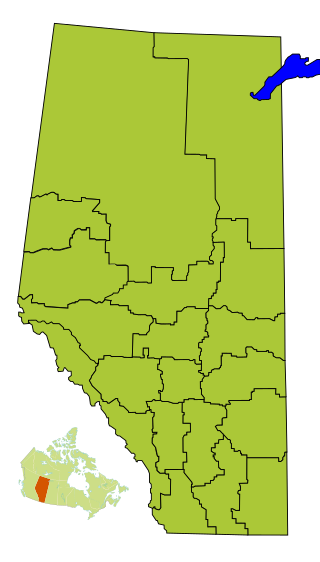
<span class="mw-page-title-main">Division No. 3, Alberta</span> Census division in Alberta, Canada

Division No. 3 is a census division in Alberta, Canada. It is located in the southwest corner of southern Alberta and its largest urban community is the Town of Claresholm.

<span class="mw-page-title-main">Division No. 15, Alberta</span> Census division in Alberta, Canada

Division No. 15 is a census division in Alberta, Canada. The majority of the division is located in Alberta's Rockies, while the southernmost portion of the division is located within southern Alberta. The division's largest urban community is the Town of Canmore.

<span class="mw-page-title-main">Municipal District of Bighorn No. 8</span> Municipal district in Alberta, Canada

The Municipal District of Bighorn No. 8 is a municipal district (MD) situated in Census Division No. 15 of Alberta, Canada. It is located between Calgary and Banff National Park, north of Kananaskis Improvement District. Highway 1 passes through the municipal district.

<span class="mw-page-title-main">Brazeau County</span> Municipal district in Alberta, Canada

Brazeau County is a municipal district in central Alberta, Canada. It is located in Census Division 11. The municipal district was incorporated on July 1, 1988 from Improvement District No. 222. On October 1, 2002, the name was changed from Municipal District of Brazeau No. 77 to Brazeau County.

<span class="mw-page-title-main">Cardston County</span> Municipal district in Alberta, Canada

Cardston County is a municipal district in southern Alberta, Canada. It is located in Census Division 3 around the Town of Cardston.

<span class="mw-page-title-main">Mackenzie County</span> Specialized municipality in Alberta, Canada

Mackenzie County is a specialized municipality in northern Alberta, Canada. It is located in Census Division 17, along the Mackenzie Highway. The municipal office is located in the hamlet of Fort Vermilion.

<span class="mw-page-title-main">County of Northern Lights</span> Municipal district in Alberta, Canada

The County of Northern Lights is a municipal district in northwest Alberta, Canada. Located in Census Division 17, its municipal office is located in the Town of Manning.

<span class="mw-page-title-main">Municipal District of Ranchland No. 66</span> Municipal district in Alberta, Canada

The Municipal District of Ranchland No. 66 is a municipal district (MD) in southwest Alberta, Canada. Containing no urban communities of any kind, its municipal office is located in Chain Lakes Provincial Park, approximately 38 km (24 mi) southwest of the Town of Nanton. Ranchland's rugged foothill terrain is unsuited for the crop agriculture practiced elsewhere in Alberta, and ranching remains the single livelihood of its inhabitants. With a 2016 population of 92, it is the least populated municipal district in Alberta, and its population density of 29 square kilometres for every resident is almost exactly equal to that of the Northwest Territories.

<span class="mw-page-title-main">Special Area No. 4</span> Special area in Alberta, Canada

Special Area No. 4 is a special area in central Alberta, Canada. It is a rural municipality similar to a municipal district; however, the elected council is overseen by four representatives appointed by the province, the Special Areas Board.
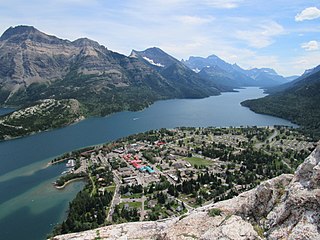
<span class="mw-page-title-main">Waterton Park</span> Community in Alberta, Canada

Waterton Park, commonly referred to as Waterton, is a hamlet in southwestern Alberta, Canada within Improvement District No. 4 Waterton.

Mountain View is a hamlet in Alberta, Canada within Cardston County. It is located along Highway 5 approximately 25 kilometres (16 mi) west of Cardston and 20 kilometres (12 mi) east of Waterton Lakes National Park near the United States border. It is also a kickoff point for visitors to Police Outpost Provincial Park, 18 kilometers to the south.

<span class="mw-page-title-main">Kananaskis Improvement District</span> Improvement district in Alberta, Canada

Kananaskis Improvement District is an improvement district in Alberta, Canada. It is located within Alberta's Rockies, sharing much of its boundaries with Kananaskis Country.

<span class="mw-page-title-main">Improvement District No. 9</span> Improvement district in Alberta, Canada

Improvement District No. 9 (Banff), or Improvement District No. 9, is an improvement district in Alberta, Canada. Coextensive with Banff National Park in Alberta's Rockies, the improvement district is the municipality that provides local government for the portion of the park outside the Town of Banff.

<span class="mw-page-title-main">Improvement District No. 12</span> Improvement district in Alberta, Canada

Improvement District No. 12 , or Improvement District No. 12, is an improvement district in Alberta, Canada. Coextensive with Jasper National Park in Alberta's Rockies, the improvement district is the municipality that provides local government for the portion of the park outside the Municipality of Jasper.

<span class="mw-page-title-main">Improvement District No. 13</span> Improvement district in Alberta, Canada

Improvement District No. 13, or Improvement District No. 13 , is an improvement district in Alberta, Canada. Coextensive with Elk Island National Park in central Alberta, the improvement district provides local governance for lands within the park.

<span class="mw-page-title-main">Improvement District No. 24</span> Improvement district in Alberta, Canada

Improvement District No. 24, or Improvement District No. 24 , is an improvement district in Alberta, Canada. Coextensive with the portion of Wood Buffalo National Park in northeast Alberta, the improvement district provides local governance for lands within the park that are not within Indian reserves.

<span class="mw-page-title-main">Improvement District No. 25</span> Improvement district in Alberta, Canada

Improvement District No. 25, or Improvement District No. 25 , is an improvement district in Alberta, Canada. Coextensive with Willmore Wilderness Park in central Alberta, the improvement district provides local governance for lands within the park.

References

  1. 1 2 3 4 5 6 "Municipal Profiles: Improvement Districts" (PDF). Alberta Municipal Affairs. October 1, 2021. pp. 1–7. Retrieved October 3, 2021.
  2. 1 2 "Population and dwelling counts: Canada, provinces and territories, and census subdivisions (municipalities)". Statistics Canada. February 9, 2022. Retrieved February 9, 2022.
  3. 1 2 "Population and dwelling count amendments, 2021 Census". Statistics Canada. December 1, 2023. Retrieved September 22, 2024.
  4. "2024 Municipal Codes" (PDF). Alberta Municipal Affairs. June 3, 2024. Retrieved June 14, 2024.
  5. 2021 Provincial Base Map: Municipalities (PDF) (Map). Alberta Environment and Parks. July 26, 2021. Retrieved October 3, 2021.
  6. "Economic Regions - SGC 2006 (4803003 - Improvement District No. 4)". Statistics Canada. November 27, 2018. Retrieved October 2, 2021.
  7. 1 2 2018 Municipal Affairs Population List (PDF). Alberta Municipal Affairs. December 2018. ISBN   978-1-4601-4254-7 . Retrieved December 20, 2018.
  8. "Population and dwelling counts, for Canada, provinces and territories, and census subdivisions (municipalities), 2016 and 2011 censuses – 100% data (Alberta)". Statistics Canada. February 8, 2017. Retrieved February 8, 2017.
网站备份克隆 量子镜像站群 镜像站群 网站镜像克隆 站点核心词加权