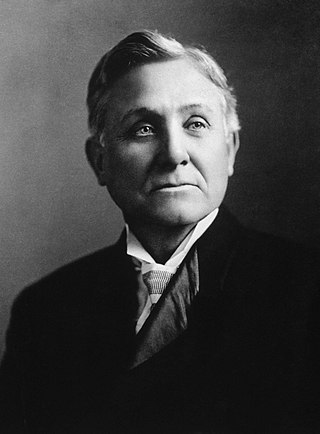
Asa Griggs Candler Sr. was an American business tycoon and politician who in 1888 purchased the Coca-Cola recipe for $238.98 from chemist John Stith Pemberton in Atlanta, Georgia. Candler founded The Coca-Cola Company in 1892 and developed it as a major company.

Ivan Earnest Allen Jr., was an American businessman who served two terms as the 52nd mayor of Atlanta, during the Civil Rights Movement of the 1960s.

Jonathan Norcross was elected in 1850 as the fourth Mayor of Atlanta, Georgia, serving the customary term at the time of one year. Dubbed the "Father of Atlanta" and "hard fighter of everything" by publisher Henry W. Grady, he followed three mayors elected from the Free and Rowdy Party.
John W. Grant was a member of the Georgia School of Technology board of trustees and a well-known Atlanta, Georgia, merchant around the 1880s.

Evan Park Howell was an American politician and early telegraph operator, as well as an officer in the Confederate Army during the American Civil War.

Richard Peters was an American railroad man and a founder of Atlanta, Georgia, in the 1840s.
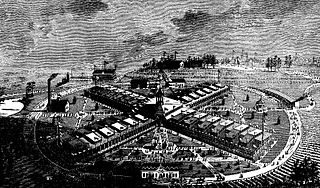
International Cotton Exposition (I.C.E.) was a world's fair held in Atlanta, Georgia, from October 4 to December 31 of 1881. The location was along the Western & Atlantic Railroad tracks near the present-day King Plow Arts Center development in the West Midtown area. It planned to show the progress made since the city's destruction during the Battle of Atlanta and new developments in cotton production. It demonstrated the rebirth of Atlanta and the South by announcing an end to the Reconstruction Era and the sectional hostilities that had plagued the nation for several decades.

Hannibal Ingalls Kimball was an American entrepreneur and important businessman in post-Civil War Atlanta, Georgia.
Arthur Crew Inman was a reclusive and unsuccessful American poet whose 17-million-word diary, extending from 1919 to 1963, is one of the longest English-language diaries on record.
The Kimball House was the name of two historical hotels in Atlanta, Georgia. United States. Both were constructed on an entire city block at the south-southeast corner of Five Points, bounded by Whitehall Street, Decatur Street, Pryor Street, and Wall Street, a block now occupied by a multi-story parking garage.
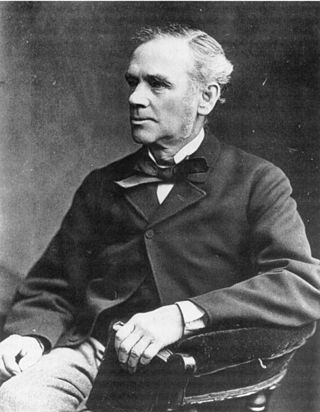
Hugh Mason was an English mill owner, social reformer and Liberal politician. He was born in Stalybridge and brought up in Stalybridge and Ashton-under-Lyne until he entered the family cotton business in 1838 after a seven-year period working in a bank. Having originally opposed trade unions, Mason became a paternalistic mill owner, creating a colony for his workers with associated facilities and ensuring that they experienced good conditions. During the Lancashire Cotton Famine of the 1860s he refused to cut workers' wages although it was common practice.

Samuel Martin Inman was a prominent cotton merchant and businessman in Atlanta, Georgia, who is best known for the neighborhood in Atlanta that bears his name. Inman is also commemorated in the name of the Samuel M. Inman Middle School in the Virginia-Highland neighborhood.

John Hamilton Inman was an American capitalist who invested in cotton, coal, iron and steel, and railroads, especially in the impoverished American South during the Reconstruction Era. While he is remembered as a tycoon in the age of laissez-faire, cut-throat capitalism, he nevertheless helped the economic development of his native state and the South in general.

The Edward Inman "Swan" House is a mansion in Atlanta, Georgia. It was designed by Philip T. Shutze and built in 1928 for Edward and Emily Inman. The house is currently part of the Atlanta History Center, and it has been featured in The Hunger Games: Catching Fire and The Hunger Games: Mockingjay, Part 2.
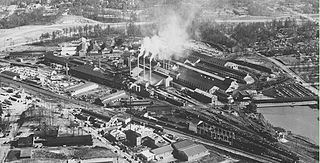
The Atlantic Steel Company was a steel company in Atlanta, Georgia with a large steel mill on the site of today's Atlantic Station multi-use complex.

C. R. Makepeace & Company, established in 1889, was a nationally active firm of mill architects based in Providence, Rhode Island. It was dissolved in 1944.
Ardfinnan Woollen Mills was a former wool mill, trading under messrs Mulcahy-Redmond and Co. Ltd. and located in the Suir Valley at the village of Ardfinnan, County Tipperary, Ireland. Founded in 1869, it manufactured woollen and worsted cloth, specialising in tweed and suitings for the tailoring trade. It briefly produced a unique weatherproof cloth, while later in its history turning to off-the-peg suits it became noted as the only firm in the Republic of Ireland completing all processes of clothing manufacture. A leading industry in Irish textiles, it closed in 1973 with the loss of over 100 employees.

Hugh Moss Comer was an American businessman. He was a president of the Central of Georgia Railway and co-founder of Bibb Manufacturing Company, in addition to having several directorships and self-owned companies.
The 1914–1915 Fulton Bag and Cotton Mills strike was a labor strike involving several hundred textile workers from the Fulton Bag and Cotton Mills in Atlanta, Georgia, United States. The strike, which involved about 500 millworkers, began on May 20, 1914 and ended almost a year later on May 15, 1915 in failure for the strikers.
Oglethorpe Park was a municipal park in Atlanta, Georgia, United States. The park, consisting of about 50 acres (20 ha), was created in 1869 and hosted numerous fairs, most notably the International Cotton Exposition in 1881. Following this exposition, the park was sold by the city and was converted into the Exposition Cotton Mills, utilizing facilities that had been built for the event. The closure of the park indirectly contributed to the creation of two later parks in Atlanta: Grant Park and Piedmont Park.


